

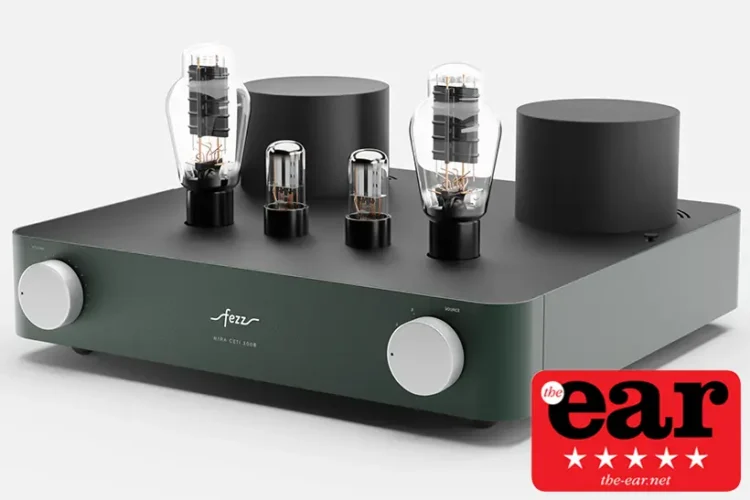
Fezz Audio Mira Ceti 300B tube amplifier
We hear lots about the vinyl revival and there is no doubt that the LP format is here to stay and is growing in popularity. But there is another revival going on – namely valve amplifiers. Statistics are sketchy for Europe, but several sources estimate global sales at $1.2 billion in 2022 and they are expected to double by 2033.
I admit to being a big fan on valve amps and use one in my own system, so when the editor asked if I wanted to review this new integrated tube amp from Poland’s Fezz Audio, I was intrigued and jumped at the chance. Not only because Fezz was a new name to me, but also because, rather unusually, they use toroidal output transformers instead of the more usual laminated core types.
Fezz Audio was founded in 2000 by Lech Lachowski, father of the current CEOs Maciej and Tomasz, and is a spin-off from sister company Toroidy, which specialises in the manufacture of toroidal transformers and was set up in 1991. Toroidy started designing simple lighting transformers but now employs over 40 people and makes mains and output transformers for high-end audio applications.
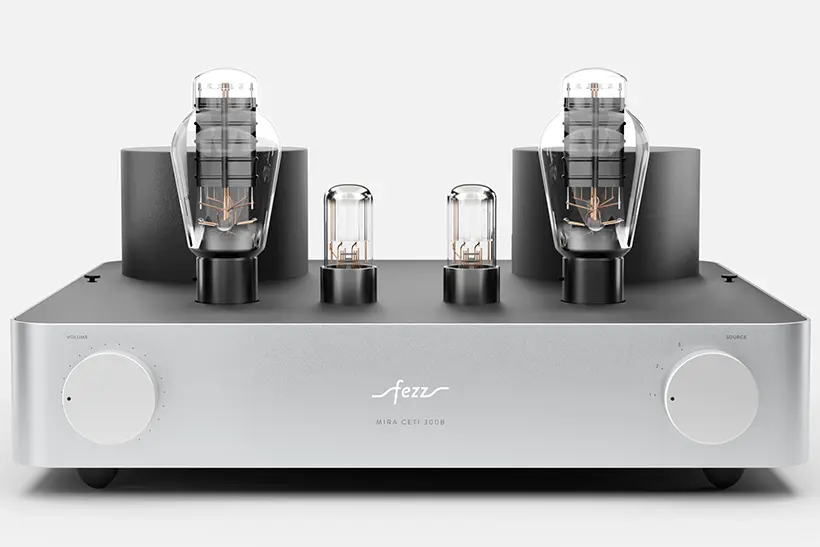
Fezz makes a variety of valve-based products, from integrated and power amps to DACs, phono stages and a headphone amp, as well as two solid-state integrated amps. The original Mira Ceti was part of its Legacy series and laid the foundation for the current version, the Mira Ceti 300B, which came along in 2022 and is part of its Evolution range. This includes seven integrated amps, with various types of valves in either single-ended or push-pull configurations.
The Mira Ceti 300B reviewed here retails at £4,495 and is a single-ended triode design using one 300B power valve per channel, giving an output of 8 Watts. Single-ended tends to be favoured in audiophile circles as each power valve amplifies the whole of the signal, whereas in a push-pull configuration one valve handles the negative part of the signal and a second handles the positive swing – a configuration that gives rise to the dreaded crossover distortion.
The Mira Ceti 300B is a minimal feedback design (around 3dB) and uses 300B power output valves sourced from Psvane in China, and one 6SN7EH preamp valve per channel from Electro Harmonix in Russia.
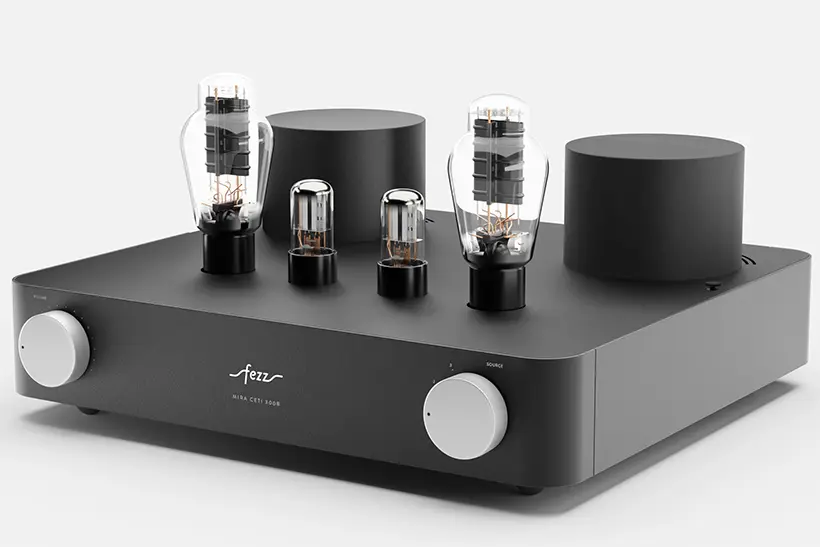
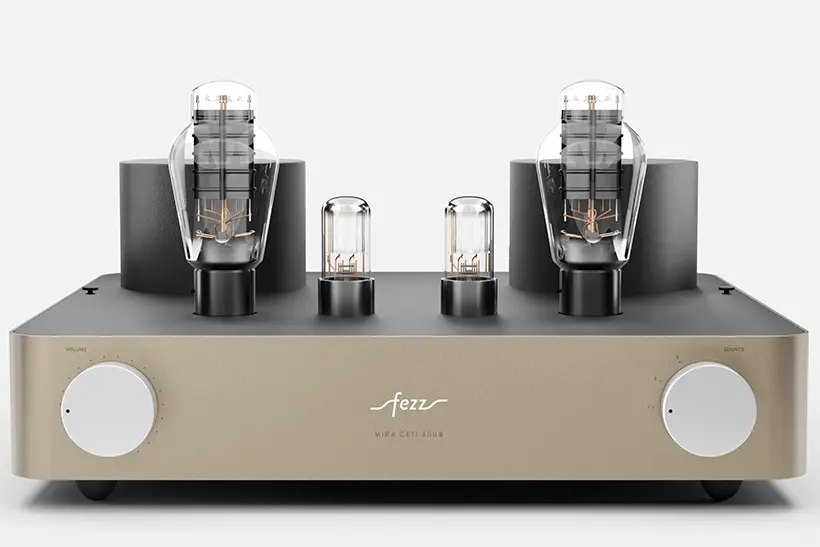
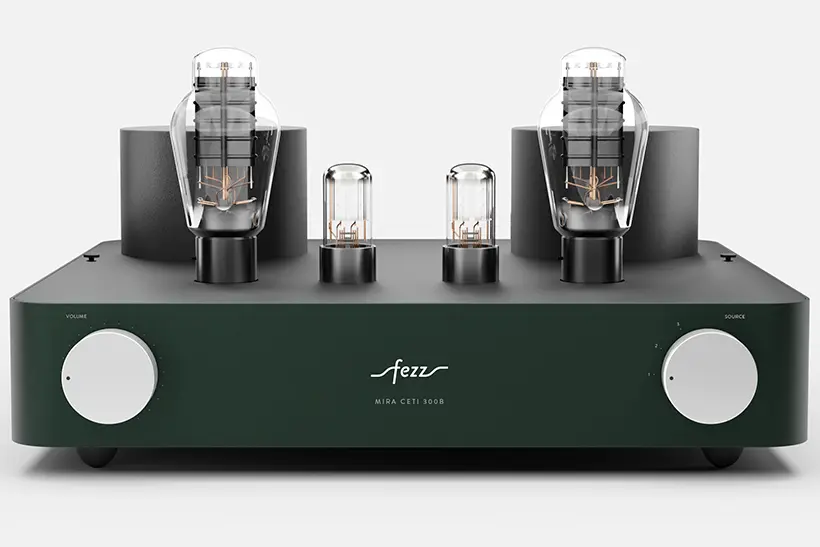
The Mira Ceti 300B has a quality feel and look to it, thanks in no small part to the Red Dot award-winning Kabo & Pydo design house. It’s a minimal look, with just a volume control and input selector on the front panel, and these functions can be controlled from a remote handset. The back panel has loudspeaker connections for 8 Ohm or 4 Ohm loudspeakers. It offers three RCA line inputs and also offers a Bluetooth input (selectable on input 3) so that you can stream to it from your phone, laptop or tablet. A metal cage is provided if you wish to ensure young children do not burn themselves on the valves, but the clear plastic front still lets you admire the valves in all their glory.
Core blimey
As I mentioned earlier, you do not see many valve amps with toroidal output transformers. A laminated C or EI core is far more common. The laminations in these cores help to reduce eddy currents that lead to uneven magnetic flux distribution, energy losses and reduced efficiency. Obviously, Fezz has access to the expertise of its parent company Toroidy in the manufacture of toroidal transformers, but I was keen to find out why they decided to use them when so few others do.

Fezz chief engineer Jakub Korpacz explains that it wasn’t down to cost saving, as laminated transformers are actually cheaper to make and do not require the kind of specialised winding machines that Toroidy had to invest in. He also feels that the squareness of the laminations and their sharp edges compromise performance and increase leakage inductance. He adds that “toroidal transformers have virtually no air gaps, which means that when skilfully wound, they offer quality unattainable to conventional EI transformers”.
Knowing that solid cores cause eddy currents and impair efficiency and that the typical powdered iron or ferrite cores used in industry are not suitable for audio applications, I ask him about the core in the Mira Ceti 300B’s output transformers. He tells me that they are made from strips of cold-rolled, grain-oriented silicon steel, which provide high flux density and low distortion.
Korpacz reveals that some other companies have also embraced toroidal output transformers because of their reduced magnetic leakage, lower hum and more compact size. These companies include Copland, Ayon and BAT.

A glowing report
Whatever the advantages of the technology Fezz has used, what really matters is how it sounds. To check that out I used the Mira Ceti 300B in two systems. The first was my own system of Audio Note CDT-Five transport and DAC 5 Special with Russell K Red 150Se speakers. I also tried it with the more modestly-price Accuphase DP-450 CD player and Tannoy Super Gold Monitor SGM10 speakers. I had a feeling that, with their 89dB efficiency, the Tannoys would make a perfect match for the Fezz’s 8W.
On my own system, the first thing I played was a beautiful instrumental from George Benson called Being With You. The Fender Rhodes piano on the intro is a good test for any hi-fi component, and I am pleased to say the Fezz conveyed it with great leading-edge bite and its signature bell-like sonority. By contrast, Benson’s guitar is mellow, soulful and brooding yet nimble, and the Fezz conveyed its mellow voice beautifully but still kept up with the fast-moving fingerwork of the more complex parts.
Switching to the Bridges CD by saxophonist Eric Marienthal and guitarist Chuck Loeb, I played the track Westward and was very impressed by how well the Fezz captured the energy and skilful play of this duo. The complex percussion work on this track is dynamic, detailed and delicate and the Mira Ceti 300B tackled it with ease, conveying its movement and nuances, while John Patitucci’s bass line was tight and nimble.

Nothing tests the mettle of a component quite like a great vocal, and so I spun up You Bring the Sun Out by Randy Crawford. Even before she joined in I liked the openness and definition on the strings and piano on the intro that the Mira Ceti 300B delivered. When she did come in, her distinctive, breathy, emotionally charged vocal style was well conveyed. Her diction and enunciation are always superb and you could clearly hear her pronounce the ‘t’ at the end of the ‘you bring the sun out’ and the ‘p’ at the end ‘to warm my life up’. Her voice was natural, open and packed with feeling on the Fezz, with no tendency to glare or shout when she used her amazing vocal power to really push a note.
Having proved that the Fezz Mira Ceti 300B’s 8W is more than capable of driving the 85dB sensitivity of the Russell Ks, I switched to the Tannoy SGM10s. I also had a similarly-priced, very well-respected transistor integrated amp to hand as a benchmark to gauge the value for money of the Fezz.
On a masterful instrumental cover of Minute by Minute by guitarist Larry Carlton, the Mira Ceti 300B took control of the powerful, sinuous bass line that drives the track along, conveying its twists and turns well as well as separating out the notes nicely, even on the lowest notes. Percussion was delicate, Carlton’s guitar play was articulate and the Fezz let me hear how each note was shaped and played. Its solid state rival was more laid back, lacked the space around the instruments and did not have quite as much swing.
Moving on to the beautiful ballad So Amazing by Luther Vandross, the vibrato on the synths in the intro was better defined on the Mira Ceti 300B, Vandross’s voice was simply more human and rounded and I got a better insight into his unique style and phrasing. Marcus Miller’s bass line was also excellent, it moved well and had good weight. The transistor amp was perhaps slightly tighter on the bass line, but I preferred its texture and tonality on the Fezz.
I also used the Bluetooth facility to stream to the amp from my phone using Qobuz through mConnect, and it worked very well. It was stable and the sound quality was good. Nowhere near the quality from a good CD player, but a useful string to its bow. Bluetooth is compromising of sound quality but the convenience factor makes it quite useful at times.
Hats off!
There is a magic to the sound of a good 300B powered valve amp, and the Fezz Mira Ceti 300B had that in spades. It is powerful, open, dynamic and yet beautifully open and rounded, able to convey the crack and weight of a tom tom, the delicacy of brushed cymbals and hi-hats, the magic of a great vocalist and the essence of what makes my favourite sax players and guitarists the outstanding musicians and entertainers they are.
Don’t look at the 8W in its spec sheet and worry it might not drive less efficient speakers, it will, it drove the Russell Ks perfectly. If you do have a large room, however, and like to listen really loud, pair it with one of the excellent high-efficiency options from the Tannoy, Klipsch or Living Voice ranges, and crank up the volume. The Fezz Mira Ceti 300B is a very capable amplifier, it represents excellent value for money and I recommend it unreservedly.