


Clipaudio Dolomite turntable and Ninewave tonearm
One of the most amazing things about hi-fi is the ongoing quest to wring the most out of what many would term outdated media. Within living memory we have been informed that the LP is dead, long live the CD, and then that streaming will never catch on; it’s not hi-res enough, and despite the development of DAB we still have both AM and FM radio (wireless to some) broadcasts enjoyed by millions across the globe on a daily basis.
And thank goodness those media are still with us. We can but wonder at all the recordings which exist on old media which will be very unlikely to see transformation into a digital format. There are scores (probably tons!) of shellac 78s which contain priceless archive recordings that were made when some of the composers of the works recorded were not only still alive, but also influential in shaping how those recordings were made. Some have commented that those recordings (especially the acoustic ones) are about as close as you can get to the live events of those times.
So it’s little wonder that aside from the larger manufacturers, many smaller outfits are still working hard to extract the most information (not just the sounds but the emotional content) from old media. So it is with turntables, and there continues to be a concerted effort, particularly by some of the smaller manufacturers, to provide the means to continue enjoying the musical events squeezed into those tiny grooves on a slowly-spinning plastic disc.
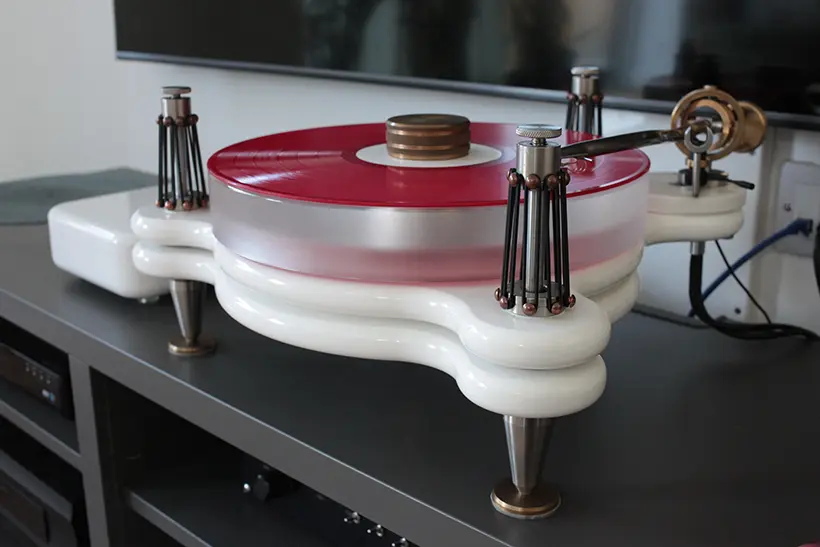
Clipaudio is one such, and they have been beavering away, employing a few known techniques, some interesting material combinations and a solid engineering based approach to a turntable which also has a delightfully eye-catching aesthetic.
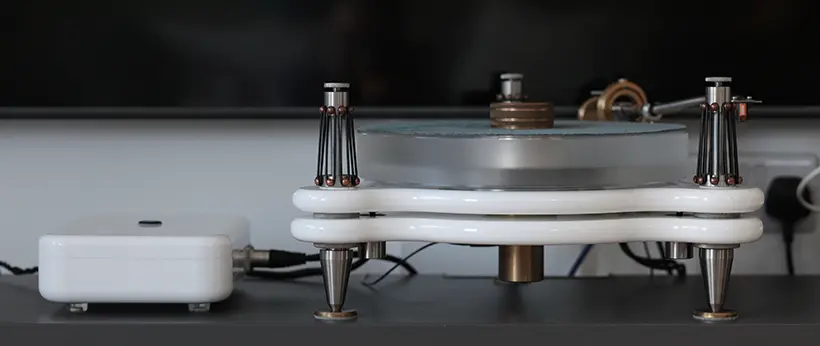
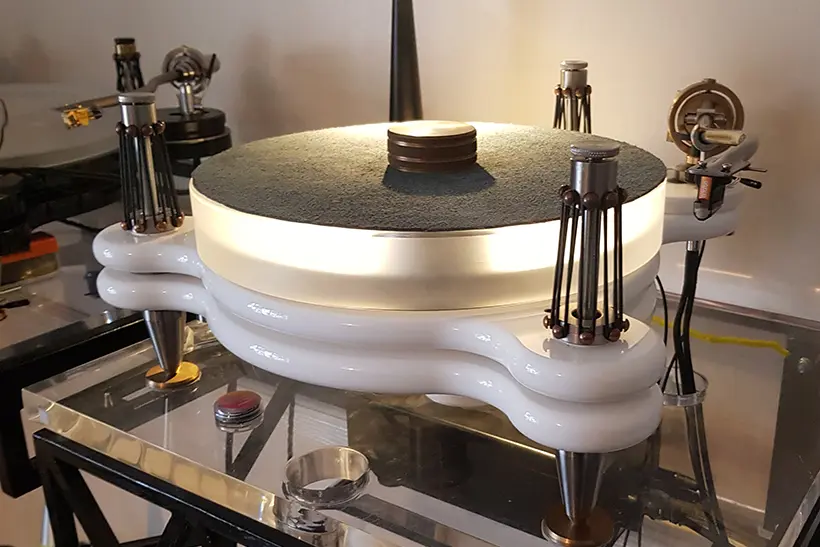
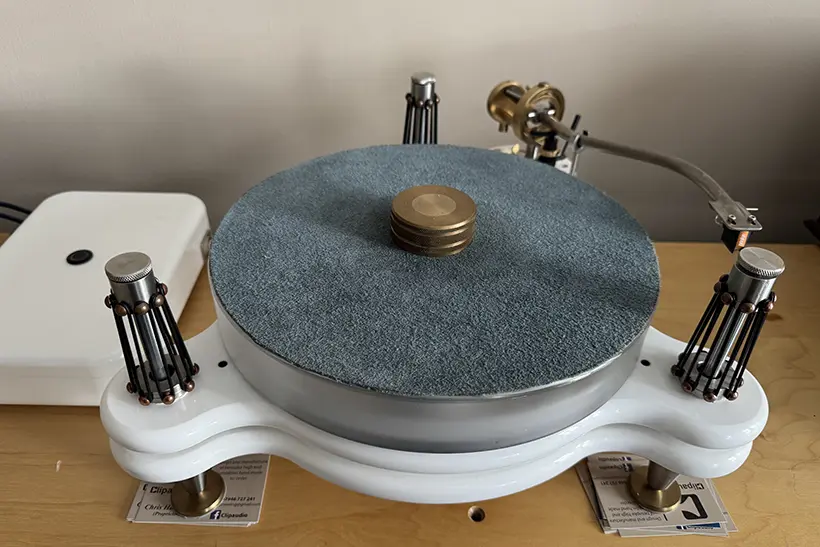
Based in Wigan, Clipaudio manufacture from scratch both a rather gorgeous tonearm, and a beautiful turntable. The turntable itself stands on three large, tapered, adjustable legs whose feet sit in heavy machined cups. These support a two-piece, two-part chassis of polished white (or black, or clear) acrylic with either curved or straight edge profiles.
The two parts are separated, the upper part supported partly by silicone damping, and partly suspended on elastomers from three pillars. One could be forgiven for drawing comparisons with another manufacturer which uses a similar approach, but Clipaudio has chosen the suspension/support locations specifically to ensure optimum musicality and sound quality. Admittedly, as Clipaudio readily admit, a tripod is the most stable form, but if four, or five, or two would have sounded better, they would have used a different number, yet three it is.
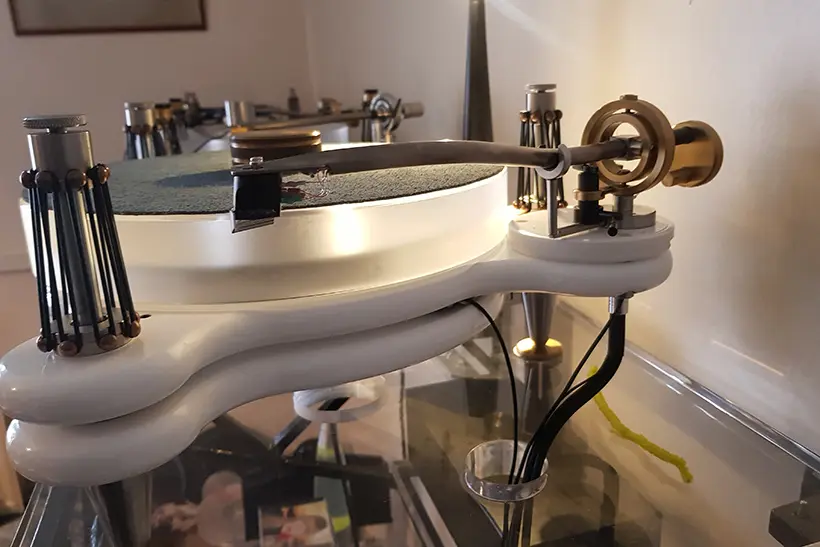
Both the legs and the chassis/suspension are fully adjustable, and centring the upper section is an important part of the set-up, as is (and this may seem obvious) getting everything absolutely level. The armboard is also polished acrylic, mounted as a small outrigger, and slightly (but resiliently) decoupled. This ensures sufficient coupling to the main chassis that no musical information is lost, but also sufficient decoupling that unwanted influences (footfall, for instance) aren’t transmitted through the system. Interestingly the turntable felt a lot more solid than its decoupled design would initially suggest, but as you will read later, it’s a design which works rather well.
The platter itself is also acrylic; a thick frosted (eg not clear or polished) affair topped with a leather mat. Again, after extensive listening both the platter material and the mat were chosen for their sonic characteristics. A smallish (slightly smaller in diameter than the average record label) heavy brass platter weight keeps the centre of the record firmly in contact with the mat, and the proof of that pudding is that if you play the same record with, and without the weight the difference is not difficult to hear. With the weight is definitely the way to go.
The two-part platter is driven by a synchronous AC motor controlled by a large (also white polished acrylic) power supply with options for both 33 and 45 rpm speeds. This drives the inner platter via a flat belt.
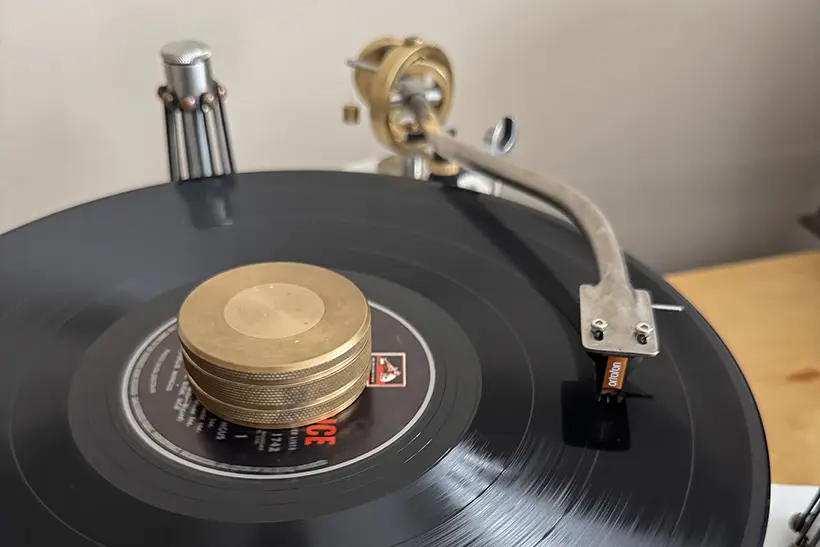
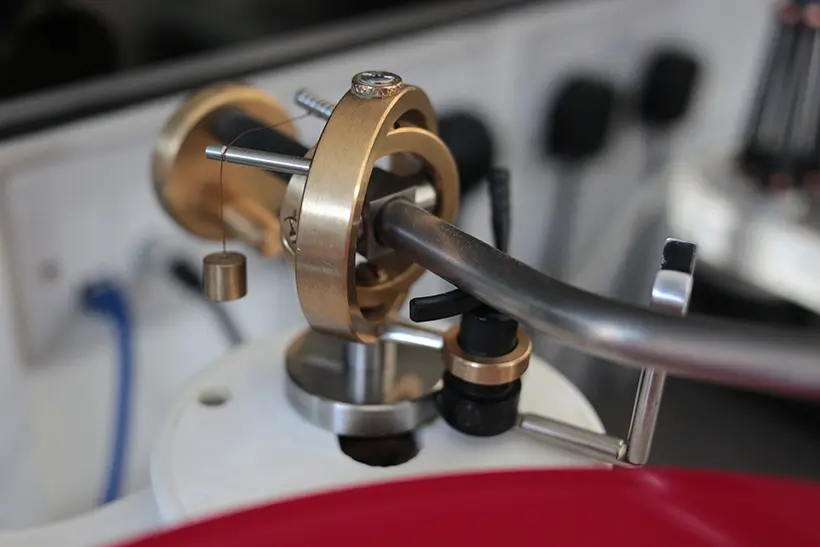
The pick-up arm is the Ninewave, so called because of the complex curves employed in its construction, both in the lateral and vertical plane, which are designed to maintain consistency of the stylus and gimbal centre during playback and improve stylus tracking. The combo came equipped with a rather fine Ortofon Cadenza Bronze MC cartridge which was used throughout the review process.
The arm-lift/lower is a joy to use, being both very precise when cueing up, and also very gentle in lowering the stylus into the grove without that annoying tendency some arms have to let the stylus skitter across the first few grooves. The lift/lower, counterweight adjustment and headshell fitting confirm to the usual norms. The last point to mention is that the bearings are a unique multi-material design that exhibit particularly free movement, and no play at all that I could detect. Once connected into my system (no grounding issues) the fun began.
Clipaudio on record
One of my all-time favourites is Brahms 3rd Symphony, particularly the 3rd movement. Under Karajan on DG (DG 138 926). This is one of those movements where the space between the notes is at least as important as the notes themselves. This version is beautifully paced, and the recording lends everything to the air and space of the venue. The Clipaudio Dolomite and Ninewave combination really did this justice. The background was eerily quiet, the impression of the venue amazingly engaging and the presentation of the orchestra’s layout (the Berlin Phil) easy to pick up on. The performance itself engages the listener utterly, and you are drawn along in this wonderful soundscape with the warm depth of the lower strings, the cuddly brass section and the silky strings above. The pacing is just right, neither pedantic nor hurried and the Clipaudio made this an unforgettable listening experience.
Turning to something a little more intimate, Borodin’s String Quartets on EMI recorded back in the 1980s, holds a special place for me. First heard when I was a student, they have continued to fascinate, particularly with the wildly different interpretations that various ensembles have brought to bear through different recordings.
The Borodin String Quartet version (ASD4100) remains my favourite overall performance, and again the sound quality is amazingly good. The background is inkily quiet, and the four players each have their place not only in the musical unfolding, but also in the soundscape. The Ninewave arm was totally unfussed, dealing with both sudden sforzandi while managing to convey the intricacies of the inner workings at the same time. Playing this late one evening really was like being at a salon concert. With the lights down low, and the volume at a sensible salon level, the ASD4100 combination produced such a convincing aural image I was almost waiting for the chap next to me to cough, (I jest; it was just me there, but the feeling of realism and rightness was quite astonishing.)
Something a little more upbeat was needed now, so another favourite Marty Paich’s Big Band New York Scene (DS-844) provided a couple of interesting challenges. Firstly, it has an unfortunate warp, which certainly tested the Ninewave’s tracking ability. Secondly the record itself has wide dynamic range with incredible rasping brass, deep bass and a lot of other stuff going on. Let’s deal with the warp first. It didn’t bother the Ninewave arm at all. In fact aurally you’d never know that there was anything wrong with the record from that perspective at all. It happily kept the stylus in the groove without turning a hair, and the presentation remained poised, focussed and assured with each revolution.
As for the transients and deep bass, again Clipaudio’s Ninewave presented all with almost disdainful competence. Not that the presentation was disdainful in any sense – far from it – but it seemed that nothing would upset the arm’s ability to simply present the material retrieved from the grooves without any fuss, which is not a simple job. Listening was easy, and this was one of those occasions when you really weren’t aware that there was a turntable between you and the music.
Having a bit of fun came next, with the Edgar Winter Band playing Frankenstein (TE297). Lovely deep bass riffs, heavy drumming, soaring and screeching electric guitars – wow, wow, wow! This was one of those occasions when turning up the volume to 11 is mandatory. Despite the increase in volume, and the proximity of the turntable to the loudspeakers everything stayed on point. This was real fun of the ear-splitting variety. At no point did the turntable lose focus, or start to sound muddy or distorted. The configuration of the suspension, the materials used and the turntable’s set-up obviously worked in what could be termed an unfairly compromised setting. And still it did the business.
Conclusion
The Clipaudio Dolomite turntable with the Ninewave tonearm is an unbelievably good record player. The designer’s choice of materials, suspension configuration and thoughtful design works wonders with everything I played on it. The arm is also exceptionally competent and musical. The Borodin was utterly engaging, the Edgar Winter right in yer face and the Marty Paich a foot-tapping revelation.
This was a turntable that I listened to very late into the early mornings, and when I tried to fool it, I failed miserably. Speed-wise there was never a hint of wow, and setting a strobe disc on the platter the markings remained resolutely static. Speed change is affected by pressing and holding the On button on the power supply – and both 33 and 45 rpm were spot-on.
I’d not tried a leather platter mat before, but trying other mats on the Clipaudio turntable certainly confirmed that the leather one was the right choice. This combo is musically engaging, capable of amazing resolution, happy with contrasting loud, sudden notes against smaller intimate details, and seemingly exceptional at reducing empty-groove noise – this was apparent in virtually every record I played, with a much lower groove roar intrusion. All I can say is that I will seriously rue the day it has to go back.