

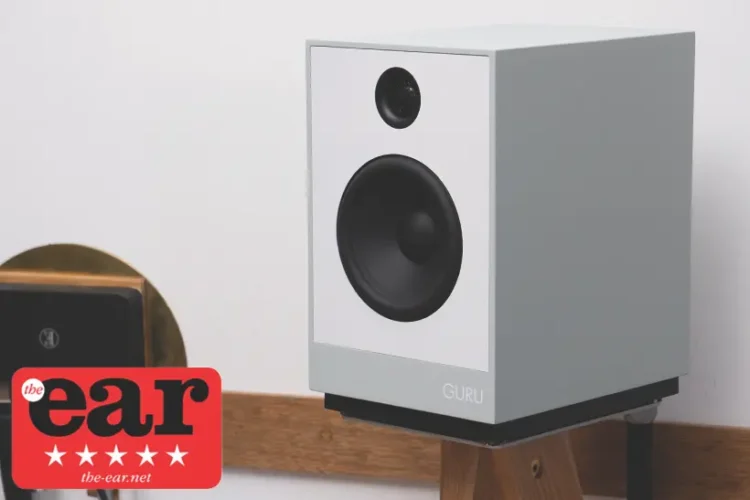
Guru 8 speakers
Running a successful audio company is not easy. This is the lesson that Guru founder Erik Ring discovered when he started to scale up loudspeaker production when the company started to grow about 10 years ago. That taught him a lot of valuable lessons and when Guru V2 started just before the pandemic he had a better idea of how to succeed. Now there are six speakers in the range with more on the way.
What killed the first incarnation of the brand was outsourcing manufacture to the far East and having to cope with the problems that that brought, this time around Guru has formed a partnership with Pro-ject main man Heinz Lichtenegger which means that they no longer have to oversee manufacturing, which is now done in the Czech Republic. Leaving Erik together with co-founder and industrial designer Erik Espmark and engineer Ingvar Ohman the opportunity to develop some higher end models using sealed rather than ported cabinets.

Guru originally made its entrance with the distinctive QM10 which I reviewed and thoroughly enjoyed in 2009, its squat aesthetics proved to be somewhat divisive however and it never really gained the recognition it deserved. The second speaker from the brand was therefore more conventional and called Junior, because it was in effect a junior version of the QM10.
The Guru 8 is very similar in basic configuration to that model, it combines a 104mm (four inch) woofer with a small 19mm tweeter in an eight litre ported cabinet. These are not the same drivers however, the Guru 8’s woofer is made to the company’s specs by SD Acoustics and has an oversized magnet with a polypropylene cone, while a small a soft dome tweeter takes care of the mid to high frequencies thanks to an unusually wide crossover range of two to seven kilohertz. They sit in a very nicely finished cabinet that has a slot port tucked away at the bottom of the front baffle. Cable connections need to be made with 4mm banana plugs unless you want to go fully old school and push bare wires in with a matchstick, but that would be less than optimal for many reasons.

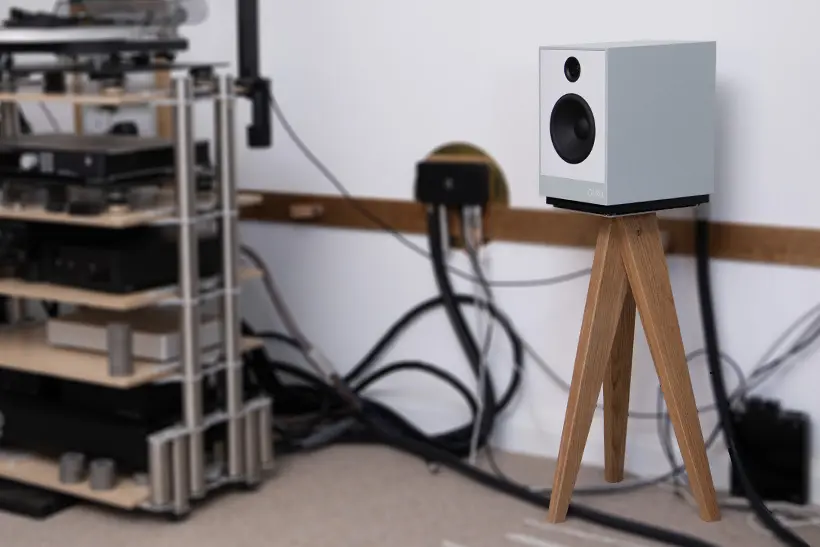
I received one of the painted finish options in a grey colour called Fog, if it were made by Farrow & Ball it would be called Elephant’s Breath, and it looks great with the contrasting white baffle. There are other paint options and two veneer finishes because Guru appreciates that speakers are not just sound sources but furniture as well – if you make them look good they are more likely to be welcomed in the home is the thinking.
This speaker’s port is cut out of a black plinth that forms a shadow gap under the cabinet and sits on four foam feet. These feet provide a degree of isolation and are similar to the softer foam stick on feet that Guru used to supply with the QM10 back in the day. They mean that you can put the Guru 8 on any surface without danger of marking it, or if it’s a surface shared by a turntable, much likelihood of causing excess vibration.
These feet also provide the interface with Guru’s matching three legged Standpoint stand that’s made out of three pieces of oak held together with a single fixing, they have an aluminium top plate and look great under the speaker. They don’t have spikes which may be of concern to some but this fits in with aesthetic and the desire to reduce vibration transmission.

The Guru 8 has a low-ish 5 ohm nominal impedance but the 4 ohm minimum means that it is not a difficult load, especially when combined with an 87dB sensitivity. Guru recommends amplifier power of 20W to 160W but the latter seems excessive given that this is not really a high power speaker.
Guru provide a few useful tips for setting up their speakers, these include placing them less than 5cm (2 inches) from the wall behind and toeing them in so that their imaginary axis crosses in front of the listener. They also suggest that soft furnishings such as curtains, sofas and rugs be used in the room to reduce reflections and reverberations, as well as breaking up flat walls with shelves, paintings, books etc. Finally, a low coffee table in front of the listening seat is recommended to break up floor reflections, the comment about this being a good place to rest your feet is no longer included however, but take it from me, it is.
Sound quality
Putting the Standpoints together has a slight Ikea vibe to it but doesn’t involve too much cursing and soon I had the Guru 8s sitting close to the wall with plenty of toe-in which generally creates a wide but shallow sweet spot. More people get a decent stereo image but it lacks the precision of an on-axis set up, making it perfect for casual listening. Set up thus you can appreciate the Dieter Rams influenced styling of these compact speakers and enjoy the soul in the music. In an easy effort to reflect the Guru 8’s Nordic origins I played Bugge Wesseltoft’s It’s Still snowing on my piano live, a solo recital with a slightly hard sound. This was handled well with the emphasis being placed on the heart of the performance so that the character of the recording didn’t get in the way. It was very engaging.

I was taken by how well sound escapes the boxes with appropriate recordings, there is no shortage of scale and the timing is excellent. The balance is a shade mid forward but the bass is not lacking, in fact it can be surprisingly deep with the right tune, and it avoids the blurring effect that you get with less well designed reflex speakers. It’s not overblown but well extended for the size of speaker. More important however is that the Guru 8 keeps you listening. The danger in the era of shrunken attention spans and instant access to all manner of music is that one jumps from one track to another looking for the elusive hit. But that hit that only comes if you give the music time to make an impression, these Gurus encourage that approach and whole albums can flow by without the slightest inclination to find something else raising its head.
The Guru 8s are not designed for very high playback levels, there are some speakers of this size and price which are but these ones have a charm that doesn’t require force, they simply weave a musical spell that pulls you in. Bill Frisell’s live version of Lost Highway (Further East/Further West) works particularly well if you don’t try to push the volume too hard and his take on Masters of War induces eyes closed bliss. Detail levels are about par for the asking price, you can hear plenty of what matters in the recording but these are not monitors. That said there is plenty of filigree to be heard in good recordings and this is certainly part of what makes these speakers so enthralling.

Sound does escape the boxes well as mentioned, my system gets in the way a bit with speakers that are against the wall but it didn’t stop the vocal on several tracks from standing proud, centre stage. The bass while impressive for the box size is not prodigious, a sub or a bigger speaker is needed for the low synth on Dead Can Dance’s Host of Seraphim, but the Guru 8s make a decent fist of it and don’t lose composure. Double bass on the other hand is often fabulous, the speaker is articulate and fast enough to give you the energy that counts in a chewy and powerful fashion, making the instrument particularly enjoyable.
Up to this point I had used my 150W Moor Amps Angel 6 to drive these speakers, in an effort to put them in a more likely context I hooked up a Rega Elex-R integrated. This brought out a faster, brighter presentation in the Guru 8s with even better timing if less tight control of the bass. Bob Marley’s No More Trouble was particularly up beat and engaging but the bass line exhibited some bloom. I tried offsetting this with a bit more space behind the speakers and that did the trick but left other material feeling a little light in balance, clearly there is a sweet spot to be found here.
Contrasting them with some old Dali Royal Menuet IIs was illuminating, the Guru 8 is a bigger and more expensive speaker but it made the Dali sound very lightweight in terms of bandwidth. Timing wise the two were close however, but the Guru had the upper hand and presented notably more detail, which has more than a little to do with their ability to hold your attention.
Conclusion
It’s great to have Guru back on the scene, they have a strong sense of design aesthetics and a sound that encourages extended listening. I can think of few speakers at any price that look more attractive and this appeal is enhanced by the dedicated stands. You can buy a more powerful speaker that goes lower in the bass for the price but the Guru 8’s combination of sonic and visual style makes it a very appealing loudspeaker for listeners who want the joy of music without the garishness of many modern speakers.