

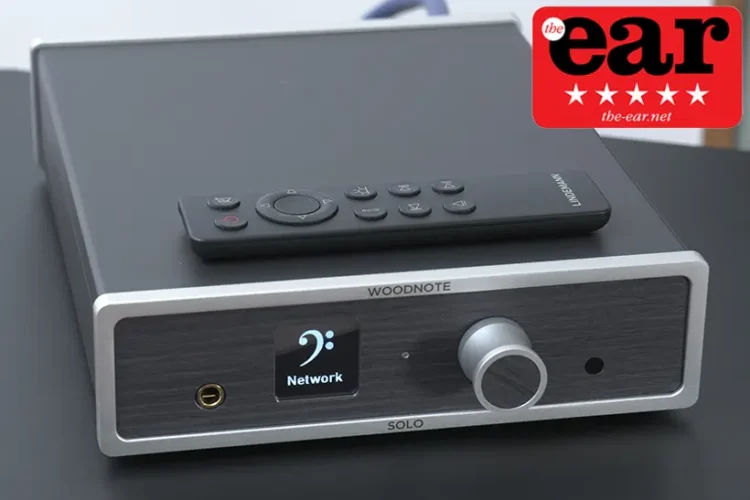
Woodnote Solo streamer
Woodnote is an example of a European hi-fi manufacturer that has grasped the nettle when it comes to shifting requirements in the market place. The brand is part of Lindemann, a company that started out making conventional 17 inch components in 1993 with the integrated Amp1, they made a CD player six years later and an SACD player shortly thereafter, adding higher end electronics and speakers along the way. But something changed in 2007 with the introduction of a small device for connecting a PC to a sound system in the early day of streaming, the fact that they were on top of what was to become the dominant format at this time is an indication that Lindemann has its finger on the broader audio pulse.
Today Lindemann makes a several ranges of compact components with the Musicbook series at the top and the small and affordable Limetree units at the entry level. Woodnote is the midrange offering in Lindemann’s catalogue and consists of two models the Solo streamer and Combo streaming amplifier. Both inhabit the same 8 inch wide case with its distinctive wood veneer style fascia and single control knob, the Combo incorporates a 30W Class A/D amplifier and both models sport a headphone amplifier, inputs for digital, analogue and HDMI signals plus streaming connectivity via ethernet or over wi-fi.

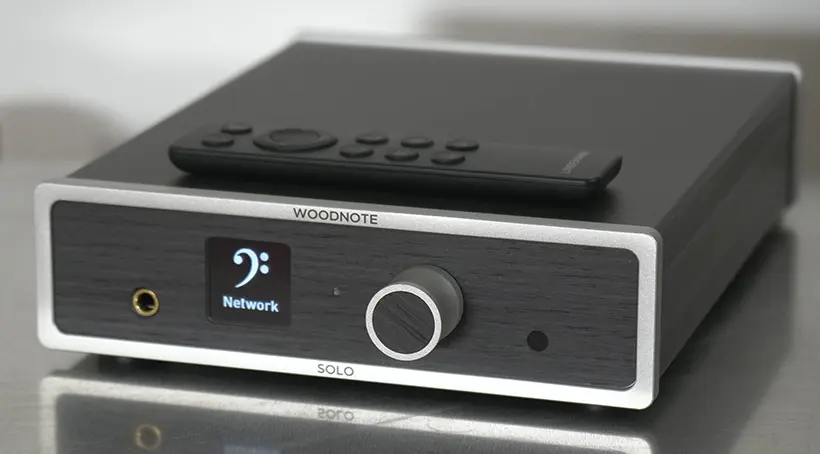
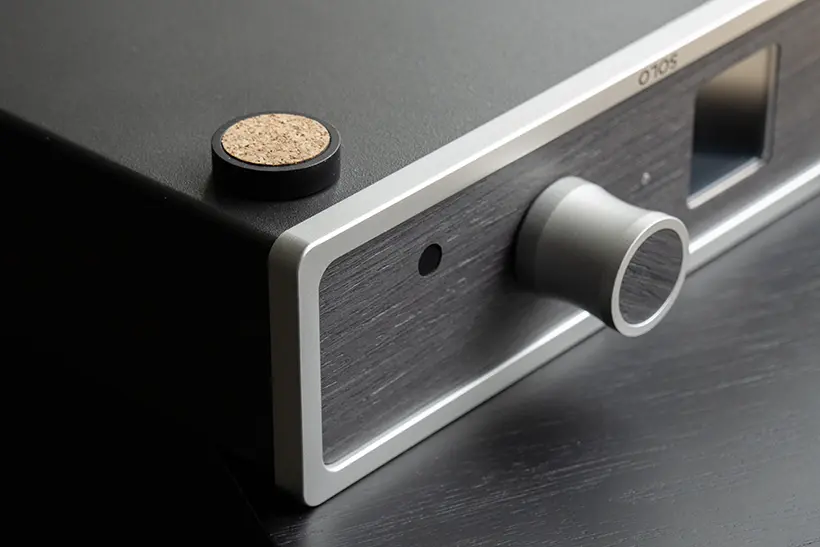
The Woodnote Solo is a beautifully executed piece of kit, its German build is apparent in the attention to detail and finish of all elements, not least the sculpted control knob but the cork facing on the metal feet is also a nice touch. The textured fascia is wood like but probably a laminate as this ensures consistency for the manufacturer, when a partnering Woodnote product comes along, maybe a power amp, then both units will match. The Solo can be controlled by pressing and rotating the knob which serves as a volume control once it’s powered up, but it’s easier to do input selection and volume with the remote handset which is a compact but ergonomically thought thru device.
The features on offer, of which there are many, can be easily accessed via Lindemann’s control app which provides the option to change one of the Solo’s headline features, DSD resampling. This is part of what they call a De-constructed DAC, presumably a DAC chip where some functions are controlled by discrete components. DSD resampling is the conversion of the incoming PCM signal into 1-bit DSD for a sound that is “natural, vivid and rich in detail.” The app provides access to popular streaming services including Spotify, Qobuz and Tidal plus their Connect counterparts, which generally sound better in our experience, there’s also Highresaudio and Airable internet radio. It’s a good app in terms of ease of use and allows you to navigate and play from your own music library albeit without displaying as much metadata as the streaming services.

The back panel is necessarily compact which isn’t a problem unless the IEC plug, on your power cable, and ethernet plug are chunky high end varieties, in which case the two are a little snug. I got round this by using a power cable with a relatively normal IEC plug which is what’s supplied in the box and the most likely type to be combined with a device at this price. I could have resorted to wireless network connection but that isn’t my usual approach and a quick comparison on the Solo revealed why I will be sticking with cables whenever sound quality is important.
Woody
I connected the Solo to my Music First preamplifier with its output fixed through the app and used my Rega Solis power amp to drive the Dali Epikore 9 speakers that have become entrenched in my system in a very enjoyable way. This arrangement allowed for enjoyably warm and smooth results that were produced with a range of musical styles, the Solo really is a polished performer, with a balance that masks the worst excesses of certain recordings. Its carefully tailored presentation promotes musical fluency above absolute transparency, which given the market it was designed for seems like a good choice.
However, switching DSD upsampling off went some way to increasing transparency and improving the sound all round for my money, with timing in particular becoming much better. I have never been a fan of DSD because it tends to undermine this key quality, but I appreciate that there are many who enjoy the more airy, polished sound of 1-bit processing. It’s great that the Woodnote Solo offers both presentational styles in this apparently simple box.
With PCM selected the sound produced by the Solo’s RCA outputs was spacious and natural, and more importantly it was engaging and encouraged extended listening at relatively high levels. I enjoyed Bill Frisell’s version of Masters of War and Fred Frith’s inspired thrapping out of Hard Time Killin’ Floor Blues on a steel string acoustic guitar, noting a slight softening of leading edges compared to my significantly more pricey reference, but equally hearing plenty of low level detail. Contrasting the Lindemann app with my preferred JPlay controller revealed that the native (and free) app is pretty hard to fault. Which is frequently not the case, JPlay regularly wipes the floor with the apps supplied with streamers, even some quite pricey ones, so this is a feather in Solo’s cap.
As mentioned I also contrasted the sound with wi-fi instead of the usual ethernet connection. I should have known that with several thousand pounds worth of network switch and ethernet cable that the wired approach would be better but suspect that it would be worth using cable wherever possible, the Solo is more than transparent enough to let you hear why. I also tried streaming via Bluetooth from a Macbook and that worked seamlessly, providing the only way to use Spotify without paying for it and accessing some material that was too obscure for Qobuz.
With PCM selected and the volume being controlled by my preamplifier the sound produced by the Solo’s RCA outputs was spacious and natural, and more importantly it was engaging and encouraged extended listening at relatively high levels. I enjoyed Bill Frisell’s version of Masters of War and Fred Frith’s inspired thrapping out of Hard Time Killin’ Floor Blues on a steel string acoustic guitar, noting a slight softening of leading edges compared to my significantly more pricey reference, but equally hearing plenty of low level detail. Contrasting the Lindemann app with my preferred JPlay controller revealed that the native (and free) app is pretty hard to fault. Which is frequently not the case, JPlay regularly wipes the floor with the apps supplied with streamers, even some quite pricey ones, so this is a feather in Solo’s cap.
As mentioned I also contrasted the sound with wi-fi instead of the usual ethernet connection. I should have known that with several thousand pounds worth of network switch and ethernet cable that the wired approach would be better but suspect that it would be worth using cable wherever possible, the Solo is more than transparent enough to let you hear why. I also tried streaming via Bluetooth from a Macbook and that worked seamlessly, providing the only way to use Spotify without paying for it and accessing some material that was too obscure for Qobuz.
Conclusion
The Woodnote Solo is a lovely piece of kit, both to behold and to use. It is really well put together and finished and offers ease of use that competes with the best. It has a strong raft of features and the option to tune the sound to personal taste in a way that few alternatives offer at the price.

Anyone looking to make the step up from a one box solution could do a lot worse than trying either the Solo or its amp equipped partner the Combo, I haven’t tried the latter but the Solo is capable of highly compelling music making when given a decent amp and speakers to work with, throw it the bone of a wired network connection and you will be captivated by what the Solo can do for your musical entertainment.
Pros
Excellent build quality and finish; compact, stylish design with thoughtful details (control knob, cork-faced feet, wood-effect fascia).
Wide feature set for the price; streaming (Ethernet & Wi-Fi), HDMI, digital and analogue inputs, headphone amp, Bluetooth.
Strong app support; access to Spotify, Qobuz, Tidal (and Connect), Highresaudio and Airable internet radio.
Intuitive and stable app; compares very well with third-party control apps.
Selectable DSD and PCM modes; allow tailoring of sound to taste.
Warm sound; smooth and musically engaging presentation when used with fixed output into an external preamp or integrated amp.
Good value step-up option from all-in-one systems, especially when paired with quality amplification and speakers.

Cons
Not the most transparent or incisive streamer; slightly soft leading edges compared with higher-end references.
DSD upsampling can reduce timing precision and clarity for some listeners.
Rear panel connections are cramped; bulky IEC power and Ethernet plugs can be awkward to fit.
Wi-fi connection audibly inferior to wired Ethernet.