

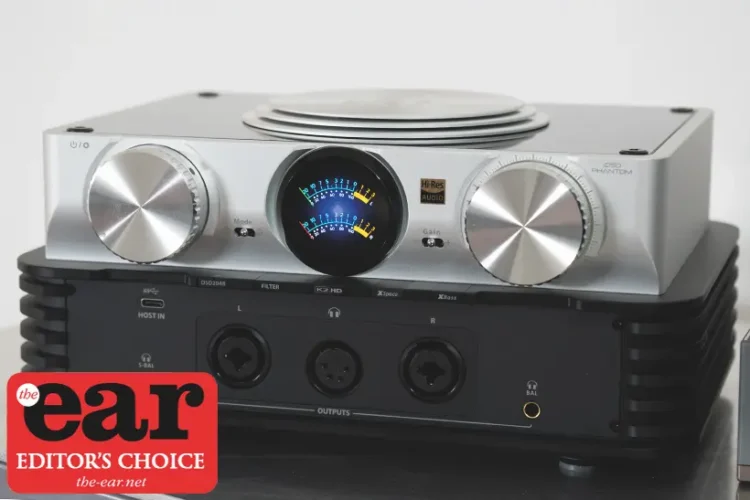
iFi iDSD Phantom DAC streamer headphone amp
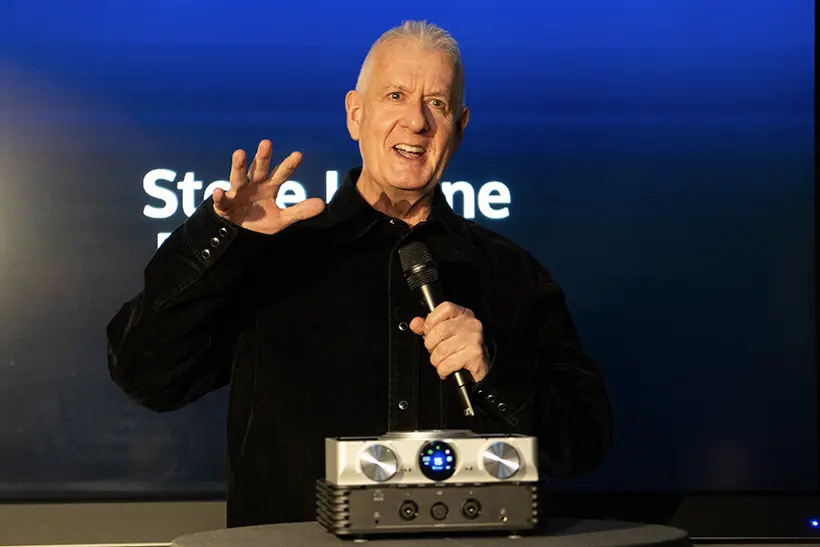
On a wet night in January iFi launched its most ambitious digital to analogue converter to date in one of the towers on London’s Tower Bridge, it was a novel location which will have helped get journalists out into the rain, fortunately the appearance of a recording industry legend and the iDSD Phantom itself warranted the effort. iFi has built a reputation for making great value audio electronics centred around headphone listening but including phono stages and all manner of devices created to aid the reproduction of digital audio. The iDSD Phantom is a rather different kettle of cheese, while not a full size device it’s an elaborately built one with all of the features under the sun, and then some more.
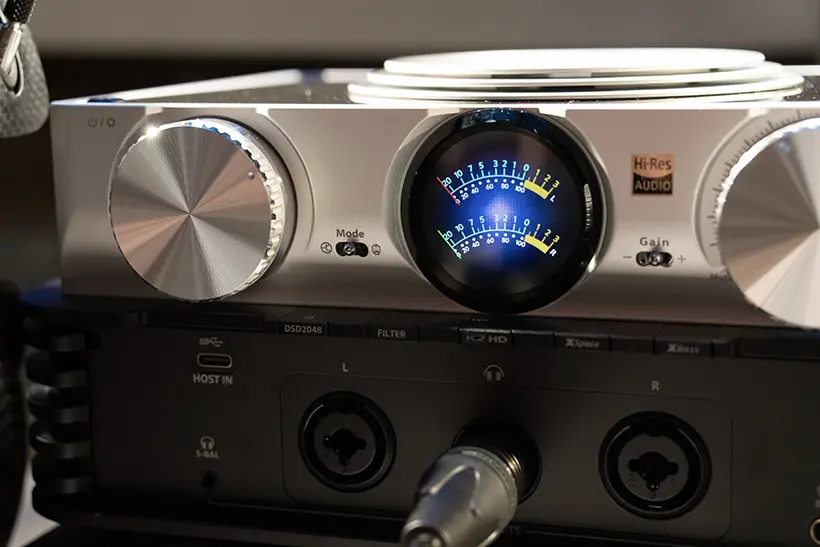
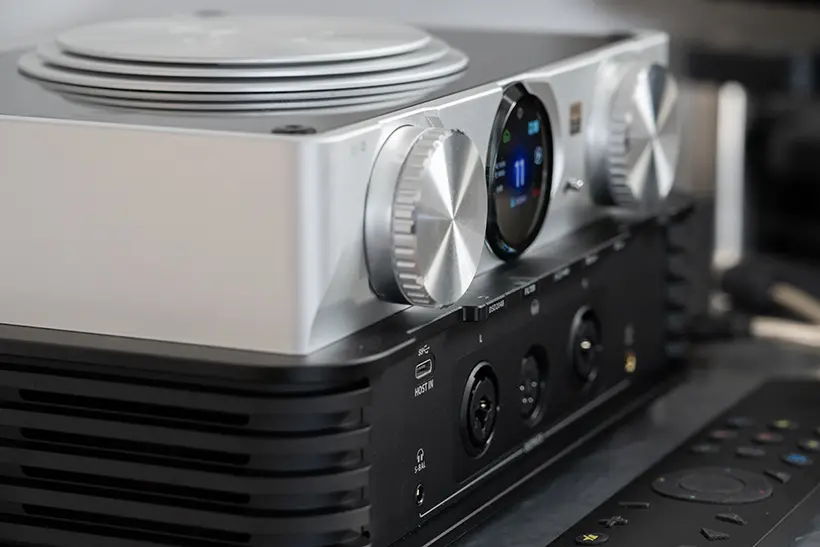
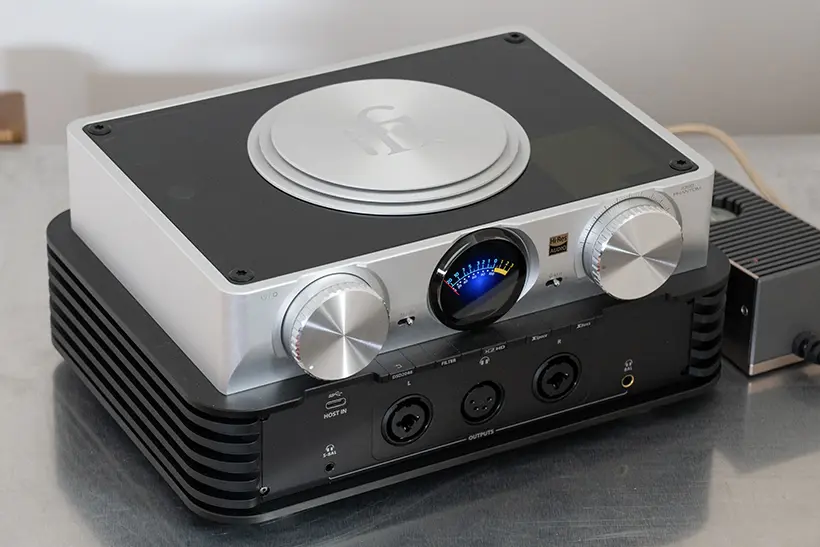
It looks like two components stacked atop one another and in many ways that’s what it is. The top half is a DAC with onboard streamer while the darker base forms a headphone amplifier with a variety of connectors to suit balanced and single ended plugs. IFi make a dedicated headphone amplifier, called iCan Phantom, that has the same casework as this iDSD version, but that model has more extensive headphone driving capabilities including, power for electrostatics, but no streaming capability
Internally the iDSD Phantom is one unit and you get some idea of this if you peer through the tinted glass top of the case, here it’s possible to spot the tubes/valves that can be chosen to power the output stage in two of three output options.
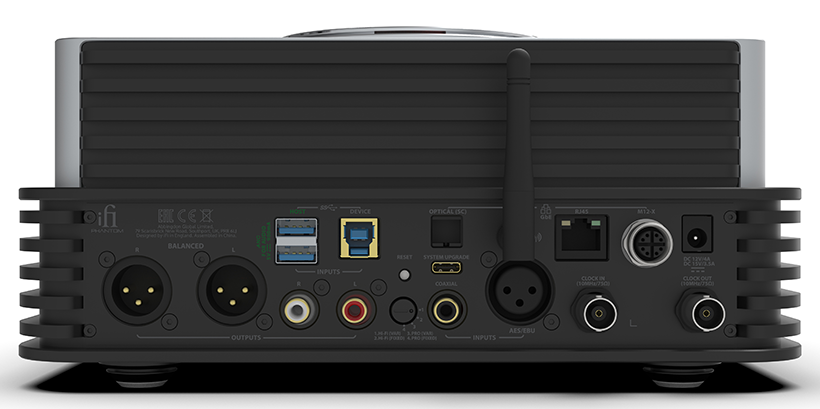
The back panel is compact but there is space for a wide variety of in- and outputs, the latter consist of the usual RCA and XLR sockets, single ended or balanced, while inputs extend to coaxial, optical and AES/EBU digital, USB A and B for streaming from either a drive or a PC and RJ45 for ethernet connection. The iDSD Phantom can be operated with a network connection over wi-fi if no wired option exists. There are several lesser seen connectors on the back including in- and outputs for a 10MHz clock signal, which is a very effective means of upgrading almost any digital component if you have a suitable word clock. There is one socket labelled M12 X which is an industrial ethernet connection that is gaining traction in high end circles, I have to admit it’s the first one I’ve encountered.
No load too heavy
Being iFi’s top DAC the iDSD Phantom has more features than you can shake a stick at, these start with seven DAC filters and go on to DSD2048 remastering, JVCKenwood’s K2 and K2HD tech, as well as spatial and bass enhancement options. The array of options would keep a tweaker diverted for months. This is also a pretty serious headphone amplifier with enough power to ‘drive the toughest headphone loads with ease.’ It says here. It also has three power modes for different head- and earphone types. DSD remastering converts the incoming signal to one of three degrees of DSD resampling assuming that signal is PCM or DSD but not DSD512, maybe that’s upsampling too far.
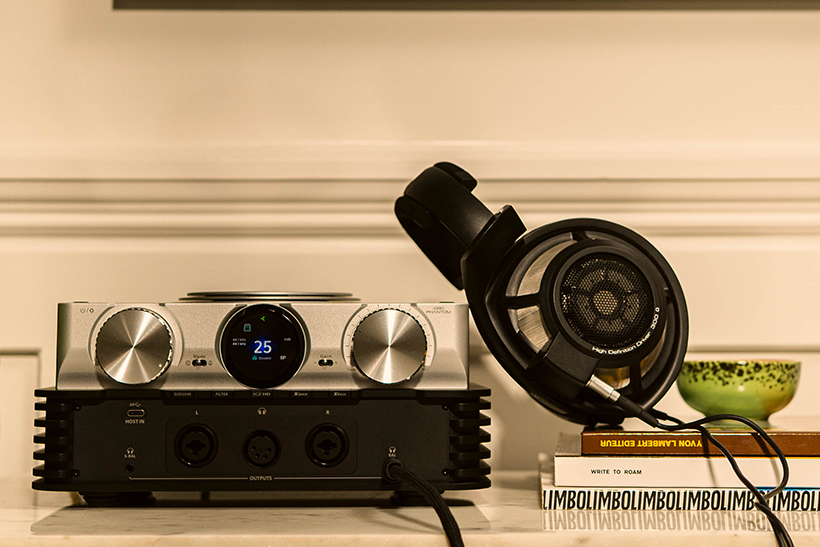
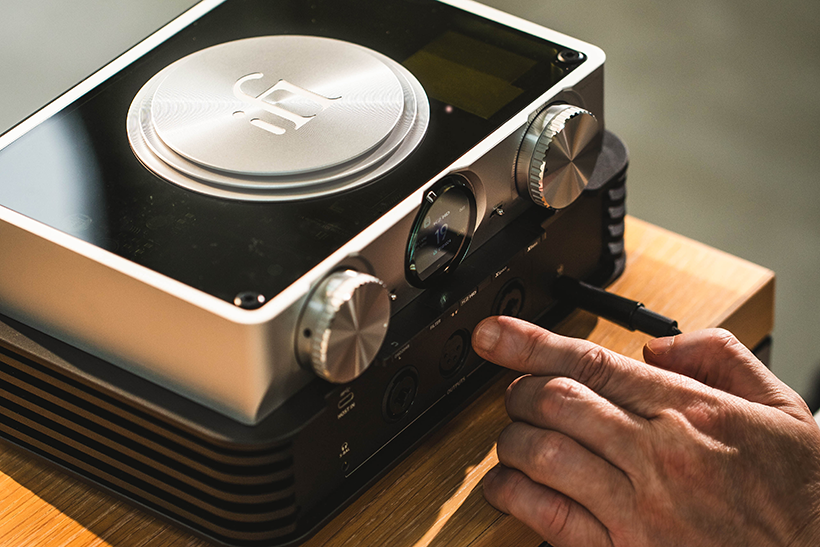
There are multiple ways of activating the various features including pressing the left hand knob and selecting the required degree of the feature being used, the remote makes this process a lot easier however as long as you are able to read the graphics in the central display. Both handset and display use some less than obvious symbols and it helps to have the user manual to hand in the early stages at least. You can access a huge range of information via both the display and iFi’s Nexis control app, this is naturally the easiest way to change things
The display can tell you tube hours used, which of three brightness levels are set, cover art or variations on a VU meter as well as the playback modes: auto, DLNA, Roon, Tidal or Qobuz in their Connect guises. You can sync volume to an attached PC and choose from external clock types, DARS, WCLK via I2S or 10MHz. More fundamental is input selection, the options including all the usual suspects plus ethernet for streaming directly via the iDSD Phantom.

What’s in the box?
Not usually a very interesting question but in this case iFi have loaded the iDSD Phantom with extras that are not usually provided, these include an iPower Elite 15V power supply which is a high quality switching supply that usually sell for £299. There are also USB, RCA and fibre optic cables, the latter included to connect an Optibox transceiver that’s also provided. This converts data from its electrical ethernet form to an optical one and is designed to reduce noise transmission in the process. Finally there is an infra red remote handset that is most useful for controlling volume when using the variable output but also allows you to change most of the other parameters on the machine.
Sound quality
Not so long ago I used this DAC’s predecessor the Pro iDSD as my reference so am fairly familiar with its digital filters at least, so I selected the non-oversampling bit perfect option as it sounded best on the original and is my goto with most DACs that offer it. I started with the solid state output and made a few comparisons with that and the two tube options that while they have some appealing qualities and will certainly suit some systems and tastes well, didn’t work as well via the relaxed Dali Epikore 9 speakers I am enjoying so much at present.
Initially I hooked the iDSD Phantom’s variable balanced outputs directly to a Rega Solis power amplifier which is the way I use my reference DAC. But this resulted in being limited to single digit output levels from the iFi, there was too much gain which didn’t make for a good sound nor was it much fun having so little volume range to play with. I checked that the DAC’s gain was set to minimum and also tried its RCA outputs but the issue remained. In the end I turned the switch on the back from variable hi-fi to fixed hi-fi and hooked it up to a Music First Baby Reference preamplifier. The ‘pro’ output setting delivers higher voltage than the hi-fi so was left well alone.
This cured the level problem but revealed a second issue that was more prominent with the RCA outputs, notably a low level burbling that came through when music wasn’t being played. I asked iFi about this who said that the iDSD Phantom is sensitive to its surroundings and were there any components near to it that might be causing interference? As it turned out the DAC was sitting next to, under and above devices that might be emitting something problematic. It was sitting in approximately the same place as my usual DAC but being half width was nearly surrounded by other kit. Moving it to another spot solved the issue completely and musical engagement could now commence.
The iDSD Phantom is an impressively transparent and revealing digital to analogue converter, it delivers results that you could reasonably expect at twice the price which is quite an achievement. I used it with both USB and AES connections to my Lumin streamer and was very impressed with just how open, live and vital the sound it produced was. These qualities have to be on the recording in the first place of course, it doesn’t hype everything up, but if they are you know all about it. The scale and dynamics it found in Bill Frisell’s Beautiful Dreamers album made it feel really alive yet controlled. Some DACs add a touch of brightness to leading edges that makes everything sound more exciting but that soon becomes tiring in a revealing system. Here the balance is very well chosen with wide dynamic range and bandwidth plus a clean delivery that allows you to engage with the spirit and intent of the music being played.
As the iDSD Phantom has a word clock input I hooked up my Mutec Ref10 Nano 10MHz clock via its 75 ohm output and gave that a spin. The result was better timing, greater depth of image and a more relaxed presentation. An all round improvement in other words that made the music easier to enjoy and the sound more realistic. This clock costs nearly half as much as the iFi but it’s useful to have this upgrade option available, it’s certainly not all that common. I also spent many happy hours using the iDSD Phantom as a streamer and while the result wasn’t quite as effortless as using a separate (and costly) streamer, it certainly wasn’t shabby. Richard and Linda Thompson’s Night Comes In has the potential to captivate if the system is on song and that proved to be the case here, the subtle tension in the guitar playing coming across very clearly and providing an emotional anchor that was powerful.
I tried using the iDSD Phantom’s streamer straight from the raw network feed coming from the router, playing a fairly robust tune in the form of Miles Davis’ Duran (take 4) from the Complete Jack Johnson Sessions. This sounded intense but rather rough around the edges so I dropped in the Optibox ethernet transceiver that iFi provides in the box, taking its feed in via the SC optical input. This smoothed off the harshness but undermined the phenomenal immediacy of the direct feed. The Optibox is powered by a USB wall wart and I suspect that using a good quality 5V power supply would help here, but there will be some who prefer the undoubtedly cleaner sound of it as is. However, we vinyl junkies prize immediacy very highly.
Another way of taking the edge off less than pristine signals is the DSD remastering option and that worked rather better here, smoothing the worst excesses and brining out the air in the recording. I also tried the Xspace setting which does indeed make the sound more open but has a slight loudness effect as well, being a purist I turned it off and returned to ethernet via the calming influence of a Network Acoustics Tempus switch. I like the way that the iDSD Phantom shows artwork for albums being streamed, the image may be small but you notice when it’s not there, which happened with a few of the files on my library but not with Qobuz Connect.
I did a bit more comparison between output types and enjoyed the harmonic richness of Tube+ which makes leading edges a little sweeter without undermining timing, but with most music via the Dali speakers at least the extra power in the bass made the transistor option more appealing. That was certainly the case on Marc Johnson’s Bass Desires, ironically this is not a heavy recording (it’s acoustic bass), just a very good one of a particularly inspired group of musicians. The track Samurai Hee Haw includes the rather unattractive sound of synth guitar yet the iDSD Phantom managed to put the music first, and tonal issues second. Which for me is the way it should be; the hardware should be of service to the software and not the other way around.
Conclusion
After the initial teething troubles I got a fabulous result with the iFi iDSD Phantom, it is better than its predecessor and offers more features than almost anything else on the market. I am not a headphone guy but did get a pair of Grado Signature S750s in to try just in case the combination did the unlikely trick of luring me away from speakers, it turned out that my ears are the wrong shape for them and while the sound was very good I didn’t feel the inclination to listen for long.
I suspect that many headphone fans will find a lot to like about the iDSD Phantom, they will appreciate the fundamental transparency it offers alongside features which are perhaps better suited to the intimate listening experience. That said I enjoyed a lot of intimate listening with a full system and could have carried on doing so for a lot longer, and I’m a purist who doesn’t a slew of upsampling and filter options. This is iFi’s USP though and their are many who love what they do, but this is an excellent piece of kit on many levels, tweak it or leave it alone it will deliver the musical goods.
Pros
Exceptionally transparent and revealing sound with strong dynamics, scale and musical engagement
Outstanding value for performance, competing with DACs at significantly higher prices
Extremely feature-rich: multiple DAC filters, DSD2048 remastering, K2/K2HD processing, spatial and bass options
Three output stages (solid state, Tube, Tube+) allow tailoring of sound character
High-quality built-in headphone amplifier with multiple power modes
Integrated streaming capability
Comprehensive connectivity including USB, AES/EBU, coaxial, optical, Ethernet and balanced outputs
10 MHz word clock input offers potential for significant performance upgrades with external clocks
Generous accessory bundle including high-quality power supply, cables and Optibox optical ethernet converter
Flexible control options via remote, front panel and the iFi Nexis control app
Cons
Initial setup can be complex, with a large number of options and settings to navigate
Display icons and remote symbols are not always intuitive, requiring reference to the manual
Sensitive to placement and nearby equipment, which may introduce noise if poorly positioned
Variable output gain can be too high when driving power amps directly in some systems
Optibox optical Ethernet converter may reduce immediacy compared with direct ethernet feed
Huge range of tweakable features may overwhelm purist users who prefer simplicity
Shorter than average one year warranty