

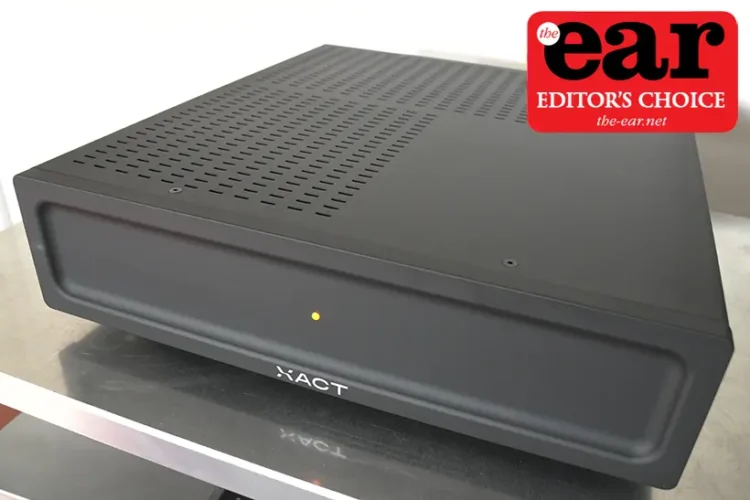
Xact N1 network switch
The Xact N1 is a high-end network switch designed from the ground up to improve streaming audio quality by minimising noise and signal interference, using features like a linear power supply, galvanic isolation, and a precision OCXO clock. Compared to typical adapted IT switches, it delivers a clear uplift in performance, lowering the noise floor to reveal greater detail, clarity, timing accuracy, and instrument separation, while giving music a more natural, fluid, almost analogue character. It reinforces the idea that the network switch is a critical part of the streaming signal chain. Despite its high price, the N1 is considered a worthwhile upgrade for well-developed systems, enhancing overall musicality and realism.
Xact factor
A year ago I was frankly blown away by the Xact S1 Evo server/streamer, a not inexpensive but fabulous sounding example of streaming audio art that has remained a high water mark ever since. The S1 Evo was slightly odd in that it had multiple ethernet ports and looked as though it could be used as a switch as well, this was not the case however, its switching capabilities could not be used at the same time as file streaming. In other words if you wanted to use an Xact for both switching and music playback you needed two of them, which at the price was a big ask.
Xact’s Marcin Ostapowicz has finally released a dedicated network switch in the form of the N1 which is smaller than the S1 Evo and a lot more affordable (£6,000 rather than £16,000). Ostapowicz has dedicated what must be the majority of his working life to improving the sound of streaming audio, he started out with JCAT software for the PC and went on to develop the JPlay streaming software and app that is the best sounding example of its kind that I have tried, it makes the apps supplied by hardware manufacturers sound surprisingly poor and kicks the most popular third party control app into the tall weeds when it comes sound quality.
It was only a matter of time before Xact built the N1 and I have to say that it doesn’t disappoint. This is a company that understands the problems that assail streaming systems better than most and has taken the time to figure out how best to combat them. The majority of network switches from audio brands are essentially IT examples combined with a cleaner power supply, the sheer complexity of and cost of building a network switch from the ground up prohibits most from going any further.
Xact have created a mother board for the N1 that is designed primarily to keep noise to a minimum in order that the signals being channeled through it remain as pure and uncontaminated as possible. The N1 was designed in the same way as any piece of high end audio – for minimum distortion and maximum sound quality.

To achieve this Ostapowicz has used ultra low noise linear regulation in order to supply clean power to the critical parts of the circuit, and also to isolate those parts from one another and avoid cross contamination. The N1 power supply differs from other network switches in this regard, where most if not all use switched mode power supplies the Xact has a transformer and a linear supply, an approach that has long been favoured in high end audio. Much like a streamer or DAC the N1 has a master clock to keep everything in synch, in this case its an OCXO (oven controlled) example with its own dedicated linear power supply. The power supply uses galvanically isolated voltage rails to ensure devices do not interfere with one another.
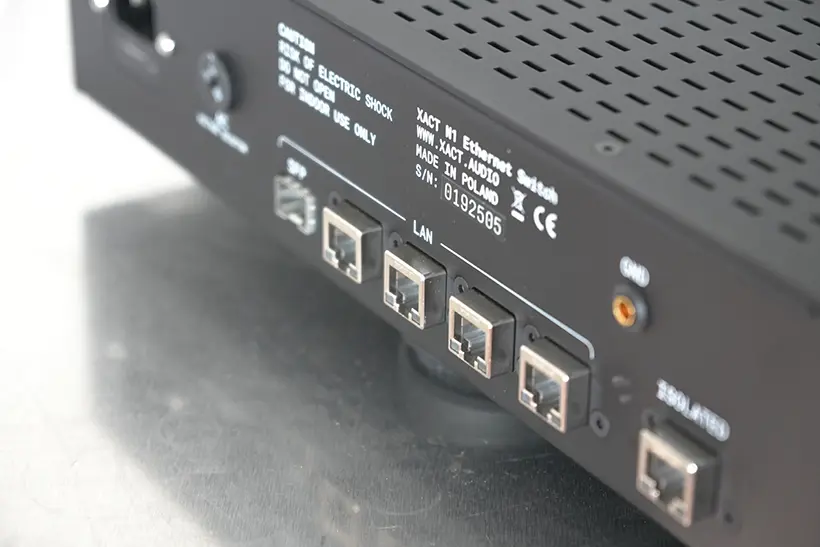
The N1 has five LAN ports with RJ45 connectors for ethernet, these are all 1Gb types, Xact are not of the opinion that slower network connections benefit audio quality in the way that Dela (formerly Melco) is. One of these ports is isolated from the rest, that is all network signals, clock controls and comms are isolated from the other ports, this is intended to be connected to the streamer for best results. The final port is an SFP for optical connection that Xact suggests be connected to the router, but any of the LAN ports can be used for the same purpose, one of these was used for this review.
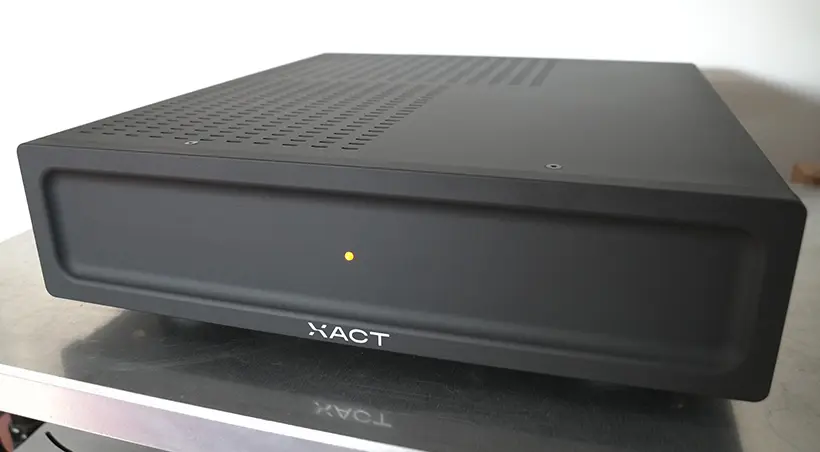
Unlike most of the audio oriented network switches we have reviewed this one has an onboard power supply, this means that only one box needs to be accommodated because there’s no separate PSU, and that the unit can be improved with power cable upgrades. The N1 is large for a switch but smaller than most hi-fi components at just over 24cm (9 inches) wide, making it a larger than half width device. It feels professionally made and I particularly like the way that the ports are well spaced, indication in itself that this is not a tweaked Netgear, and a feature that means that larger RJ45 ethernet plugs are not crammed together. The last connection on the back is a ground point, another indication that keeping noise at bay was a primary concern in its conception.
Sound quality
I used the N1 in place of the Network Acoustics Tempus that provides switching duties between the router, a Lumin U2 Mini streamer (with Origin power supply) and a Melco N10 server, digital to analogue conversion was carried out by the Moor Amps Mana DAC and my Bricasti M11 Classic. Initially I used ATC EL50 active speakers to reveal what the new switch could do as these are among the most revealing and even handed speakers I have encountered and, critically, they aren’t easy to move.
The upgrade provided by the N1 was not small, it delivered clearly higher resolution – I could hear more detail because the noise floor was lower – and this allowed greater depth perception and greater precision without grain or digital edginess. I was surprised to hear that even timing was improved, the Tempus is particularly good in this regard, but whenever the noise floor is reduced the blurring of leading and trailing note edges also goes down. Another obvious benefit was better separation of instruments and voices. I played a track that ATC had used to set up the speakers, Christine and the Queens’ Tilted, and found that it was easier to pick out what the drums, guitar, bass and voice were doing, likewise the way in which the tempo picks up at certain points became more obvious.

Clarity is the main winner with the N1, this switch manages to drop the noise floor quite clearly and this means that you can hear the quieter things in the mix much more easily. I loved the speed and clarity on Keith Jarrett’s Everything I Love, this didn’t sound rushed but had a natural immediacy that made it highly engaging – in truth my foot would not sit still. That the Xact N1 manages to do this in a calm, open fashion that makes the music so compelling is particularly attractive. It has an ease that one associates with good analogue and in my book there’s no higher complement for a digital component.
The above observations were made with music streamed from Qobuz, switching to my preferred digital source, the Melco N10 server the differences between the N1 and Tempus weren’t as big but they were still easy to hear. Again the more expensive switch sounded more natural and easier to follow, the rambling lyrics of Mark Kozalek were easier to understand and the bass was superb. The latter inspired me to look up Meshell Ndegeocello’s Mary Magdalane which often swamps the room with low end energy, the ATCs are way too controlled for that however and delivered the low bass line in clean and coherent fashion. What stood out once again was lyrical intelligibility, the way that the N1 declutters the sound means that every element is easier to follow.
I got a particularly inspiring result with Bill Frisell’s Blues for Los Angeles (East/West), in fact I heard phase information that has previously eluded the system and which gave the live performance a depth and three dimensionality that is very rare indeed. This is a great recording, I’ve been hammering it for a few years now, but this physical presence was something new. The piece is so good yet the audience really doesn’t get excited enough, the performance warrants a lot more enthusiasm. But maybe the sound at the concert wasn’t as good!

I particularly like the way that the Xact N1 allows the digital stream to sound so fluent and relaxed, it really encourages high level playback and full immersion listening because there is so little trace of the digital in what it sends to the streamer. Some might think that a network switch can only have so much influence on the sound of a high end system, but they would be wrong. Every signal goes through the switch, therefore if that switch is tainted by any form of interference the signal will be degraded, the smallest signals lost in the noise floor and the clarity of the music compromised. The network switch is not a minor element, it’s a critical part of the signal chain.
I also tried hooking up the ground point on the N1 to a CAD GC3 grounding box, this had the sort of result that I have come to expect, it opened things up, letting light into the aural picture and allowing the sound to escape the speakers more comprehensively.
Conclusion
The Xact N1 does precisely what it says on the tin, for tin read website, it enhances a network signal in all the ways that you could desire and makes a digital signal sound distinctly less digital. It brings calm, control, solidity, tightness of timing and weight of bass whilst increasing dynamic contrast and resolving greater tonal depth. In other words the N1 is an all round upgrade for a streaming system. The price is high but far from excessive in the context of what it achieves in a system that is already well sorted on the noise suppression front. Once you have a decent server, streamer and DAC the network switch is the area to upgrade and the Xact N1 will upgrade pretty well any streaming system.

Pros
Significant reduction in noise floor, revealing more detail and clarity
Improved timing, precision, and instrument separation
Natural, fluid, almost analogue-like presentation
Strong gains in vocal intelligibility and low-level detail
Purpose-built design with high-end components (linear PSU, OCXO clock, isolation)
Noticeable upgrade over other high-quality switches
Solid build quality with well-spaced ports and thoughtful layout
Grounding option allows further system optimisation
Enhances both streamed and server-based playback
Cons
Expensive (£6,000) for a network switch
Benefits are greater for streaming services than with local servers
Large compared to typical network switches
Gains depend on overall system quality and resolution
Concept of such a costly switch may be hard to justify for some users
Requires a high-end system to fully realise its potential