

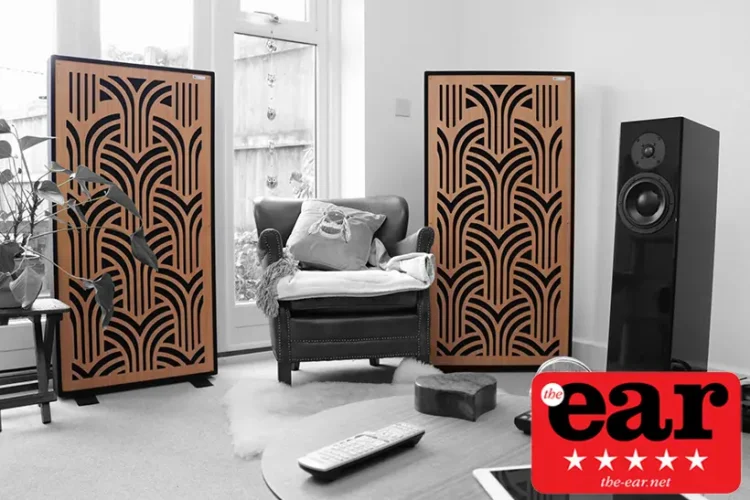
GIK Amplitude Acoustic Panels
Building your perfect system can often be a frustrating process. Often, despite painstakingly choosing and assembling our dream setup, we still find aspects of the system’s performance that fall short. You may have invested in the best supports and, perhaps cables and mains products with price tags that make you wince, but one critical aspect is often overlooked. Very few of us, especially in the UK, have the luxury of the perfect listening space, but how many of us make the effort to optimise what we have?
I have been as guilty of this as anyone. Aside from a visiting friend in the know making a passing comment about my room sounding somewhat ‘lively’, I confess to disregarding any potential issues with my current listening space. Much of the reason behind my dismissal here was a desire to avoid heading down yet another audio-related rabbit hole – I have form here. I have finally overcome this reluctance, following a chat with GIK Acoustic’s CEO, Dave Shevyn, at a recent event. Dave is nothing if not refreshingly honest, and gave me a good idea of what could, and probably couldn’t, be achieved through the brand’s products. A few emails followed, during which we decided to start with three of the free-standing Amplitude panels to see how I got on.
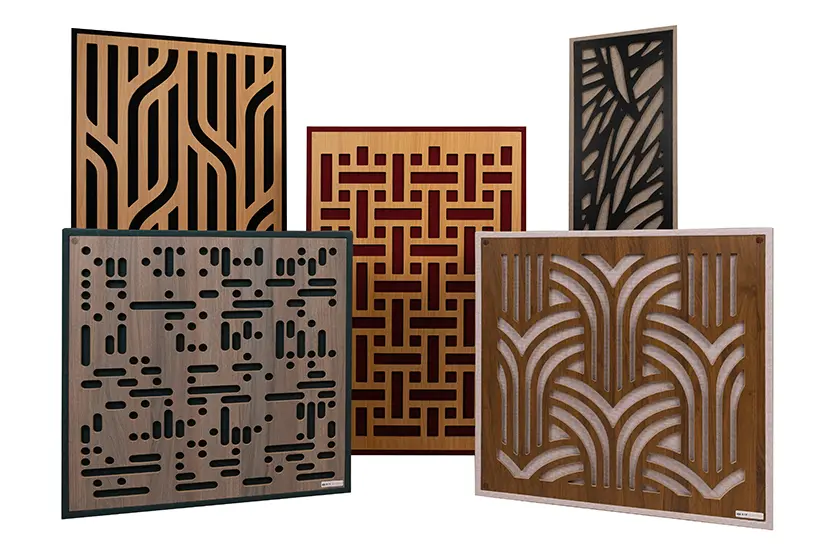
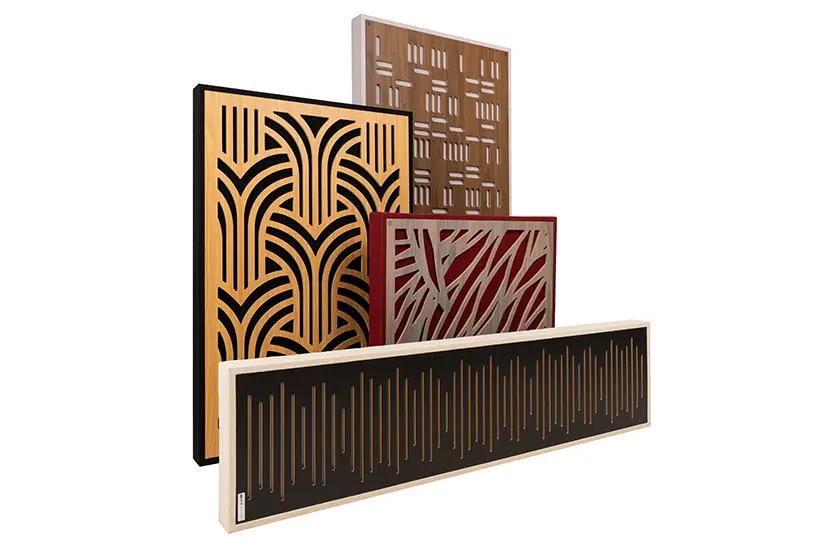
Before delivery of the review samples, I hadn’t given much thought to the different kinds of panels available, but further investigation revealed that each panel has a specific surface designed to target particular types of reflections. As part of the development process, each product is tested at the University of Salford. This level of scrutiny gives both potential and active customers confidence in their choice of panel, backed by graphs showing how the panel responds across the frequency range.
I will first talk about the Classic panel, which forms the basis of GIK’s range of diffuser panels. The Classic is covered in plain Camira fabric and the framework is constructed from fibreglass. These come in various colours, including artwork coverings, in four shapes, and with custom options, prices start at £59. The Classic tackles a wide range of frequencies from mid to high. In particular, these panels aim to reduce reverb and tame unpleasantness in the high frequencies. At only 6cm thick, they will not reduce low-frequency reflections to the same extent as a thicker panel.
Still, the Camira covering does a better job of absorbing low-frequency sound than traditional foam panels. I was fascinated to read that these panels are used in gyms and even classrooms, where they can make speech easier to discern. I genuinely had no idea the GIK panels I’ve seen so many times at hi-fi shows, studios and domestic living rooms were used outside the bubble we audiophiles inhabit.
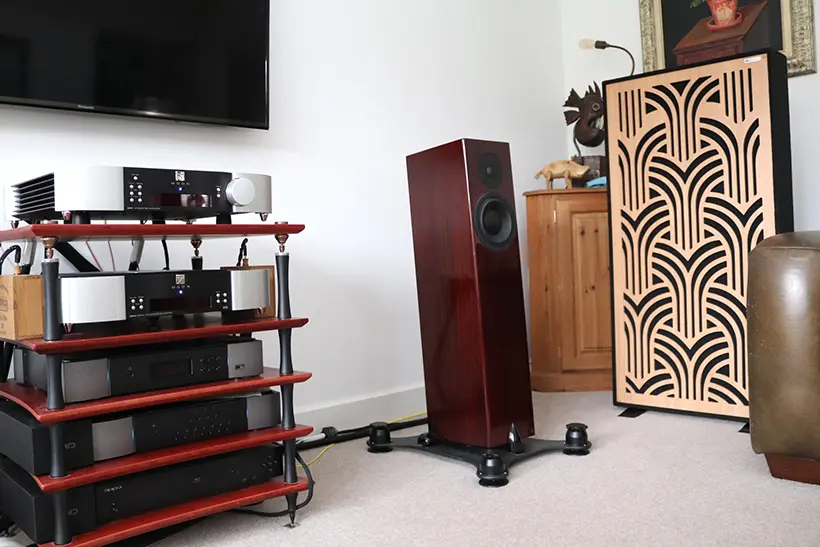
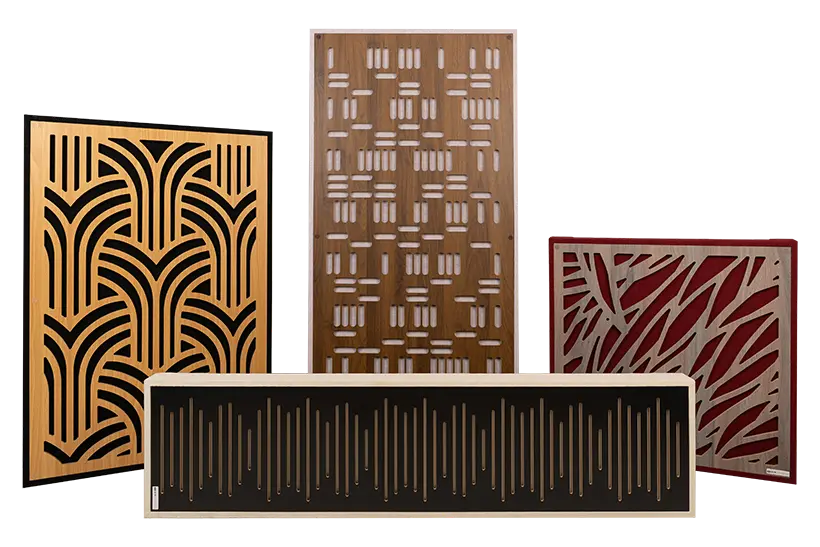
The 60 x 120cm, freestanding Amplitude panel, which we are looking at here, adds a slotted faceplate to the Classic’s form. This faceplate, which is available in various designs, reduces flutter echo and early reflections, however the faceplate means the Amplitude will not reduce the high frequencies to the same extent as the Classic. The reverse side of the Amplitude panel is effectively the same plain Camira fabric as the Classic, which allowed me to experiment by turning the panel around, so that the fabric side faces into the room, rather than the patterned wooden side.
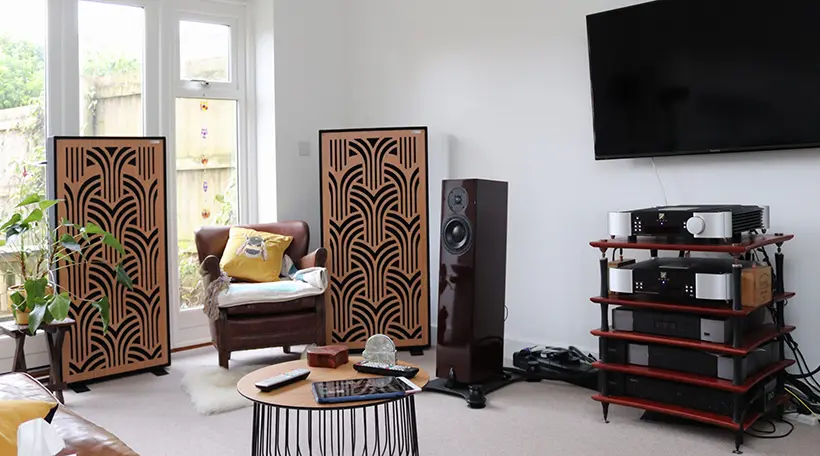
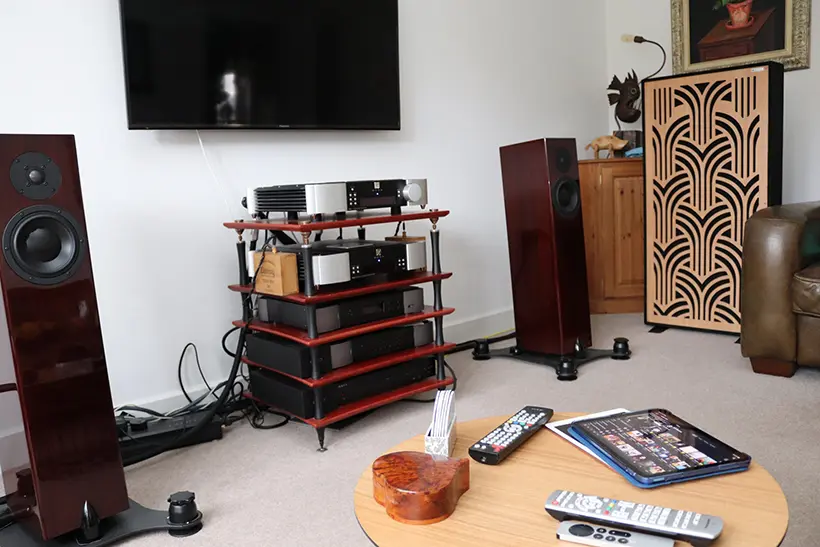
The faceplate is finished in wood veneer and available in many colour options. GIK allowed me, well, in practice, my wife to choose the colour and design of our freestanding panels. We opted for the Gatsby design in beech, with a black background. The differences between the designs are purely aesthetic, and performance should not differ significantly across the options. The panels themselves are pretty substantial and came with footers, which I had to attach using a screwdriver. At a guess, I’d say each panel weighs around 10kg, and they appear to be built to last.
Setting up
We chose the free-standing panels solely to simplify the review process. The wall panels would likely have been more effective, but, dedicated as I am to the cause, drilling into my living room wall would have been a step too far, at least at this stage. GIK explained that, had this been a permanent setup, mounting wall panels behind my sofa, which sits opposite the speakers, would likely have been highly beneficial. In my listening space, the wall behind me is the first point of reflection. Therefore, managing these reflections would reduce issues from the wall behind the speakers, which is the second reflection point.
One of the jobs I keep putting off is sourcing a cover for the TV to fit during critical listening, which is mounted on the wall between my speakers. According to GIK, managing the first reflection point would reduce the need for this, although fitting one could still be beneficial, albeit to a lesser extent than with room treatment. The mounting options are comprehensive, including wall- and ceiling-mounting hardware.
I placed one Amplitude panel across the exposed glass area to the right of my living room, in front of the patio doors. I put the other two panels at the corners of the room, on either side of each speaker. Thankfully, my speakers are just over a metre from each side wall. I had initially, for convenience, put one of the panels closer to the speaker, which restricted the soundstage on that side. Moving it further away, towards the wall, balanced things out nicely.
Calm, yet precise
Before setting up Amplitude panels, I was somewhat apprehensive that they might not be sufficiently beneficial to warrant a review, especially given the potential issues with the untreated wall behind my sofa. Thankfully for all parties concerned, especially readers of the Ear, the Amplitude panels produced a wholly positive effect.
Firstly, I noted a reduction in glare and a sense of calmness in the presentation of music that was not previously present. This did not appear to rob the music of dynamics or life; I just got more music and less distracting glare. This had a positive effect on the timing, as if I were now hearing each note or percussive strike, with fewer reflections around them.
Although the Amplitude panels are not designed to target the low frequencies, the upper bass was now tighter, with less overhang. I can still induce overhang in the lowest frequencies if I am not judicious with the volume control when, for example, playing tracks with strong electronic bass, but electric and acoustic basses benefit greatly. GIK produce bass traps specifically for addressing the lowest frequencies, which may well be something I need to look at next.
The Amplitude panels significantly improved soundstage definition and instrumental focus. Whilst the soundstage is not objectively larger, I find myself making less effort to hear the extremities across all three dimensions. Instruments towards the front of the soundstage appear to have more body and dimension, and again, I find I don’t need to focus as hard to appreciate these aspects of recordings. For example, the intro to Bill Frisell’s Heard it Through the Grapevine (WAV file via my Dela N1 server) always startles due to the phenomenal image and presence of this recording. With the panels in situ, I am left in no doubt that the image expands beyond the room’s boundaries, and indeed towards my listening position. Equally, notes appear to start and stop more cleanly. Drum and cymbal strikes are better defined, with more air around them, making them sound uncannily realistic.
Turning the Amplitude panels around so that the fabric side faces into the room reduces focus and top-end energy compared to the wooden-fronted side facing the same way. But I can see how this configuration may be beneficial if your system has an overly bright presentation. In my case, music sounded more focused and energetic with the patterned side of the panels visible, with no trade-offs.
Conclusions
Integrating the Amplitude panels into my listening room has certainly opened my eyes and ears to the concept of room treatment. It has also increased my interest in GIK’s range of treatments. As GIK recommended, a wall panel behind my listening seat could potentially be the next step. I suspect I have only scratched the surface of my rooms’ potential with these panels, but the improvements are already significant. It is no small wonder we see so many of GIK’s products used at shows and in dealerships.
The huge range of colours, designs and custom print options means that those of us without dedicated listening rooms should be able to find something to suit the room’s décor, you may even feel enhances it visually, as well as sonically.
I have a good friend in the industry who has achieved great results with a huge pair of speakers by fitting the room out extensively with GIK panels. His speakers really should not work as well in his room, but the results prove just what is possible in what would normally be a highly compromised situation.
Even if, like me, you don’t think you have any issues with your room, I urge you to try some of GIK’s products. In my case, they have made listening to music a more relaxing, yet more involving and satisfying experience.
Pros
Reduces glare and unwanted room reflections
Improves soundstage focus and instrument separation
Tighter, cleaner upper bass performance
Attractive, customisable designs and finishes
Solid build quality with flexible placement options
Cons
Less effective on deep bass without additional bass traps
Freestanding panels take up floor space
Wall-mounted versions likely offer better results
Some experimentation with positioning is required
Premium finishes and multiple panels can become expensive