


PMC prophecy speaker range interview
PMC launched the prophecy range of loudspeakers at the Bristol Show in February, we took the opportunity to talk to co-CEO Oliver Thomas about the range in an attempt to find out more about the thinking behind it. We have reviewed the prophecy5 in the meantime and were very impressed with what we heard.
The Ear: Prophecy is an odd name, you haven’t given your speakers names in the past, what’s occurring?
Oliver Thomas, PMC: We had to lose the 25 or any reference to the number two. There were too many twos, weren’t there? So, we’ve gone for prophecy. A prophecy is, of course, a prediction of things to come in the future. So it’s alluding to the new technologies and the direction of designs to come.
The Ear: What are the new technologies?
Oliver Thomas, PMC: So there are three key pieces of exciting technology. The first and most prominent is Laminair X. This is further development of the Laminair technology, which we first introduced in the twenty5 series about 10 years ago. Laminair X takes that theory and develops it into what we would say is fully optimised. So this is going really in depth into the simulation, and now, with a bit of experience with how Laminair works, we’ve created a new set of design principles which are patent pending, and this allows us to develop a Laminair X.

One of the key factors we’ve paid attention to in Laminair X is a parameter called the hydrodynamic entry length. This complicated parameter sets the minimum length for the fins in the Laminair X device to maximise efficiency. A range of other simulated parameters dictate the width, height, and number of fins to give the fully optimised performance.
The Ear: Entry? Isn’t that the exit?
Oliver Thomas, PMC: It’s one of those engineering terms; it’s still the exit of the transmission line, which you have in any kind of quarter-wave resonating speaker.
The Ear: How does that differ from its predecessor? Obviously it’s made of metal and it seems to be much bigger, before there were some plastic fins and it is essentially deeper. But does this make a big difference?
Oliver Thomas, PMC: Essentially, it’s the length and the depth. And there are a few more things as well, which really make it physically different.
The Ear: It no longer appears to look like something that you’d find on the back of a racing car.
Oliver Thomas, PMC: You can design the technology any which way you like, and incorporate it into a lot of different physical shapes and sizes. On these we wanted to combine that with a new redesign of the whole bottom of the speaker, the plinth, so it’s all integrated as one piece, which is why the Laminair is made from this long-extruded piece of aluminium. That’s very heavy, and it gives the speaker its stability, so that we don’t need to have outriggers.
The Ear: It really makes that much difference?
Oliver Thomas, PMC: It does. I’m rocking a speaker here without tipping over; you couldn’t do that with previous designs; you need the mass at the bottom of the speaker to lower its centre of gravity.

The Ear: In the process, you’ve lost the isolating grommets, though, haven’t you?
Oliver Thomas, PMC: Yes, this is true. We did have the isolating grommets on the twenty5 series, well highlighted, and the new prophecy series, which replaces the passive twenty5 versions, has a stack of equally or more clever innovations that make them outperform the outgoing models. We’ve got a spread of models from the prophecy 1 bookshelf up to three floorstanders, which overlap nicely, and they are a better design.
The Ear: You don’t feel the need to have any form of isolation in it?
Oliver Thomas, PMC: Well, like the PMC design philosophy this is a holistic approach, so we’re not looking for any one element that will define the whole product. We went in a different design direction for these, so we don’t have the isolation plinths. However, on this cabinet, there are various other things that we think elevated the performance. The most notable thing is Laminair X, which in this design would be more difficult to incorporate with that kind of isolation.
The Ear: What are the other technologies different to the twenty5i series?
Oliver Thomas, PMC: There are three main new technologies, and we’ve talked a lot about Laminair X, because that’s the most prominent. And the benefit of it, we should be saying, is, again, transmission line linked, specifically super low distortion bass, which helps with the really big sound stage. The new tweeter wave guide design used throughout the series is really key to the enormous soundstage, though. On the midrange, we’ve got the n-compass wave guide design, which we employed first on our Ci range; it’s a very distinctive shape of the wave guide. It’s also used on some of our professional products, and combines two different midrange waveguide profiles, as you can kind of see, one is much steeper and one is shallower. With the shallow waveguides, you get a much wider off-axis dispersion pattern, and with the steeper waveguide, you can reinforce the low frequency of a midrange drive unit of that size. So by incorporating both, we have a little bit of the best of both. We can control the off-axis whilst also boosting the low frequency, allowing us to crossover at 500 hertz or so.
The Ear: Which is quite low for a 55mm driver.
Oliver Thomas, PMC: We tend to try and run our dome midrange quite low because then, provided you can also run them up high enough in frequency, you haven’t got a crossover point in the band of frequencies that handles the human voice.

The Ear: How high do you take it?
Oliver Thomas, PMC: They crossover at about 3.2 kHz.
The Ear: Is that wider than in the preceding range?
Oliver Thomas, PMC: Compared to the 25.26 it’s quite similar. Again, that had a two inch dome midrange. I’d say this one with the wave guide offers much more off axis control, and it gives you that really vivid, three dimensional sound. Likewise, with the tweeter, there is also a new wave guide on that, which allows us to control the off-axis. It means that the merge of the tweeter with the midrange is so much more accurate.
The Ear: There weren’t wave guides like this on the previous range, were there? Presumably, that gives you sensitivity as well?
Oliver Thomas, PMC: When you look at the profile of the waveguide, they’re not super steep, so we’re not fully in horn-loaded territory just yet. We still get a reasonable boost at the bottom end of the tweeter’s response, which is good because on the two-way designs, we push the tweeter down low to crossover at about 1.5 kHz. It means that you aren’t trying to run the bass driver up too high, where, of course, it will start to beam and get narrower, which is bad for making anything sound realistic. The wave guide also allows us to run the tweeter lower without having issues of power handling.
The Ear: Is there anything else that’s different about the new series?
Oliver Thomas, PMC: Yes, the environment. We’ve got three new finishes, all with a greater level of sustainability in mind, with a far more natural, less processed feel: Natural walnut, blackened walnut and the beautiful and currently the most popular, Mediterranean oak. This is an engineered eco veneer, so each sheet can be produced to the ideal cabinet size, which means zero wastage. The walnut is generally quite a sustainable tree, because you can regrow them quite quickly. And importantly, the packaging for the prophecy, is 100% cardboard, so we haven’t got any big styrene-type inserts that are commonly used to ship big, heavy speakers.

The Ear: Is that going to cope with big heavy speakers?
Oliver Thomas, PMC: Absolutely. We’ve already tried and tested them, but if you’re thinking about when you use the packaging again, you’ll find that most people don’t store the boxes; they see them as single-use and throw them away.
The Ear: No they don’t!
Oliver Thomas, PMC: Have you still got your packaging?
The Ear: Yes.
Oliver Thomas, PMC: Our service department frequently has to send out new packaging.
The Ear: How queer.
Oliver Thomas, PMC: So it was conscious, and we wanted to remove that element of plastic.
The Ear: You’re not bi-wiring anymore?
Oliver Thomas, PMC: No, the twenty5 series didn’t have bi-wiring but, if you go up into the fact series, which is essentially the next series up from prophecy, they’re bi-wirable or tri-wirable. The Se series is also bi-wirable or tri-wirable. It’s a case of including the features that benefit the performance at the right price.
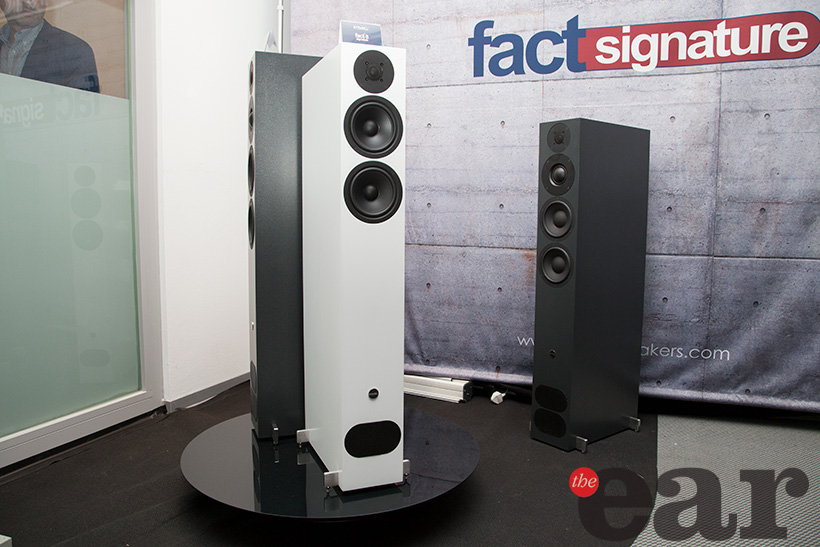
The Ear: Speaking of the fact series that still hasn’t got any vents on it with fins in (Laminair), isn’t it beginning to look a bit out of place in the range?
Oliver Thomas, PMC: You are the most frequent to ask this! As I said before, you’ve got to incorporate Laminair at the initial design stage, otherwise you’re not going to get any benefit from it.
The Ear: Does that mean that fact is not a hugely popular range so it’s not critical to bring in Laminair?
Oliver Thomas, PMC: It means this is potentially the next range that could be addressed.
The Ear: What is it? 10 years that you’ve had Laminair in products?
Oliver Thomas, PMC: Well, maybe, but I think anytime you wheel out a pair of fact 12s, they continue to surprise.
The Ear: Do the prophecy models come with grilles?
Oliver Thomas, PMC: Yes, this is the first time I’ve liked one of our products with grilles on. It’s a full-length one like the 20 series, but with a new fabric, which really sits well in all sorts of interiors.
The Ear: So, how would you sum up the changes that the prophecy range brings?
Oliver Thomas, PMC: Slim with a big sound, vivid soundstage, n-compass, Laminair X.
Jason Kennedy