

Cinnamon Galle DAC
Hi-fi shows are sadly not always the best places to audition audio gear, they are noisy and often cramped but fundamentally they rarely play the music you are familiar with at the right levels. At the recent Hi-Fi Show Deluxe the smaller of Boyer Audio’s dem rooms managed to contradict this impression by playing some interesting music at a sensible level via a system that didn’t cost more than a house, which at that particular event is a rarity.
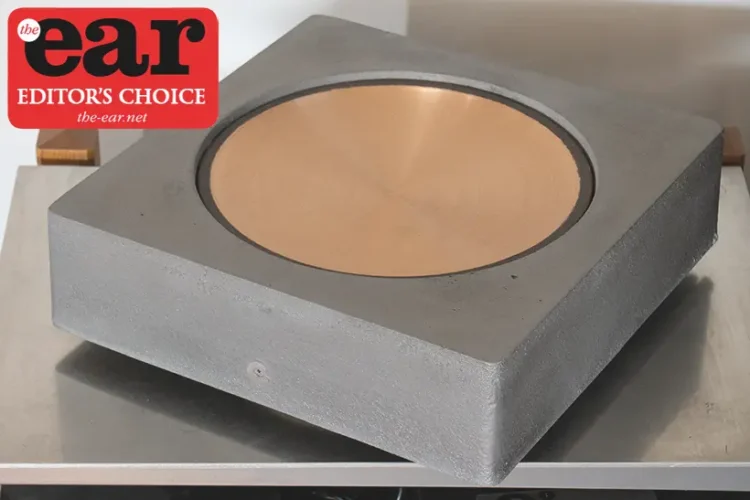
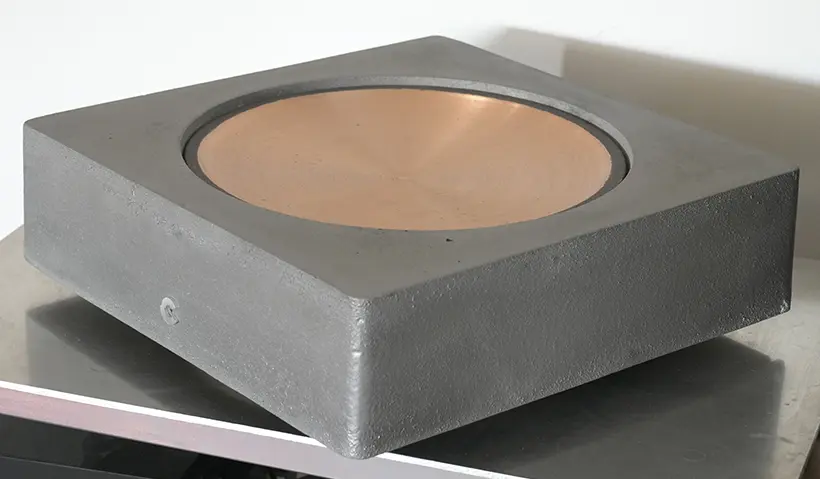
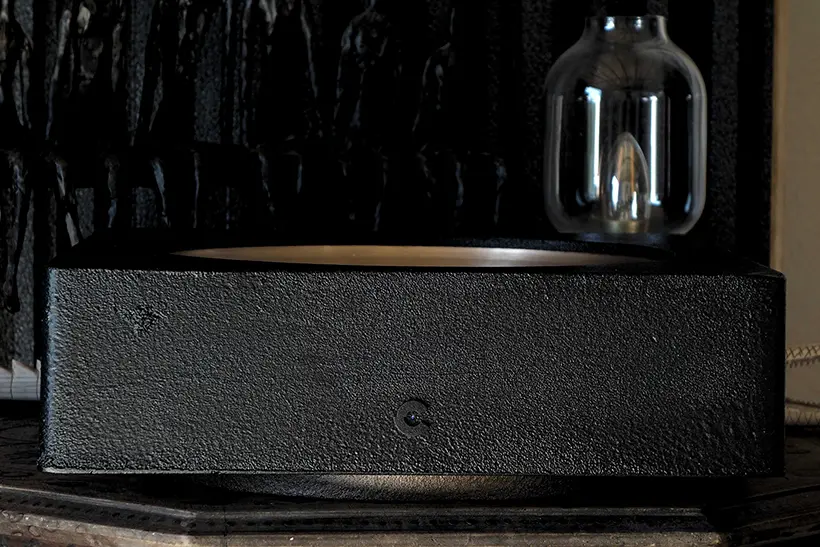
The system consisted of a Metronome Le Streamer, the Cinnamon Galle DAC, an Engstrom Arne tube amp and Kroma Atelier Thais speakers with power conditioning by Shunyata Research. This sounded very appealing but what caught my attention was the crudely cast nature of the Galle and the fact that it appeared to have a fruit bowl built into the top.
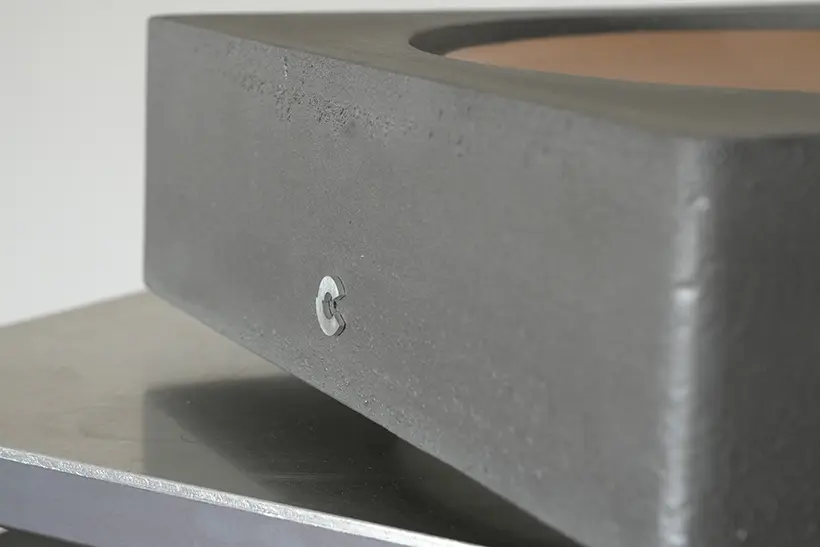
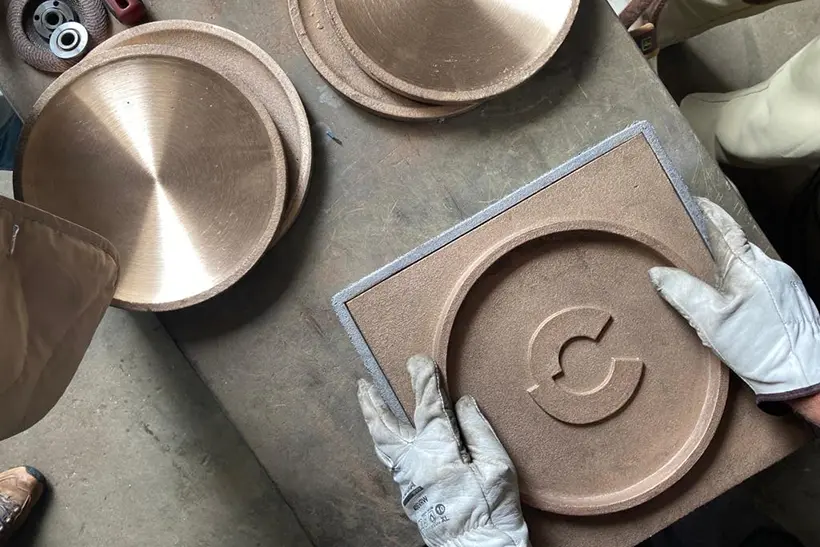
I later learned that Cinnamon is a Portuguese company that is particularly keen on casting casework in aluminium and bronze. They call the bronze bowl an inverted pendulum and damp it in order to minimise vibration in the Galle, feeling that the shape is particularly suited to this application. But one of the most appealing things about the Galle is the bronze base which has their large C logo cast into it and is designed to allow components in the series to stack atop one another, assuming that is you have a table that’s strong enough. The DAC weighs 22 kilos yet is only 35cm (13.7 inches) square, it is almost as dense as the sun and certainly more substantial than most of its ilk.
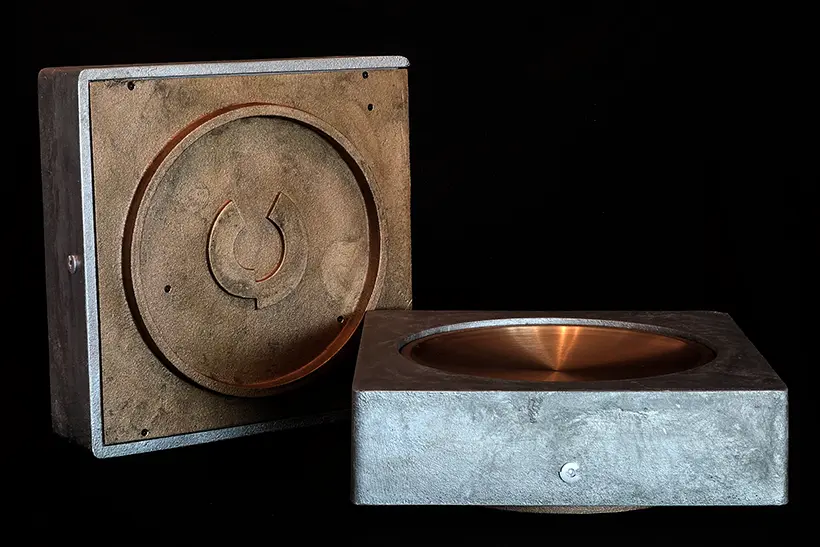
I imagine that the aesthetic is likely to be divisive but I love it and applaud architect Inês Moreira and designer Miguel Moreira of IM Collective who conceived it. Mass is not something usually found in digital to analogue converters and as a rule I prefer the sound of less rather than more aluminium but the results here would suggest that if you have enough bronze in a case it offsets such factors.
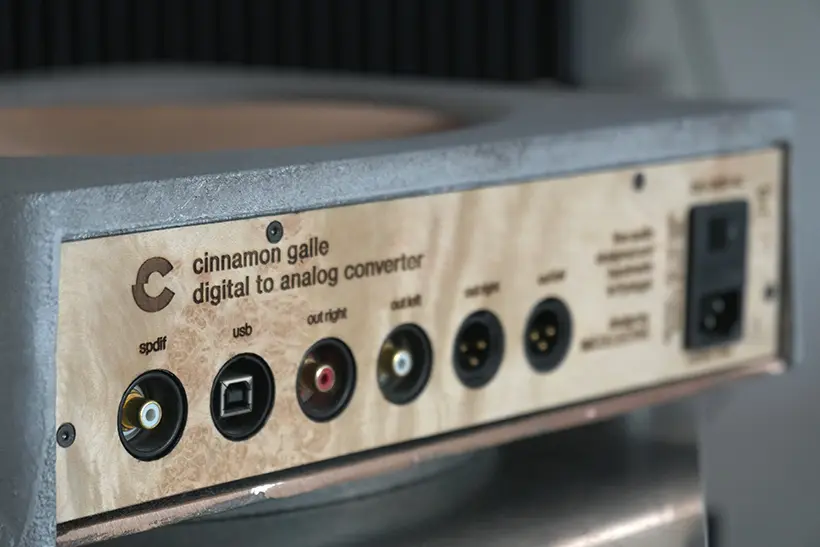
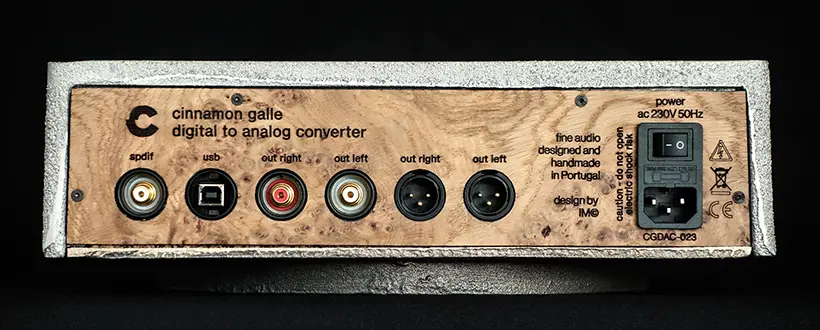
The unusual materials continue on the rear panel where you can choose from over 50 sustainably sourced wood veneers sealed with beeswax and oil. The inputs are limited to SPDIF coax and USB, it would have been nice to see an AES/EBU as well but these two are probably the most popular connections for digital audio today. You will note that there is no input selector on the Galle, you hear whatever is being fed to the DAC through either input. Apparently the coaxial connection takes precedence if both are live.
I’m told that the USB input is Cinnamon’s favourite, or should I say that of the brothers whose company it is, Ricardo and Diogo Canelas who work with local craftsmen to build these distinctive components near Lisbon. They also make loudspeakers which are considerably slicker in appearance and have an open baffle in design, but these too incorporate aluminium in their construction.
The actual converter inside the Galle is also a rarity, an R-2R discrete resistor ladder rather than a chip. This approach offers the engineer considerable flexibility in the design but increases cost. Cinnamon compares the popular approach of adding a custom analogue output stage to a DAC on a chip to seasoning a ready meal before serving and a bit of a cop out. As is often the case with ladder DACs they have opted to avoid oversampling but have achieved 27-bit resolution using 430 precision resistors.
Interestingly Cinnamon identified timing precision as being “paramount to achieving exceptional tone, spatiality, and inner detail”, which in my book is right on the money, timing is absolutely critical and the area where digital is often to be found wanting. There is no output stage within the Galle because the DAC produces sufficient voltage to drive the output on its own, which is not totally new but a path less well trod.
Sound quality
Despite its substantial mass the Galle is one of the most delicate and transparent converters I have had the pleasure of using, it’s almost as if the physical grounding provided by the casework allows the signal processing to disappear from the sound. High frequencies have long been the tonal weak point of digital audio, they are usually either rolled off to avoid inherent graininess or have a brittleness that sounds unnatural. This DAC manages to render highs in an extended and clear fashion that avoids these pitfalls, instead sounding open, natural and extended. This means that instruments and voices that occupy this end of the band are much more relaxed and realistic. If they are electric guitars or saxophones they have as much aggression as the artist intended but this isn’t exaggerated or embellished by any brightness in the DAC.
Ladder DACs are a little bit like the tube amps of the digital world, they don’t always measure perfectly yet manage to sound more musical and natural than their Sigma-Delta counterparts. This example doesn’t have any tube characteristics but does seem sweeter across the critical mids and highs whilst retaining a degree of precision that illuminates details. This is most obvious with the USB input which is more open and densely detailed than the coaxial, anyone looking to hear precisely what the tambourine player is adding to the mix will probably prefer this sound. Those of us looking for musical fluency might well prefer the coaxial option which is what I hooked up to my Network Acoustics’ power supplied Lumin U2 Mini streamer for the majority of the listening. I also included the Mutec MC3+ USB reclocker and the Ref10 Nano word clock that backs it up, as these are regular parts of the system.
They proved to be more than up to the task of revealing what the Cinnamon Galle is capable of when presented with a wide range of musical styles, which is a lot. Voices proved particularly powerful and several prompted an exclamation on my part along the lines of ‘wow’ and ‘damn’. One such was Terry Callier’s on his New Folk Sound album from the sixties, I used to play this to death and have heard it on a variety of excellent systems, but here it took on another dimension in the presence and reality stakes. The song Cotton Eye Joe was like a bolt from the blue, the sense of the man in the room was uncanny and the dark meaning of the song all the more prescient as a result. It was probably a valve powered recording in the first place and that helps the sense of naturalness and realism, but it has not been as powerful before.
Another example is Joan Osborne, I came across an early live performance on Youtube and discovered that it’s available on CD if not streaming platforms (Live in Hollywood, 1995). I ripped the disc to the Melco N10 server and was blown away by the emotional power that she injects into the song Pensacola, the intro alone is nothing short of extraordinary when presented with the clarity and even handedness of the Galle DAC. It more than brought a tear to my usually dry eyes, I must be going soft. On Bill Frisell’s version of It Should Have Happened a Long Time Ago (Small Town) I was surprised to hear the rumble of either traffic or an underground train at the start of the recording, this is very low in frequency and level yet the Galle picked it up alongside the beauty and genius of the performance.
When Angine de Poitrine’s Vol.II came out several people contacted me about it, I hadn’t heard them but these folks felt that I should. Their King Crimson esque microtonal guitar and drums has a certain appeal but the record is inevitably somewhat compressed, not so much that the Galle couldn’t deliver it in rather engaging style once one became accustomed to the intensity. This DAC isn’t just for great recordings, it seems to be able to open up all manner of music and clarify what’s going on and how it’s being achieved. It’s not analytical but does have a purity of tone, openness and clarity that eludes a lot of converters even at this price level.
I used the Galle with the all seeing ATC EL50 Anniversary speakers reviewed recently and it stood up to the high level of scrutiny they provide with ease, revealing the depth of tone in acoustic instruments and the scale of space in heavily reverberant environments, both real and constructed. I particularly enjoyed the physicality of instruments reproduced by the pairing, the acoustic ones inevitably being the more solid and lifelike. Drums and double bass frequently had the upper hand over electric instruments in the same mix because they imaged so strongly, but electronically generated bass really took the biscuit. Massive Attack’s Unfinished Sympathy being a superb case in point, here the low end really goes all the way down, but importantly, does not drown out the string arrangement that make this piece stand out.
Verdict
I asked Ricardo Canelas why his electronics are called Galle and was told that this comes from the fortress city of Galle in Sri Lanka, this was once an important source of cinnamon, a spice which Portugal sold to the world. Somehow I doubt that there was much cast aluminium or bronze involved in that trade but the Cinnamon Galle DAC is worthy of a worldwide audience. It’s aesthetics will not be to all tastes but I for one love the rough cast look nearly as much as I find its sound so beguiling, in a perfect world this DAC would stay in my system for good.
Pros
Exceptionally natural, transparent sound with superb high-frequency refinement
Outstanding vocal realism and emotional engagement
R-2R ladder design delivers musical, detailed, and non-fatiguing presentation
Excellent timing, clarity, and spatial detail
Reveals nuances even in complex or compressed recordings
Striking, distinctive design with high-quality materials (bronze/aluminium)
Strong, weighty construction with effective vibration control
Cons
Aesthetics won’t suit all tastes
Very heavy and compact – requires sturdy support
Limited inputs (no AES/EBU or optical)
No volume control or filter options
Premium pricing for a niche design approach