

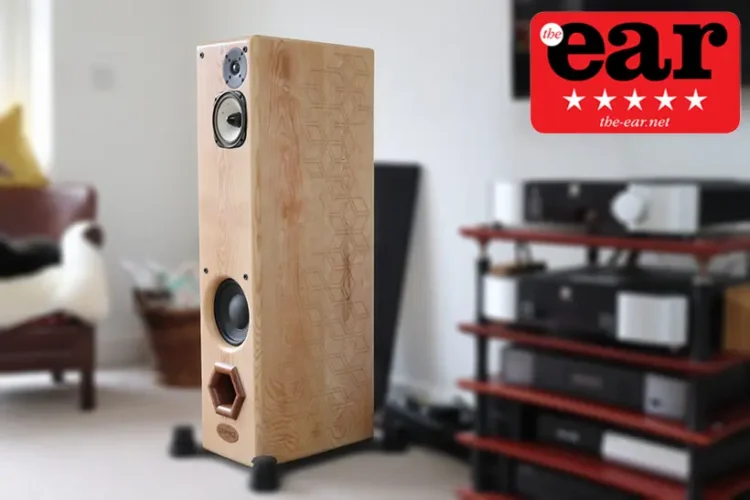
Coppice Audio BG3 speakers
I love writing about speakers made by boutique brands. These creations tend to be born of passion and a desire to create something truly individual. Coppice Audio is one such that has been making a name for itself among a select, but discerning band of music lovers in post-pandemic Britain. Their product portfolio includes racks and room treatment as well as a range of standmount, floorstanding and now modular speakers. The clue to what makes Coppice Audio different is in the name – they own around three acres of woodland, from which the wood used to build their products is felled, or coppiced.
Indeed, they can usually name the tree from which the timber used to produce a given product was felled. The brand is committed to sustainability and has access to tree surgeons who ensure that the wood felled from the donor trees is not wasted and that long-term damage is avoided. Occasionally, the wood will come from local trees off-site, which are felled due to necessity.
Coppice Audio consists of proprietor and cabinet maker Mal Hyde and music producer Ryan Morse, who is also a skilled carpenter and cabinetmaker. By Mal’s own admission, Ryan’s ability to detect small changes in a component’s performance during the design stage has enabled the brand to build products of a quality that surpasses Mal’s original expectations.

Every material, not least wood, resonates at certain frequencies, but the brand feels that ash wood is the most musical and uses it throughout their range of speakers. This choice is the result of many hours of testing different cabinet materials and, indeed, panel thickness. Throughout my email exchanges and chats with Mal, I was highly impressed with his depth of engineering knowledge, his enthusiasm for the performance of his products, and his commitment to sustainability—impressive stuff.
Design and build
The BG3 is a three-way, front ported design, it has a Scan-Speak D2608 tweeter, from the Danish brand’s Discovery range, and was selected for purely acoustic reasons. Coppice Audio felt that alternatives sounded sterile by comparison. The midrange is handled by a highly modified Lowther CM45CP, 5-inch driver. This driver was designed to be run full-range, but Coppice removes the whizzer cone, which would otherwise produce high frequencies, while the low frequencies are filtered at the crossover level. An 8-inch paper cone driver from Beyma delivers the bass, feeding a hexagonal wooden reflex port tuned to 27Hz. This configuration was chosen to allow placement close to a rear wall, although a gap of around 30cm is recommended.
The ‘s internal cabinet walls are lined with a 12.5mm layer of felt, and sheep’s wool is used to further damp vibrations. Coppice Audio tells me that wool was chosen because it is healthier to work with, environmentally friendly, and provides superior results to their ears. The crossover is a second order affair, with point-to-point wiring. Components include Mundorf resistors, Clarity CSA copper foil capacitors and Teflon-sleeved oxygen-free, four-nines copper cable.

I was fascinated by the engraved 3D cube design on the sides of the cabinet. It turns out the reasons for this extend beyond aesthetic effect. Engraving the 22m thick panel is intended to break up resonance, due to the variation in thickness. Beyond this, the cabinets benefit from internal bracing across several points. The supplied grilles are made with fairly thick material and, like most grilles, do tend to veil the high frequencies. This is a shame, as I think they significantly improve the look of the BG3. I tended to leave them on most of the time, only removing them for critical listening.
Songs from the wood
The BG3 replaced a pair of Oephi Transcendence 2.5s that I have been using for several weeks – the character of these two floorstanders could not be more different. The Danish speakers are all about reproducing the energy of the performance, which, if your system is up to it, delivers a thrilling ride. The BG3 creates a far more relaxed and often beautiful presentation of the music. This does not mean that the speaker lacks passion or dynamics, far from it. It is more the case that the top end is perhaps sweeter and softer than is strictly neutral.
Since the big Vitus RI101 Mk2 integrated amplifier that I’d been using all summer was collected a few days before these speakers arrived, my Moon 600i resumed amplification duties. This amplifier has a rich and slightly sweet presentation which matched the BG3 well. Having said that, I suspect that you could pair these speakers with a somewhat more forward-sounding amplifier if a bit more top-end bite were desired. Coppice Audio’s website states they are happy to tune the crossover to suit individual tastes, so it sounds like they’ve got this aspect covered.
I have heard Coppice Audio speakers several times now at shows, paired with Audio Detail valve amplification, and the results were both gorgeous and captivating. Their 90dB sensitivity (1W at 1m) means they require more juice than a flea-powered triode tube amp, still, they should really sing with most decent amplifiers that produce upwards of, say, 20 watts per channel, provided they have the current to handle the 6 ohm load.

I began with the BG3s set up in the position that suits most speakers in my room, which is about 30cm from the rear wall, 180cm apart, and toed in about 20 degrees. Coppice generally recommend the use of Isoacoustics Gaia feet, but I placed them upon my Townshend Podiums, which were used with the last few pairs of speakers I reviewed. Feeling something was missing, I gradually reduced the toe-in until they were firing straight ahead, at which point things snapped into place. While chatting with Mal of Coppice about this, he told me that it is pretty common in most rooms. Indeed, he said that in much larger rooms than mine, where the listening position is some distance from the speakers, that toeing them out can work well.
Sound quality
I found I could enjoy music from almost any genre, from classic rock to jazz and classical, as well as EDM and well-recorded pop music. They might not be my first choice for metal, perhaps, which tends to favour slightly more forward-sounding speakers. For example, with Spiritbox’s Tsunami Sea, which I regularly stream from Qobuz, the BG3 filled the room with a glorious, three-dimensional soundstage of enormous proportions. Still, the punch and impact were at times softer than ideal, unless I increased the volume to a much louder level than I typically listen at. Having said that, with most types of music, the BG3 remains remarkably balanced and transparent at lower levels.
Similarly, Rage Against The Machine’s Pistol Grip Pump, from a CD rip of their album Renegades, didn’t grab me quite as much as usual, giving a more analytical presentation than a gut-wrenching one. Again, Coppice Audio’s custom tweaks could no doubt tailor in a bit more bite and punch for those whose primary diet consists of hard rock and metal.
For those with more refined tastes, John Coltrane’s A Love Supreme (Qobuz DSD download) was a roaring success. One of the things these speakers excel at, which my long-term Totem Forest Signatures also get right, is the rare trick of reproducing the sensation of human hands moving over the strings of an instrument or the keys of a piano. This aspect of music reproduction is essential for a believable performance, and these speakers pull it off like few others I’ve lived with. ‘Trane’s sax is beautifully expressive here, yet without becoming piercing when he hits full flight, which can certainly happen with this album through lesser speakers.
Abbey Road may well be my favourite Beatles album, or at least it is when The White Album isn’t. The 2019 mix by Giles Martin (24/96 download) can sound somewhat hot in the high frequencies on some systems, but here I got a perfectly balanced presentation. The bass can often overwhelm things in my room yet the BG3s kept this track’s strong bass output under control and gave me a brilliantly tuneful, detailed and dynamic reproduction of Paul McCartney’s Rickenbacker, which he used for the first half of the album – he played a Fender Jazz on some of the tracks on that are on side two of the vinyl. The vocals throughout the album were positioned slightly further back in the soundstage than is usual in my room, but had a good sense of presence and plenty of space around them.

Dead Can Dance’s Into The Labyrinth was another roaring success through the BG3s. They did a particularly fine job with instrumental timbre and reproduced the texture of the analogue synths beautifully. Again, the vocals were a little further back in the soundstage than I usually hear, but they were wonderfully expressive and natural-sounding. I felt the BG3 informed me of the recorded acoustic as well as any other speakers I have recently played this album through, and there was no lack of detail – it’s simply that the detail was not thrown at me in the way that more forward-sounding designs can often do.
I have been streaming Hania Rani and Dobrawa Czocher’s Inner Symphonies via Qobuz rather a lot lately. It is an excellent recording, in 24/96. The BG3s capture the full atmosphere of the music and do an outstanding job of tracking small dynamic shifts. The soundstage is as seamless and three-dimensional as I have heard in my room. These speakers place instruments accurately within the soundstage, but not in a stencilled or hyper-focused manner. Both the piano and the violins sound as natural as I could wish for, with a beautiful sense of poise and drama.
Seeing the wood for the trees
Coppice Audio offers something that makes them unique in the marketplace: building speakers made from a known, sustainable source of cabinet material, specifically ash wood. Thankfully, a good dose of engineering and scientific know-how goes into the design of their speakers, resulting in a uniquely enjoyable package.

The tonal balance of the BG3s is more laid back than most, but they can certainly kick when provoked. And they can sound weighty, dynamic, and detailed at remarkably low volume levels which is not something you often find. However, if you want that last bit of bite and top-end definition, you may need to increase the volume, depending on the balance of the rest of your system. Thankfully, though, the BG3s remained remarkably composed, no matter how hard I pushed them. Having said that, to satisfy my personal preferences and with my current system and room, I would spec BG3s with slightly more high-frequency output than that of the review pair.
Obtaining this level of performance with speakers from a more established brand would cost considerably more than Coppice’s £7,995 asking price. Purchasing direct from the manufacturer may involve travelling if you are not local, but doing so could well be worth the trip, as it allows you to discuss your exact requirements with the designer, who can fine-tune the balance to suit your room and system.
Make no mistake, the Coppice Audio BG3s can deliver musical performances like few others. Couple this with a unique manufacturing and buying process, and you have a package which will win over many and provide a lifetime of musical satisfaction.