

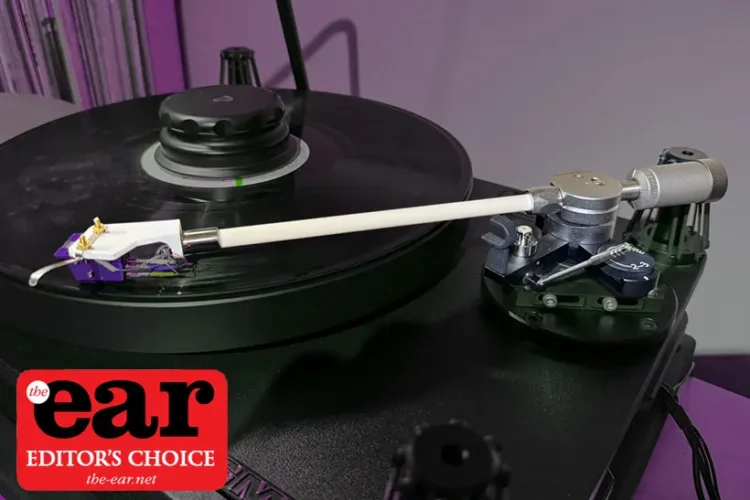
Korf TA-AF9 Series II tonearm
Korf tonearms aren’t that well known. But just because they don’t have a following going back years doesn’t mean they need time to get things right. Alexey Korf has built an arm with a reputation which deserves attention, and has built a very strong following, and in relatively short order.
By taking a very fresh approach to tonearm design, materials technology, and extensive listening and evaluation processes Korf has produced a small almost bespoke range of tonearms which really do cut the mustard.
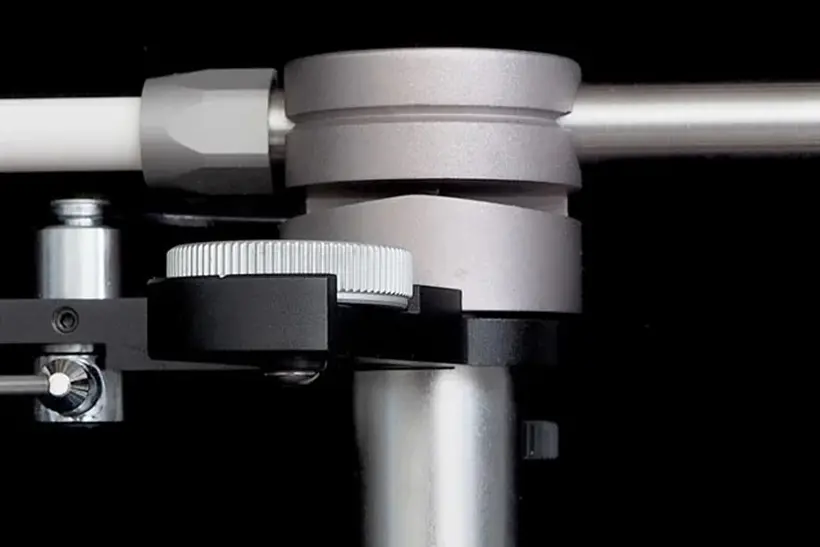
Starting with a radical departure from the norm, Korf (manufactured in Austria) have opted for a flexure bearing which is frictionless, extremely long lasting, and has repeatable but what might be termed fixed-point angular travel. The encapsulated design was patented over 60 years ago and is available through Riverhawk, a company specialising in this technology.
The result is a chatter-free, high precision bearing which provides a superbly stable movement point around which the arm can rotate (in the vertical plane). The horizontal movement is managed by two sets of ceramic high precision, high tolerance bearings which are very widely spaced, giving the main rotational pivot immense rigidity yet still allowing free movement. Again, the wide spacing reduces bearing chatter to such a low level you’d be hard-pushed to find it.
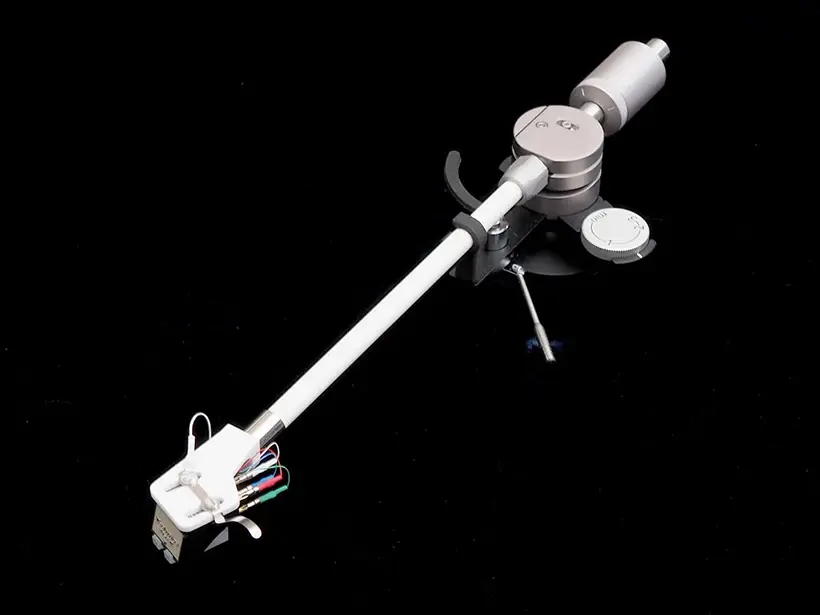
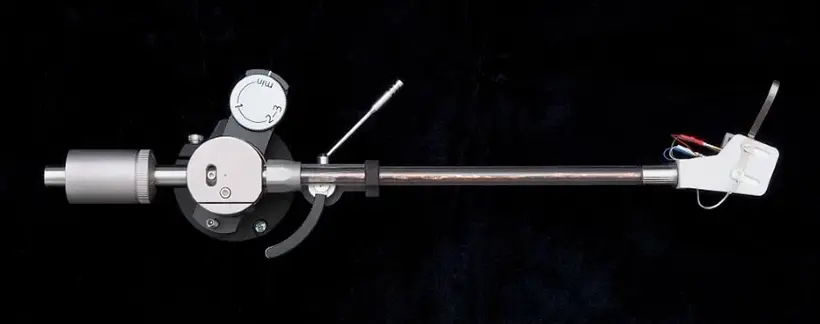
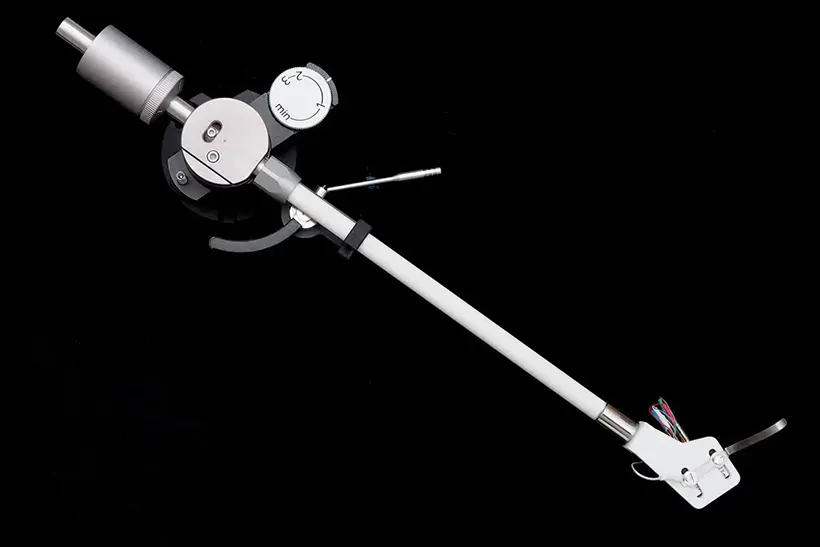
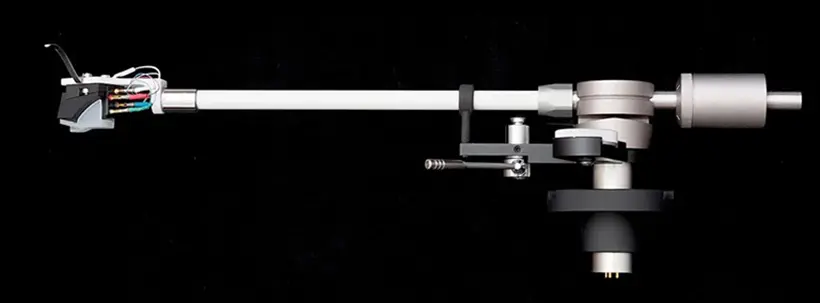
Ceramic components feature heavily in the arm’s manufacture, and both the arm tube and the headshell are also lightweight high strength ceramic with the majority of the rest of the arm being brass or high spec stainless steel. Only non structural parts are aluminium.
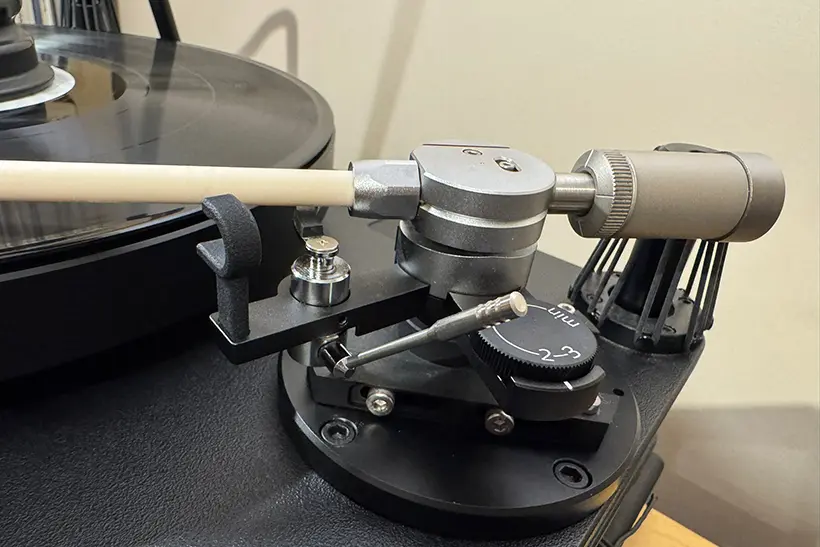
In order to keep mechanical noise to a minimum the TA-AF9’s anti-skate is magnetic and very easy to set. Azimuth is adjustable via a grub screw on the top of the main bearing/arm housing, and arm height (VTA) adjustable via a key locking screw in the base, but also a screw-thread adjuster where you can raise and lower the arm until the setting is correct, before locking it in place with a hex key. What might at first glance appear to be a simple arm is, in fact, the result of many hours of research, listening and sophisticated engineering know-how.
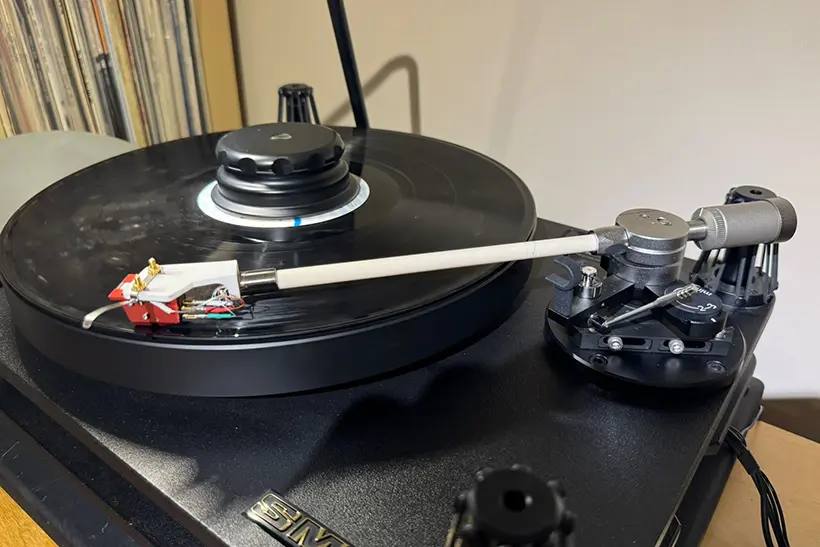
Fitting and setting up the arm took quite a while. Not because it’s difficult – it isn’t, but because I wanted to get it set up as well as could possibly be. After all, its hardly fair to (metaphorically) throw it onto any old turntable, stick a cartridge on the end and hope for the best.
I should also point out that more than one cartridge was used during the listening, ranging from a very venerable (old) Tannoy Vari-Twin through to an Audio Note Io, an Audio Technica AT-ART9Xi, an Ortofon OM40 and a Soundsmith. Listening results are the summation of all the hours spent enjoying this arm (bit of a clue there), and a testament to my long-suffering wife who heard some of the music more times than she’d have really wanted to.
Sound quality
First impressions were of a very dynamic, poised, delightfully detailed but relaxed presentation. There was a stability about the presentation which locked everything firmly in place. Not rigidly (otherwise the ebb and flow of the music wouldn’t have happened) but with a presence that let you know in no uncertain terms it’s OK; I’ve got this.
Having said that, the arm allowed the music through with an ease, a refinement, a sense of being there, and a refreshingly natural presentation of dynamic contrasts. Some arms – a bit like TV sound – lack that visceral punch. They can do loud, they can do quiet, but the transition between the two seems to leave me short changed. Not so here, so the materials choice is obviously one which bears fruit in presenting dynamic contrasts in a natural and real-world sort of way.
As my other reader may tell you, one of my oft-used scene setters is the (now very old) record A Journey into Stereo Sound. I’m one of those who first landed on this earth when the Romans were in occupation, so my experience of steam trains goes a long way back. The slam of the carriage doors, and the shrill of the engines whistle remains with me to this day. Others, not so long in the tooth, can enjoy similar experiences at a local heritage railway.
Anyway, the opening track on this particular disc (PS100, London) is that very scene. The chuffing engine, the shrill of the guard’s whistle followed by the hurried slamming of carriage doors prior to the train pulling out, all set an aural scene with alarming naturalness and believability.
The thing which struck me most when playing this using the Korf TA-AF9 was the amount of low energy thump when the doors closed, and then the low rumble as the engine started to move. It was a case of close your eyes and you could smell the coal, it really was astonishingly realistic, and for the arm to support the cartridge to track the energy in the recording, yet still retain the soundscape, the aural image and the presence of those few moments was something quite unique.
I moved on to some jazz. Oscar Peterson’s We Get Requests on an original Verve (V-8606). Deep grooves, well played, but those grooves contain a whole lotta music. Cut slightly hot, the upper treble on the piano could sometimes upset a lesser arm, but the TA-AF9 didn’t turn a hair. In fact there seemed to be more detail, more poise and more music in the way that the performance came across. And yet this detail wasn’t fatiguing, and there was almost a relief at what I must have been missing up to now. The insight, the connection to the music, and the way in which Peterson nearly sings along with himself is quite mesmerising. I have rarely felt quite as engaged (though I love the album) as I did with the Korf in control of the cartridge.
The other nice thing about the TA-AF9 is that despite the grooves having had many a stylus sweep along them (and they’re a bit worn and noisy by now) the noise floor seemed to be much lower than I remembered. The Tannoy really sounded good playing this (its from that era) but the OM40 also did a creditable job, with perhaps a little more top end owing to the finer stylus profile. Yet, different styli do sound different, and with the TA-AF9 you can hear the difference.
A diversion into London Grammar (Truth is a Beautiful Thing) followed, and here the contrast was between the soaring vocals and deep almost subterranean supporting bass in the title track. Yes it was there. It was deep. It was unwavering, and no it didn’t upset the rest of the replay either. You have to remember you’re not only asking the arm to support the cartridge in the groove (to extract the musical information unsullied), but with a track like this you’re also asking the amplifier to remain absolutely stable (hence the need for a good power supply) and also have a really clean signal path so things don’t get confused. I know the amp and speakers are up to the task, so the arbiter was whether the arm could do its job.
Absolutely. No question. In fact the bass was so rock steady that the vocals assumed an almost ethereal aspect, soaring, hovering, wailing (that’s not meant to be an unkind comment by the way) but putting a rock-solid foundation underneath the main business of the track.
Something more complicated was needed to test the TA-AF9. Delius’ Mass of Life (SB-3781) was pressed into service. Double choir, full orchestra, soloists, and the conductor who knew a lot of Delius’ music first hand, Charles Groves. If anything was likely to challenge the TA-AF9’s ability to resolve detail whilst remaining focussed and poised, this was likely to be it. There are antiphonal passages, sudden crescendi, quiet moments, soloists carefully spaced during the proceedings, and when everything is going full bore the opportunity for the front end to lose its grip.
Well, the only time that happened was with the Tannoy in situ. Its compliance and stylus profile come from an earlier age, and there was some slight mistracking, but to be perfectly honest I’d expected it to perform far less well than it did. As for the modern cartridges playing a modern groove profile, all was supported in such a way that there was no mistracking, and the differences between the cartridges were clear to hear.
Perhaps the most open was the Io, but the AT came a close second, and not far behind that, with a slightly warmer presentation was the OM40. It was very, very close, and in the context of different systems which one you’d choose might well be different. My preference would probably be the AT as it had just a tad more warmth than the Io and still seemed to have the dynamic contrasts for which the Io is famed.
No listening would be complete without some female vocal. That and piano are perhaps the two hardest things to reproduce well in a home music system, perhaps because they are sounds which we hear so often, and are so very familiar to us. Get those right (some say) and the rest will follow naturally. Well, I’ve done it all back to front so here they are. Diana Krall has one of the sultriest voices on the market and along with a piano accompaniment gives us the choice of some close-miked recordings with oodles of presence and detail in bucket-loads. How did the TA-AF9 do?
It was like she was in the room. Stepping Out (Just-50-1) has a number of wonderful tracks, but for me the stand-out has to be Between the Devil and the Deep Blue Sea. Turn the lights down low, close your eyes, set the volume appropriately and you really could be sitting by the piano as Diana plays and sings her heart out. The other tracks on the album are equally good sonically, but for me (at a time when I felt the need for some companionable solace) that particular track hit (and continues to hit) an emotionally resonant chord, and does so to this day.
Conclusion
As I mentioned at the start, many many hours went into auditioning the TA-AF9 arm, with a variety of cartridges, but the rest of the system and the turntable particularly remained the same. If I was to try and sum up what the Korf TA-AF9 does in a few words I’d fail dismally. As it is this review has been cut down because, although there’s much more to say, the majority would simply be expanding on the facets I’ve tried to touch on here.
It has poise, an elegant but responsive ability to play anything the cartridge is presented with without fuss, with accuracy, with enjoyment, with an absolute ability to provide an amazingly robust, resilient and stable platform for the cartridge is undeniable.
But where the TA-AF9 really scores is that it consistently allows the music and the emotional content of the music to shine through. In some ways, even if the background noise is high, if the emotional content and subject matter are engaging enough you might put up with it, but the replay here is possibly the best I have come across in the context of my system. There is no noise and the arm has that uncanny ability to present you, the listener, with enviable musical performances in your home time after time after time.
It’s unfussy with regard to genre. Its unfussy with regard to cartridge (the Tannoy weighs a ton, the OM40 next to nothing), and it performs consistently in every respect. It’s absolutely not the lowest common denominator, and absolutely the bringer of performance to vinyl replay in every respect. Highly recommended.
Pros
Exceptionally stable and precise tracking thanks to innovative flexure bearing design
Very low mechanical noise and minimal bearing chatter
Highly detailed yet relaxed, natural sound presentation
Excellent dynamic contrast with seamless transitions from quiet to loud passages
Strong, controlled bass with impressive solidity and depth
Wide compatibility with a variety of cartridges, from vintage to modern
Low perceived surface noise, even on worn records
Superb imaging and soundstage stability with convincing realism
High-quality materials (ceramic, brass, stainless steel) enhance rigidity and performance
Magnetic anti-skate and adjustable VTA/azimuth allow fine setup control
Engaging, musical performance with strong emotional connection
Cons
Relatively unknown brand may deter some buyers
Setup can be time-consuming if aiming for optimal performance
Requires a high-quality supporting system to fully appreciate its capabilities
Flexure bearing design may be unfamiliar to traditionalists
Performance differences between cartridges may expose weaknesses elsewhere in the system