

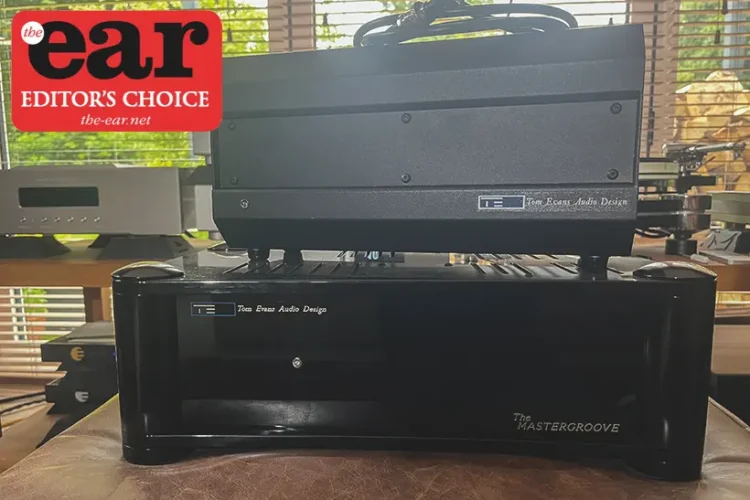
Tom Evans Audio Design Mastergroove SR Mk4 phono stage
In the rarefied atmosphere inhaled by hard-core vinyl enthusiasts such as the Ear Editor Jason Kennedy, the phono stages made by maverick Welsh Valleys designer Tom Evans are seen as the stuff of aspiration, of legend even.
The company’s flagship Mastergroove phono stage, the SR Mk4, has an aesthetic that speaks of small workshop production, but we should not underestimate it or the engineer that designed it. Fans of Evans-the-solder know something. The Tom Evans Design brand is less about what the eye sees, more about what the ear hears.
Evans has an unusually broad background of engineering experience having worked in the defence sector, for some of the largest names in consumer electronics, and for high-end audio brands. His facility in Wales is equipped with the usual battery of precision test and measurement equipment, but when it comes to manufacture there’s no flow-soldering machine or any other kind of automation in sight.
Components are painstakingly tested and selected, circuit boards are populated by hand, soldered by hand and wired together point-to-point, then assembled by the same human being into a chassis that is instantly recognisable by the cognoscenti as a Tom Evans product. It’s about as personal as high-end audio gets without being fully bespoke. There are few economies of scale; just a lot of man-hours, and Evans charges accordingly. The Mastergroove SR has a current retail price of £25,000, yet it seems there is no shortage of customers. Since 2014 when the first version of the Mastergroove was launched, Evans says some 70 have been sold worldwide.
Controversy
I was loaned the Mastergroove by Siropas Rangphet of Winters Audio. Rangphet – he prefers us to call him simply Ob – describes himself as an audiophile who owns a dealership merely to satiate his craving for quality music reproduction. That sounds like a self-deprecating joke, but there’s a large element of truth within it. The Mastergroove is part of a large collection of stuff, but one of the few items he owns that gets used almost every day.
He and I had been talking about the recent emergence of a very small group of DACs – some of them eye-wateringly expensive – that we feel achieve a reproduction quality that eclipses that of analogue master tape. We both own Master Fidelity NADAC 1-bit DACs and clocks, and both of us consider the NADAC to be, while not the most-costly of that new generation of digital converters, almost certainly the best of them from a sonic perspective. The question we had both been independently mulling is, when trickle-down eventually happens and the technology becomes more affordable, will it kill vinyl?
Neither of us thought that would happen overnight. We agreed that people interested in contemporary performances (almost all recordings are now digital) can make a rational decision, based on sonic quality, to avoid vinyl and go digital from the off. However, those with existing vinyl collections will still require something with which to play them, so statement phono stages such as the Mastergroove SR will remain relevant for the foreseeable future. At that point in the conversation Ob said: “You should try my Mastergroove. It’s the best phono stage I’ve heard. See what you think. I’ll send it to you.”
Zero error
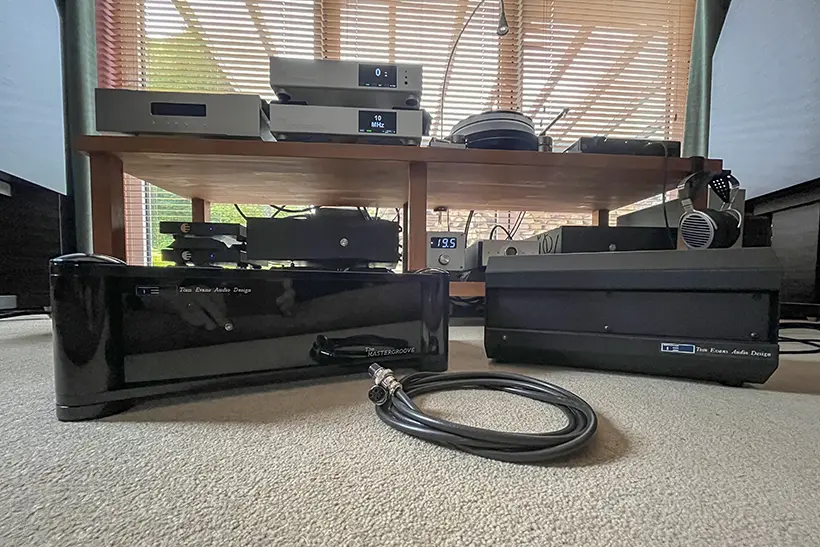
The Mastergroove SR Mk4 is a two-box-affair; the larger being the phono preamplifier itself, the smaller of the two the power supply. While a lot of manufacturers clearly take a pragmatic view and don’t allow perfection to be the enemy of good enough, Evans says he wanted his flagship design to achieve the lowest noise and widest dynamic range possible. To that end, the Mastergroove SR makes extensive (and expensive!) use of his proprietary series regulation circuit, Lithos, which incorporates op-amps selected for ‘zero-error’. They are run in Class A to achieve an ultra-fast, ultra-low ripple and noise supply of voltage for the functional circuits. The Mastergroove’s RIAA equalisation is a passive array with, says Evans, an accuracy of 0.1dB over 20Hz to 30kHz. That’s state-of-the-art, but is matched by some of the alternatives.
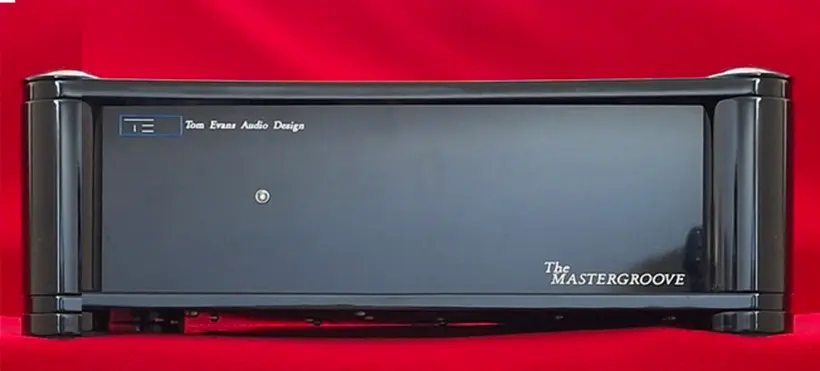
The chassis of the phono stage avoids the Faraday cage effect by being fabricated from gloss black 10mm thick acrylic panels which slot into gloss black metal pillars at each corner. There are no visible fixings. The power supply is a rather more utilitarian combination of folded metal panels and visible screw heads, but Evans intends it to be tucked away out of sight behind the kit table, removed as far from the phono stage as the supplied umbilical cord will allow in order to minimise the effects of EMI radiation.
Loading options
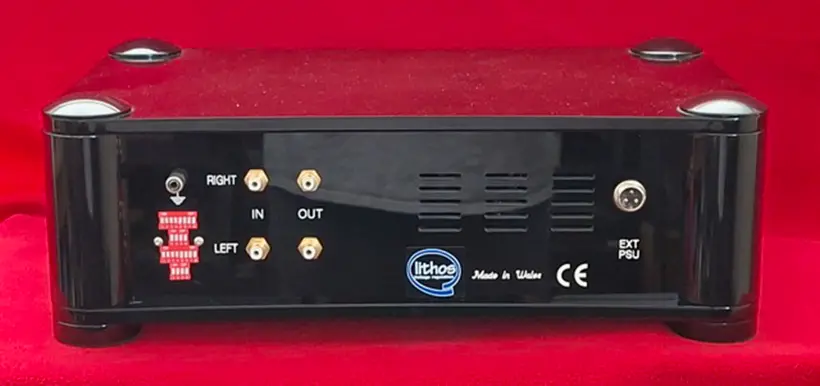
Cartridge loading resistance and capacitance can be adjusted on the fly via two banks of DIP switches on the rear panel of the phono stage, but gain is fixed and has to be specified at the time of ordering. The review unit, which had been ordered by Ob with RCA outputs only, rather than the normal fit of RCA and XLR, was set to deliver 80dBs of gain, suitable for his favourite cartridges, their outputs of between 0.1 and 0.2mV resulting in a peak phono stage output of 1.5 volts.
Evans didn’t have further measurements for that exact gain setting but said that in a unit set up for 0.3mV cartridges he would expect to see around 0.25mV of peak noise at the output terminals. He noted: “Considering the huge gain with an output of around 1.5 volt of signal measured in a 100kHz signal bandwidth (unweighted), the SNR is fairly low at minus 75.56dB. It would be better still if we measured across a 20kHz (weighted) signal bandwidth as others do, but I feel that would be a little misleading, don’t you?”
It is what it is
Given that Evans says the Mastergroove is exceptionally quiet and has the greatest dynamic range of any phono stage, why he doesn’t measure the same parameters as much of the rest of the audio industry so that buyers can make an easier apples-for-apples comparison is for him to know. However, he’s right that the variables at play here do make comparisons problematic. There’s the gain setting, the fact that unweighted measurements present between 4 and 6dB better than A-weighted, and whether the measurement is taken just over a 20kHz bandwidth, or the full bandwidth of the phono stage. Change any of those and the resulting SNR figure goes up or down. Is the Mastergroove really the quietest phono stage we can buy? Whatever the reality, as some like to say these days, it is what it is.
I used the review sample with my Soundsmith Paua II cartridge with an output of 0.4mV and a loading preference of 470 Ohms or greater. Evans said that the Mastergroove’s fixed 80dB gain was higher than he would recommend for that cartridge’s output (67-70dB would be preferable) but it was close enough for him to be happy for the review to go ahead and would result in the phono stage having a peak output 0.3V higher than normal.
Sound quality
The Paua II is hung on an Origin Live Agile tonearm, mounted on an Origin Live Sovereign S turntable. The first impression on listening to this familiar combination via the Mastergroove SR Mk4 was that Evans’ flagship design certainly does things that only certain phono stages in the top-tier do. The Mastergroove’s wide bandwidth of 100kHz – notable but not exceptional in its class – coupled to the low noise floor, allows recorded spatial information to bloom between, behind and either side of the speakers, anchored in space by strong phase accuracy across the audio bandwidth.
The Mastergroove SR Mk4 also spotlights differences in recording and pressing quality in a way that some might find hard to cope with. Vinyl spinning sessions become a roller coaster ride that oscillates between joyful head-nodding and teeth-grating discomfort as we learn how shockingly variable in quality our record collection actually is. That’s absolutely not to suggest the Mastergroove doesn’t deliver musical enjoyment, just that we need to strap in tight because it reveals so much of what lesser alternatives miss; we hear tracks with the good and the bad both laid bare, without any Vaseline on the lens, or without sugar coating if you prefer.
The Mastergroove’s a dynamic agility detail meister right enough, but it also delivers a highly satisfactory and even balance of the other essential qualities that bring us ‘closer to live’ that I wrote about on The Ear a few years ago, the most important of them being dynamic expression. I have yet to meet an audio manufacturer that doesn’t claim to be aiming at replication of the live experience, yet in many cases it’s clearly just something they think we want to hear them say, rather than a genuine expression of informed engineering intent. A minute or so spent listening to their products tells us that dynamic expression is weak, either because the designer never attends live music events and therefore doesn’t understand the critical role it plays, or is clueless about how to engineer for it.
Tom Evans is most certainly in neither category – the Mastergroove SR Mk4 signals this very clearly by delivering a remarkably large helping of dynamic expression that makes listening to good recordings a real transport of delight, so vividly dynamic and natural is the reproduction. A large part of this is undoubtedly down to the speed and muscularity with which his power supply and those fancy regulator circuits react to musical transients. At the same time, the noise floor – whatever it might measure – is low enough for us to hear even really subtle musical events in their entirety so that they start and stop within the linear passage of time at the points the musicians actually played them. That will no doubt please buyers who live in the parallel universe where timing is still the only musical quality worth noting. Rounding out the Mastergroove’s abilities is a retrieval of tonal and textural detail right up there among the best I have yet heard.
Conclusion
Ob left me alone for a few days or so after the courier had delivered the Mastergroove, then a message pinged in. “Well. What do you think?” That’s a good question given that we are talking about a phono stage that costs more than a small car. Having lived with it in the review system for two weeks, I came to regard the Mastergroove SR Mk4 with a healthy degree of respect. I would not say that it is subjectively any quieter than some others in a select group of high-end phono stages, and from a tonal, textural, spatial and timing perspective it is similarly among the leaders. What makes it notable – the tallest poppy in the field if you like – is the deep well of dynamic expression that it draws from, and which enables it to re-define what ‘closer to live’ actually means in the context of vinyl replay.
Because of that, the Mastergroove SR Mk4 is a worthy flagship for Tom Evans Design.
Pros
Exceptional dynamic expression and realism
Outstanding detail retrieval and low-noise performance
Expansive, holographic soundstage with excellent spatial accuracy
Reveals recording nuances with remarkable transparency
Superb build quality with meticulous hand-crafted design
Cons
Ruthlessly exposes poor recordings and pressings
Fixed gain must be specified at purchase
Atypical measurements may make comparisons difficult
Industrial aesthetics of power supply may not suit all tastes