


Michell Revolv turntable, arm & cartridge
The Michell Revolv is a belt driven, unsuspended turntable. Nothing about this bare bones description is remotely novel; it’s the type standard for most turntables hitting the market in 2026 and a formula that is capable of great results. Where the novelty creeps in is the existence of the Revolv itself. Prior to its announcement in late 2025, the most recently released Michell turntable was the Tecnodec which appeared in 2003. Even without any novelties inherent to its design, the Revolv is a very big deal.
Of course, the Revolv didn’t launch on its own. The new Gyro is no less a clean sheet design than the Revolv but its name and iconic appearance lends it a degree of protection that its little brother is not afforded. This is the first visibly new Michell turntable in over two decades and with that comes both a weight of expectation and a degree of trepidation. This only increases when you realise that, with a starting price of £3,995 less tonearm (we’ll circle back to this in a bit), the Revolv is actually closer to an original Gyro SE replacement than the new Gyro is. No pressure then.

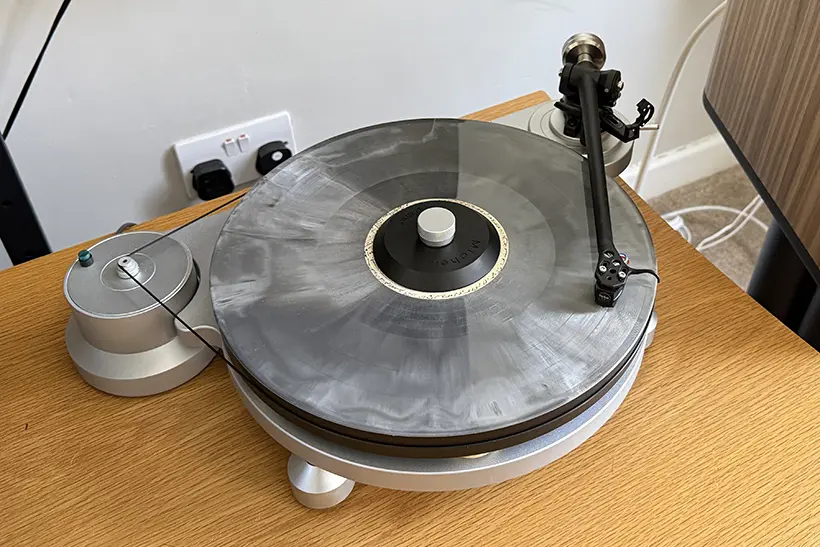
The Revolv looks for all the world like the result of an amorously inclined Tecnodec and Gyro and a broom cupboard but actually breaking down which parts are closer to which ancestor is harder than it might first appear. The appearance is closer to the Tecnodec; itself a distillation of the earlier Syncro. The main chassis is a single section that mounts the bearing and the armboard. Where the Tecnodec uses acrylic for this, the Revolv is machined from a single section of 19mm aluminium in the manner of a Gyro and is a considerably heftier device.
This supports an example of the Michell self lubricating helix bearing which uses the Archimedes screw principle to draw oil up from a well at the bottom. This is a single helix type rather than the double helix version that the Gyro gets but it’s still a usefully fit and forget item. The chassis then sits on three feet that are visibly derived from the ones on the Tecnodec. Each metal foot incorporates six bespoke Sorbothane damping nodes to isolate the turntable from external vibration. These feet can be used to level the Revolv and this means they also detach, potentially opening the door to alternative options in the future.

On the left hand side of the chassis is a crescent shaped alcove that signposts where the motor should sit. This motor is extremely similar (if not actively identical) to the one used on the Gyro. It takes power from a separate regulated PSU that is grounded and electromagnetically shielded to prevent interference. Clearly borrowing from the thinking that went into the Apollo and Muse phono stage and PSU, the power supply unit makes use of the same clamshell design and is extremely solid. The PSU includes an electronic speed control but the start/stop is still a button on the motor itself. The motor should be placed inside the crescent but without making physical contact with the chassis itself.
The platter that the motor drives is made of Delrin and is now flat sided with no indent for the belt as this allows the belt to self level after a few turns. The underside of the platter features cut down versions of the brass weights that have marked the Gyrodec out for the bulk of its existence. Michell studiously notes that these give the platter extra mass and subsequently more momentum when spinning, which serves to greatly improve speed stability and keep wow and flutter to ultra low levels, but in a way this is their secondary function. What they also do is make the Revolv a Michell turntable at a glance and give it an utterly hypnotic effect as it rotates.

This platter is topped by an example of the Michell unthreaded clamp and, after two weeks of using the Revolv on heavy rotation, it hasn’t changed my feelings toward it one iota. It is unquestionably beneficial to the performance of the Michell but it’s a bit of a pig to actually use, you needs to stop the deck to change sides and this breaks the flow of listening to records. I have found myself using a Stack Audio Serene stabliser on more than a few occasions because it is so much simpler to fit and remove.
The basic £3,995 list price of the Revolv doesn’t include an arm. Michell can sell it pre fitted with the T2 tonearm which seems to be an evolution of the Rega RB220, the T8 tonearm (a largely ‘as is’ Rega RB880) or their Tecnoarm 2 which is a more extensively modified Rega unit. Where the Revolv differs from many key rivals is that you don’t have to limit yourself to these options. Any Rega mount arm will fit but you can also specify an SME mount or order other fittings from Michell. This makes the Revolv more flexible than arch rivals from Rega and Vertere. If you want to build your turntable with fastidiousness of a jedi building a lightsabre, you can.

Equally, if you want your Revolv to turn up in a box with all the bits you need and a high likelihood that those bits will play nicely together, you can do that too. This example showed up with the RB880 and Michell’s Cusis E/H high output moving coil cartridge for an all up price of £5,595. This is fractionally more than a Rega Planar 10 pre fitted with an Apheta 3 moving coil and between the price points of the Vertere DG-X fitted with the Sabre and Dark Sabre cart respectively. You can be pretty sure that this wasn’t an accident either.
We’ll talk about the sonic differences in due course but it’s worth saying from the outset that the Revolv feels different to these two rivals. The greater use of metal means it comes across as more substantial and ‘old school’ when you interact with it. The standard of build and finish is exemplary and this has unquestionably helped with my feelings toward the looks. When I attended the launch, I had a bit of a downer on it and pegged it as a burlier Tecnodec. In use, the effect is far more ‘Gyro Lite’ and something that does a good job of feeling worth the asking price.

Sound quality
Of course, this perception has been helped by the small matter of how it sounds too. I have lived with a Gyrodec for nearly twenty years (and the deck itself is older as I am the third owner). The idea was that, when I purchased a Vertere MG-1 MkII, it would be sold on but, as this felt rather like shooting a family pet in the face, it instead lives in a state of semi retirement at the end of the rack (the ‘semi’ being needed because I used it with the Audio Origami PU8 arm reviewed on this site and it still assists with phono stage testing). I couldn’t part with it because it does certain things sublimely well and, crucially, the Revolv does the same.
What this translates to in the bluntest possible sense is that the Revolv operates in widescreen. It generates a stereo image that effortlessly and consistently expands beyond the location of the speakers and creates an airiness that makes even some breathtakingly talented rivals feel slightly hemmed in. What’s important about this is that it’s never disruptive to small scale material. Mark Holliss’ solo effort of the same name is famously one of the most intimate albums ever created but it still benefits from the Revolv injecting airiness into these delicate performances.

This is also the first time I’ve spent any time with the high output version of the Cusis but, reading back through my notes of the low output version of the E, it has kept the same admirable qualities. Michell is at pains to stress that the aim of the design is to be studiously neutral but it doesn’t prevent it from being extremely engaging. The Live album by My Baby (actually a group studio recording but still an absolute riot to listen to) is delivered with all the musicianship and out and out joy that this recording offers. You can reasonably argue that both the Rega Nd9 and indeed the Apheta 3 that the Planar 10 ships with can find a little more detail in recordings but, unless you are listening side by side, you’re unlikely to pick up on it.
What you will pick up on is that the Revolv has truly outstanding bass performance. Cards on the table; side by side tests with the Gyrodec suggests that even with the older deck benefitting from an arm that costs more than this complete Revolv package does on its own, the latter picks out a better bass line, finding both depth and definition that the older deck cannot. Given that my Gyro, thanks to a series of effective but somewhat unattractive modifications, has better bass than a standard original pattern Gyro, this does suggest that the Revolv hits harder than its illustrious ancestor. People able to lay their hands on an SME 309 for their Revolv, no small undertaking in 2026, could be in possession of some of the best analogue bass under £10k.

So, it’s better than those ever present rivals then? Here’s where everything gets complicated, subjective and, frankly, a bit messy. I am reasonably confident that were the editor to be parked in front of a Revolv in this spec side by side with a Planar 10, he’d choose the Rega. Equally, I am confident that were Chris Kelly, also of this parish, to be put in front of one and a Vertere DG-X; a turntable he liked enough to buy with his own money, he’d stick with the DG-X. The Revolv neither has the startling immediacy of the Planar 10 or the utterly imperious ability to get out of the way of proceedings that the Vertere does.
As the inveterate hoarder who has access to a Planar 10, loved the DG-X (and owns an MG-1 MkII) and who failed to part with a Gyro, I suspect it falls to me to try and make sense of this because there is sense to be made of it. The Revolv does not match the exact qualities of the Rega or Vertere because it is a Michell and that brings qualities that those decks in turn cannot equal. Neither of them will deliver the same bass depth or that spectacular, almost immersive stereo image. There will be people who sit down in front of these three decks and know beyond all reasonable doubt that they’re going to buy the Revolv.
There’s another wrinkle to this too. I suspect that the majority of Revolvs will leave the Michell factory specced as turnkey record players as this is the way that the world is going. Michell should be admired though for keeping the option to spec the Revolv as you choose, not simply with cartridge choice but with arm too. This gives the scope to tweak its abilities rather more comprehensively than most of its notional rivals will. Some quick tests with a Rega Apheta 3 moving coil introduced a slightly greater propulsive urgency to the Revolv and I suspect that the addition of Vertere’s mighty Dark Sabre would be no less effective at imbuing some of the traits of the DG-X. For some people, this flexibility will make the Revolv their only logical choice.
Verdict
All of this results in Michell’s first new turntable in decades managing to hold up against the weight of expectation placed upon it. I have already seen comments online that harbour a slight resentment that it is ‘old Gyro’ money without having quite the same presence (and good as the Michell Unicover is, as a man who now lives with four cats, I lament the passing of the full acrylic lid on both new models) but, based on what I’ve heard here, I feel the new boy is better (and it leaves me more than a little excited as to what the new Gyro can do). The Revolv expands the abilities that have defined Michell turntables for years and does so while remaining every inch a Michell. It truly has been worth the wait.

Pros
Expansive, widescreen soundstage with impressive air and imaging
Outstanding bass depth and definition, outperforming older Michell designs
Excellent build quality with solid aluminium chassis and premium finish
Flexible setup options (wide tonearm compatibility and cartridge choices)
Stable speed performance with well-engineered motor and PSU
Retains classic Michell sonic character while improving performance
Cons
Lacks the immediacy of rivals like Rega and the transparency of Vertere
Clamp is awkward to use and interrupts listening flow
Styling may divide opinion compared to iconic Gyro models
Manual motor placement and setup less user-friendly than some competitors