Mofi Sourcepoint V10 Master Edition speakers
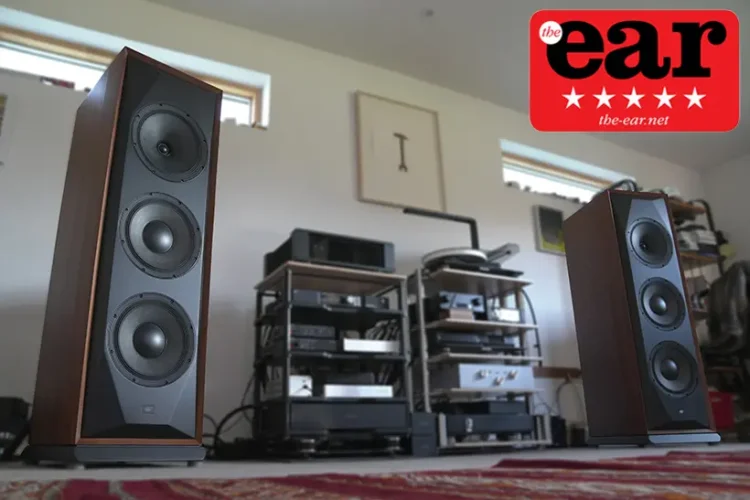
I should have read the small print or perhaps given the name a second glance. If I had then the size of these full-figuredspeakers might not have come as such a surprise. The name V10 is indicative of the 10-inch size of the drivers on Mofi’s biggest Sourcepoint speaker, five per channel, but I hadn’t quite anticipated the size of cabinet needed to house them: it’s over four feet high before you add spikes. However, I have a good size room with walls that don’t reflect bass too badly; nothing has been too much for the room in the past and I have hosted plenty of bigger designs without too much trouble.I’d venture that the Sourcepoint V10 is made for American homes where the walls are rarely as solid as the bricks and mortar we have in the UK – a speaker of this size and output could prove a bit much in your average British lounge. Fortunately, my listening shack is built US style and can cope, but even so there were a few tracks that proved a little bit overwhelming.
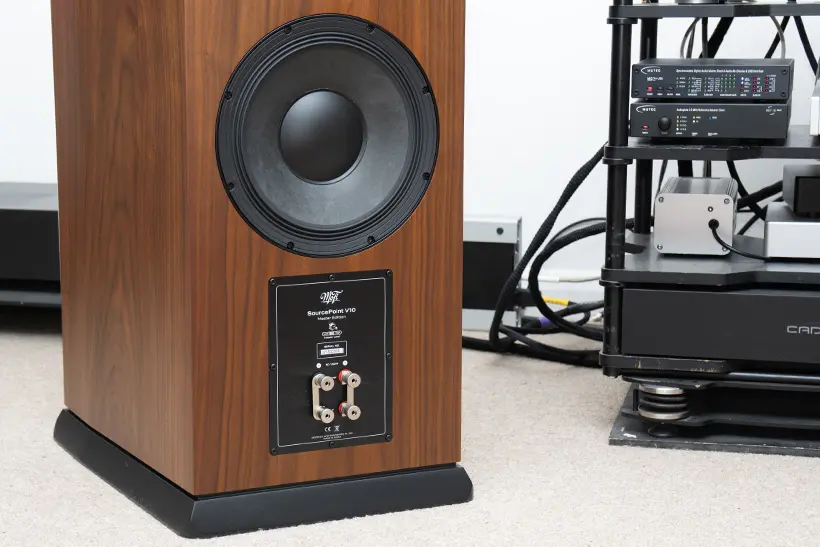
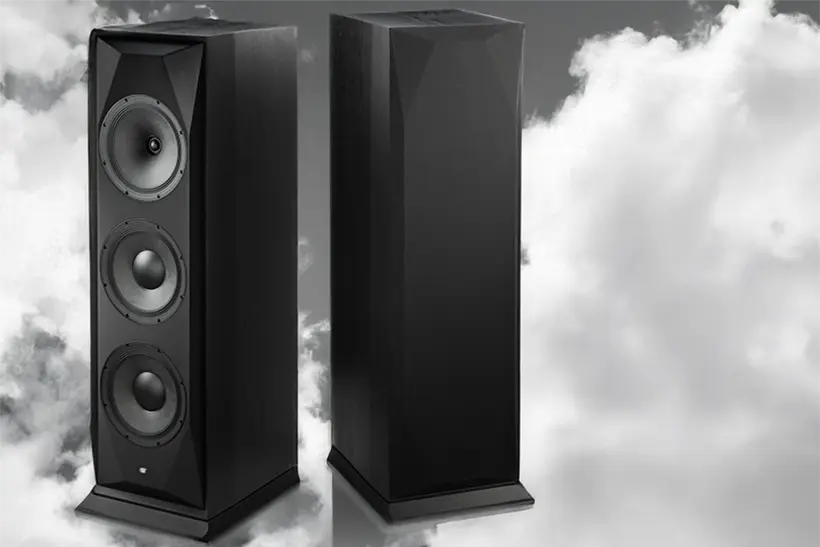
To get to the details, the Sourcepoint V10 ME is a three-way floorstanding speaker that runs two 10-inch bass drivers anda concentric mid/tweeter driver where the tweeter sits in the throat of the woofer cone. There are two further 10-inch bass drivers on the back of the cabinet but these aren’t connected to the crossover and form an ABR (Auxiliary Bass Radiator)in place of a reflex port. There are no magnets in these drivers and they allow the air inside the box to expand and compress with the movement of the active front drivers. Beneath them is a three-position switch marked ‘tweeter level’ – a feature of the Master Edition design – through which plus, neutral, and minus settings in 1dB steps provide a degree of tone tuning that could prove useful in some systems.
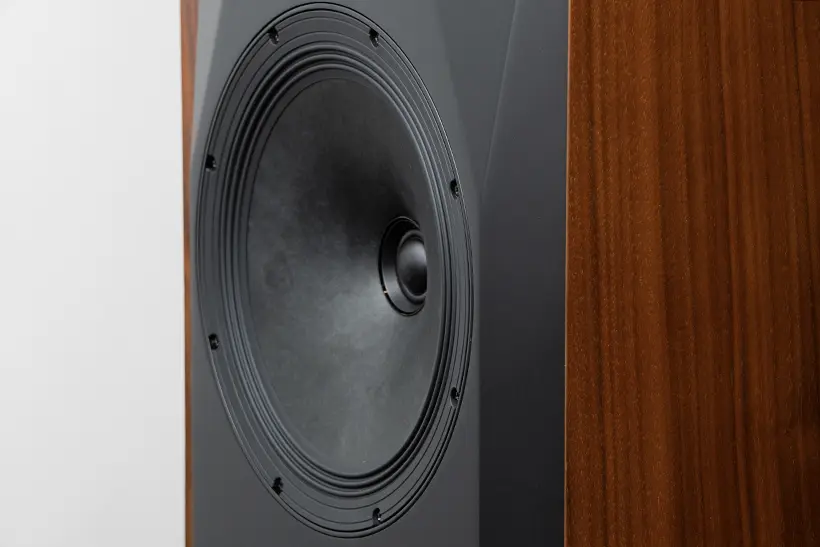
Dual concentric drivers can be seen in Fyne Audio designs and their predecessors from Tannoy. It’s also an approach that designer Andrew Jones pioneered when he was with KEF: the company’s Uni-Q is just such a thing. Since then, Jones has created dual concentric drivers for TAD, ELAC and more – you could say that this driver type is his design signature. The benefit is that you get a point source for the critical high and midrange frequencies, which emerge from the same centre toensure good coherence across a wide bandwidth.
It’s rare to find a speaker with bass and midrange drivers of the same size. As a rule, the bigger the driver the better it is at producing low frequencies versus clean mids. But it’s clear that Andrew Jones isn’t a rule taker: using a mid-driver of this size, even in a dual concentric, is pretty radical. Of course, the advantage of larger drivers is that they don’t have to move so far to reproduce low frequencies which makes for a more relaxed sound, the trade-off being that it’s harder to control such large cones and avoid colouration, but not impossible. Even though many classic designs, which relied on such things, remain popular today, they’re not mainstream due to the fashion for slim baffles that blend better with living spaces.
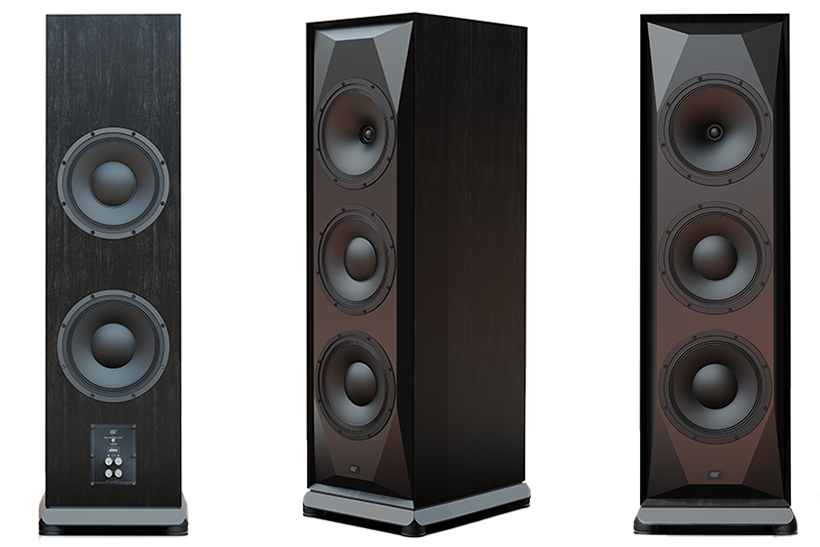
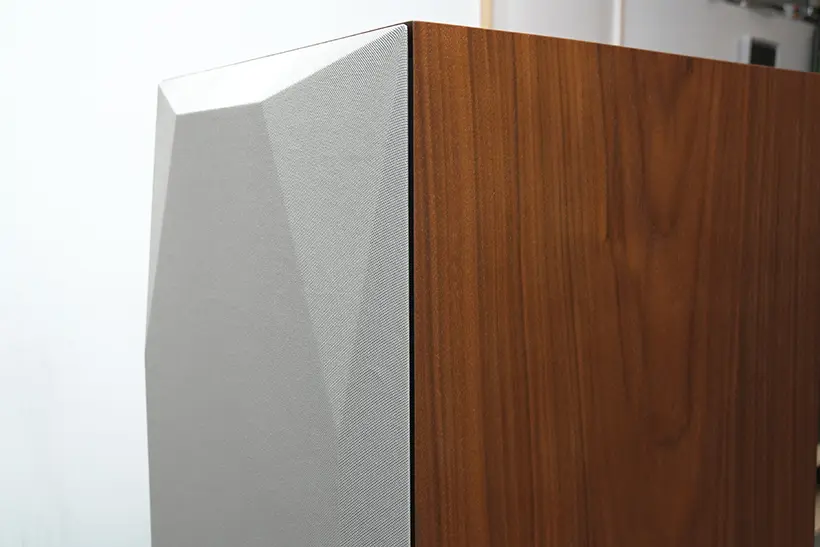
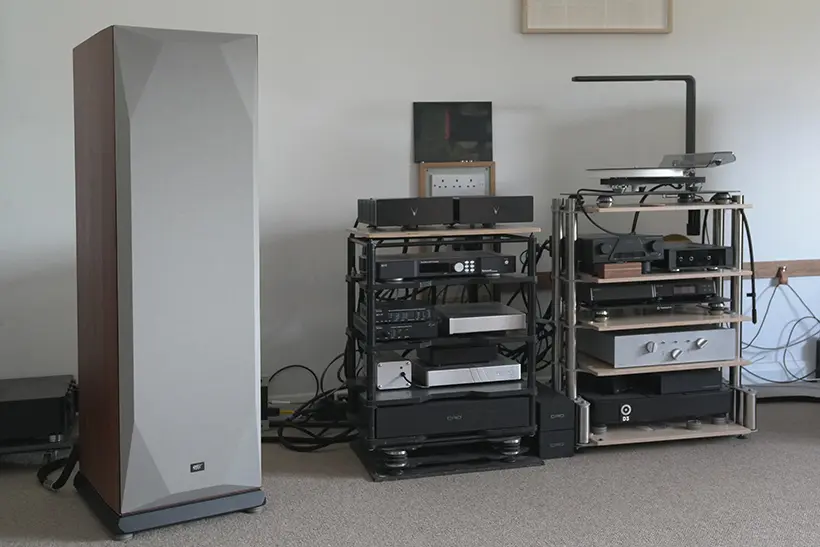
There is no getting away from the fact that the Sourcepoint V10 ME is a statement loudspeaker. It doesn’t attempt to blend into the room but states its purpose with clarity. It’s an uncompromising design that will have a lot of appeal but will be difficult to accommodate for quite a large proportion of music lovers whose systems inhabit a shared space. The real-wood veneered walnut cabinets (also available in black ash) are very attractive though, with side flanks tapering gently backwards and facets on the front baffle doing a lot to offset its size. Light grey grilles are available, which contrast nicely with the walnut veneer and give what is a modern design a retro feel. The woodwork is supported by a plinth that offsets the boxiness and provides anchor points for spikes should you feel like nailing its 73kg to the floor. I used Ansuz Darkz to lift the Sourcepoint V10s by an inch and that proved beneficial.
Sensitivity is a useful 91dB and this combined with an impedance that doesn’t drop below 4.5 ohms suggests that the Sourcepoint V10 should be a relatively easy load for the partnering amplifier, even tube friendly. Andrew Jones confirmed that he had tried it with 10W triodes and 200W push-pull designs and got good results because the impedance is very even.
Sound quality
In the system driven by my Rega Solis power amp, the Sourcepoint V10 does not sound quite as you might expect with so much driver area in such a big box: it doesn’t boom and tizz nor compress the air in the room at high volumes. It could probably do the latter if pushed but sounds a lot better when played at moderate levels. The drivers give it a degree of dynamic expression that is rare and this means you get a sense of power and drama without having to wind up the wick. The V10 MEs love great recordings including less audiophile fodder such as Djrum’s electronica where the cracked piano and deep bass expand in colour and shape thanks to their dynamic scope. This may be largely synth driven material but it contains some lovely sounds and the Mofis let you know all about it.
I love the way they track slow building tunes: smaller speakers don’t make it clear that they are skirting over the way that some pieces of music change level, but the V10s make this very obvious. And this subtle build up makes the music more engaging and reveals more about what the creator was trying to express. I heard this with a jazz composition but suspect that the effect would be even more powerful with classical pieces where the dynamic range can be huge. Those big drivers also reveal themselves in the tone of classic recordings, hence Steely Dan’s Babylon Sisters has that perfect ‘70s sound that you can’t get with small drivers, possibly because the monitors used in the studios at the time were likewise equipped.
As mentioned I did find a few pieces where the bass was too much but discovered that increasing the tweeter output helped to offset this to some extent, as would moving the Sourcepoint V10s further into the room. The front baffles were at the one metre point but this meant that there was little more than half that distance from the rear where the two big ABR drivers sit. In practice the bass only became obvious on tracks where that was probably the idea. The more evenly balanced recordings sounded just that and provided some very enjoyable music.
Wide baffles and big drivers don’t have the image precision and soundstage width of more conventional designs: most of the sound is perceived as coming from the speakers or the space in between them. This may well be because I was not able to sit very far from them; I suspect that at say five metres (15’) or thereabouts the image would have the space to expand out sideways. Even so, this is a larger-space speaker that doesn’t disappoint in modestly proportioned rooms. I also tried them with a pair of Valvet 50w Class A mono amps that have a warmer, softer presentation than the Rega. These were particularly good at developing dynamic expression as mentioned above, they also made the Sourcepoint V10 ME sound more relaxed and effortless which is an appealing characteristic in any piece of audio gear.
Conclusion
While not a likely choice for many UK homes, the Mofi V10 Master Edition speakers have many qualities that will appeal to those looking for a big sound from a carefully engineered product at a competitive price. Make no mistake, this is a lot of loudspeaker for the money: I am not aware of any audiophile offering with so much driver area at the price or, for that matter, considerably more.
Tube amp lovers are likely to be the most interested parties because so few modern speakers are made for low powered amps. These Mofis hark back to a time when available power was distinctly limited, so when partnered with my Class A amps, they delivered a beguiling sound. If you want to go large with your speakers the Mofi V10 ME is a hard act to beat.
Pros
Coherent point source sound: Thanks to Andrew Jones’ signature concentric driver design, the high and midrange frequencies emerge from the same centre, ensuring excellent coherence across the bandwidth.
Highly adjustable: The V10 Master Edition features a three-position tweeter level switch (+1dB, Neutral, −1dB), allowing you to tune the high-end to match your room or system.
Relatively easy to drive: With a 91dB sensitivity and an even impedance (not dropping below 4.5 ohms), these speakers are compatible with a wide range of amplifiers, including low-powered tube designs.
Great value for money: There is almost no other audiophile speaker at this price point (or even considerably higher) that offers this much driver area and engineering.
Authentic big speaker tone: The V10s excel at reproducing the weight and tone of classic recordings (like the 1970s studio sound), which smaller speakers often struggle to replicate.
Attractive craftsmanship: The real-wood walnut or black ash veneers, faceted front baffles, and matching plinths help offset their massive footprint with a modern-yet-retro aesthetic.