

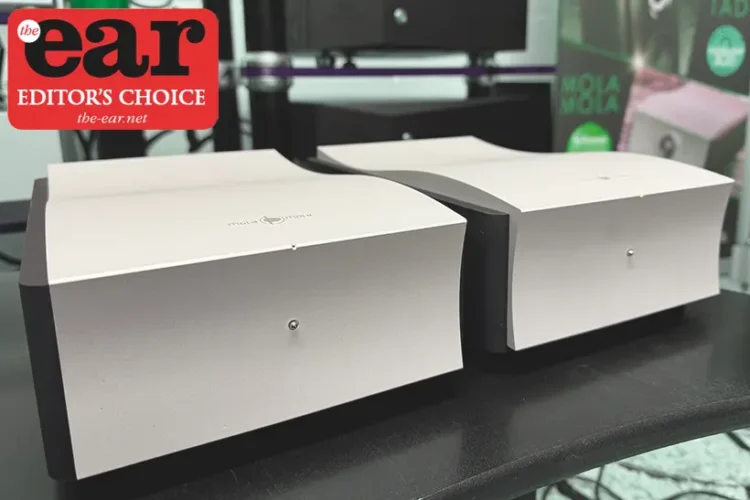
Mola Mola Ossetra monoblock power amps
A young design engineer that I interviewed last year expressed frustration that the audio industry had thus far failed to agree whether an amplifier should be Class A, Class A/B or Class D, tubes or solid state. He acknowledged that each type was associated with particular sonic and operational qualities, but he felt it all to be a distraction from what really mattered, or rather should really matter: whether an amplifier was accurate or not.
We had been talking about our shared love of acoustic string quartets, agreeing that few amplifiers came close to producing such a sound ‘right’, without either omission or embellishment. He felt this was because much of the audio industry, whatever various manufacturers may claim, still approaches product design from a position of ideology. By way of illustration, he mentioned two examples of this tendency; the argument that tiny surface-mounted discrete components resulted in ‘small sound’, and the assertion – actually more a religion – that tubes sound more ‘natural’ than solid state.
His observation was that a designer who approaches the craft in an open-minded, science-based way can make solid state sound like tubes and tiny surface mounted devices deliver simply huge dynamic expression and tonal richness. In other words, whatever dogmas some manufacturers still cleave to, it is less of case of what you have, more a case of how you use it. How long would it be, he wondered, before someone came up with an amplifier that had no sonic imprint and defied crude compartmentalisation by simply sounding ‘right’? We could then all breathe a sigh of relief, stop stressing about what was inside, and simply regard it as a black box that amplified.
Dutch audio brand Mola Mola might as well have been eavesdropping on that conversation. Its newly-available Ossetra monoblocks are a bold step towards that idealised black box. The Ossetras are a solid-state hybrid of Class A and Class D but from the listening chair that’s of absolutely zero consequence. They have no identifiable sonic fingerprint. They just deliver gain absent of colouration and, as near as matters, distortion too. If we want ‘right’, they are among a select number of amplifiers that get close to it.
Good numbers
Costing just under £16,000 a pair, the Ossetras each draw 0.45 Watts on idle and up to a kilowatt when being driven, depending upon load. Into eight Ohms we get 350 Watts, into four we get 700 and into two Ohms 900 Watts. There’s a bandwidth of DC to 100kHz, a noise floor of better than -130dB, an input impedance of 200 kOhms, an output impedance of <0.002 Ohms and an on-board damping factor of more than 4,000, (all frequencies). Combined intermodulation and total harmonic distortion at all frequencies, all power outputs, is 0.0002%.
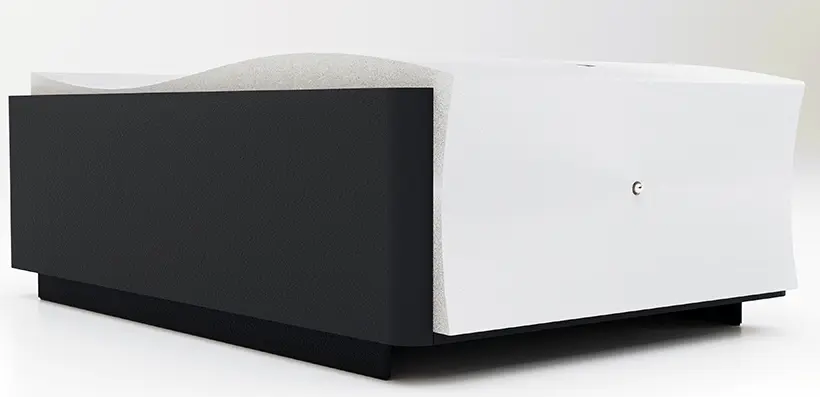
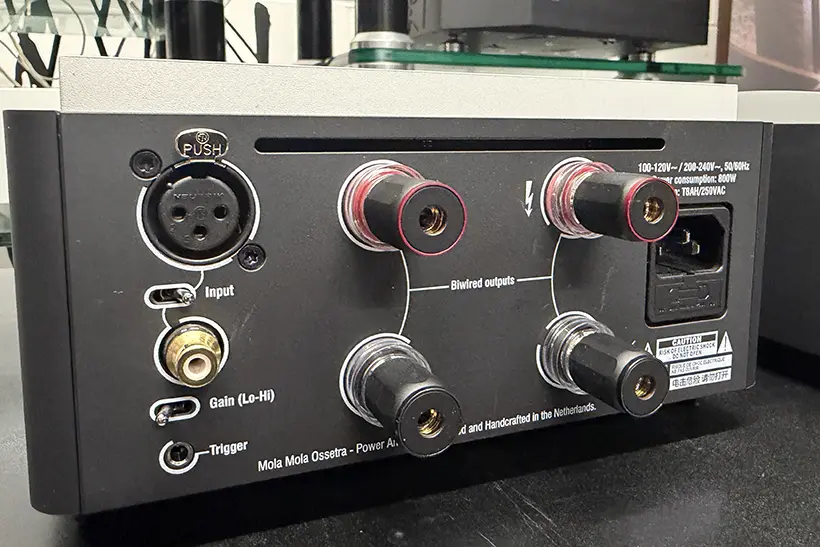
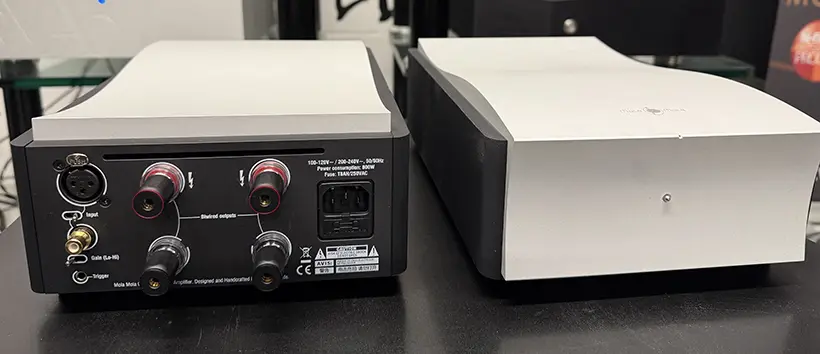
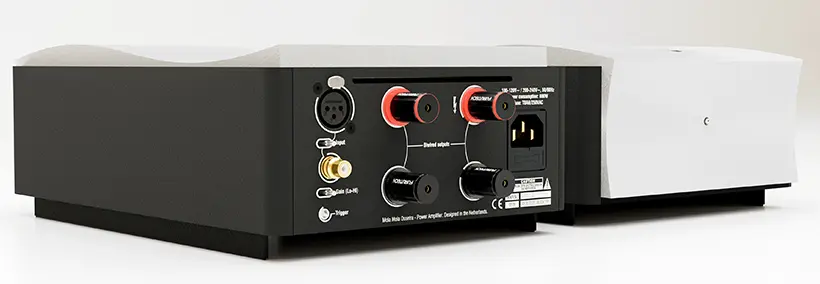
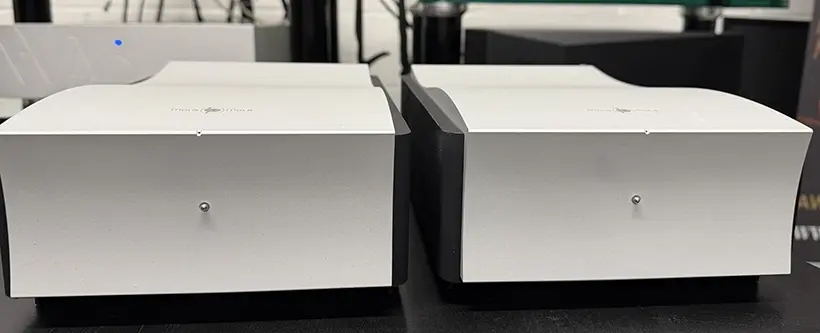
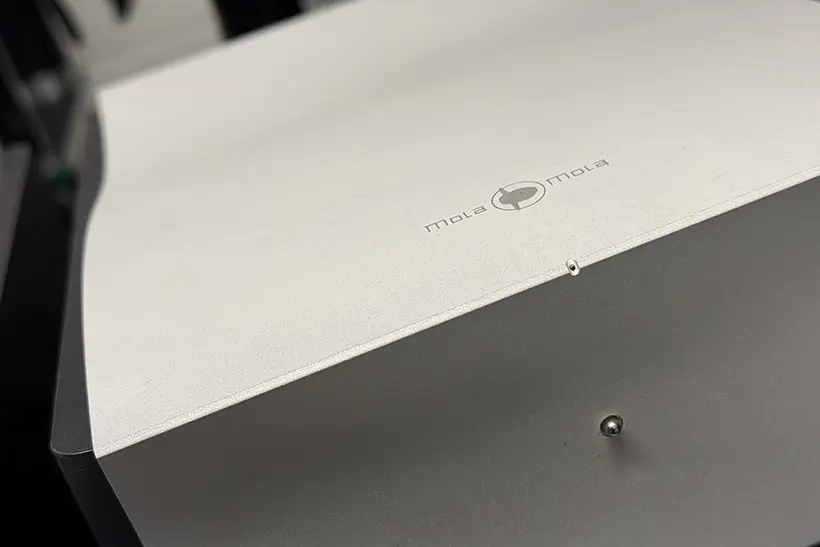
The Ossetras wear the same black and silver signature armour that adorns all Mola Mola audio products. At around 10cm high, 20 wide and 37 deep, they’re also nominally the same half-width form-factor used by Mola Mola for its Tambaqui DAC, Lupe phono stage and Perca monoblocks. On the back of each Ossetra we find an IEC inlet for the in-built power supply, two pairs of Furutech speaker binding posts to enable bi-wiring, single-ended and balanced inputs, a 2-15V trigger input and two miniature toggle switches. One selects RCA or XLR input, the other either 22dB or 28dB of gain. On the front there’s a tiny on/off button and a single LED that glows red when the amplifier is in standby, strobes white when the button is pressed, then shows solid white after the amplifier’s self-test sequence is completed. The white light is penetratingly bright in the gloom of the average listening room and there’s no dimming facility.
Past experience with contemporary Mola Mola products – I owned a Tambaqui DAC for over two years and today still own and use a Lupe phono stage in my vinyl rig – led me to expect that the Ossetras would sound better than their RRP might suggest. Mola Mola, a subsidiary Hypex, the world’s dominant developer and manufacturer of Class D plate amps, modules and power supplies, has form for being notably un-hubristic about its pricing and the Ossetras continue this pattern; indeed if we want a key take-away at this point in the review, it is that on sonic performance grounds the Ossetras make it hard to justify spending any more.
Detail
Purely in the interest of completeness, it would have been useful to pair the Ossetras with a hard-to-drive speaker load, but at the time of the evaluation all I had to hand, so to speak, was the household’s PMC MB2se reference speakers, 90dB efficiency and a nominal eight Ohm load. As might be expected, into the PMCs the monoblocks barely got lukewarm to the touch even after a long day of music playing. Still, Mola Mola’s claimed measurements – and we have no reason to doubt them – confirm that the Ossetras will cope with pretty much any commercially available speaker, given their remarkable immunity to reactive loads and an ability to drive 900 Watts and over 30 Amps into two Ohms.
Into the PMCs, the monoblocks gave one of the better performances yet heard in the listening room, reproducing complex material with an arresting quality of separation, subjectively accurate tonal density, muscular but not over-blown dynamic expression and confident transients that felt truer-to life than many of the alternatives can achieve. At the same time, the Ossetras didn’t feel like they were editorialising whatever was played; each recording, some poor, some adequate and some we might consider to be examples of benchmark engineering and mastering, was transcribed as-is, without colouration or masking background noise.
If the last paragraph scans as though I regard the Ossetras as characterless, that’s because I do, and I consider that to be not a negative, but a highly desirable quality. If we want to hear a recorded string quartet as close to how it sounds when live and in-the-flesh, characterless is what we need. An amplifier that imposes colouration or other characteristic by virtue of its operational Class or sloppy design means we are listening to an effects box, not a truth-telling reproduction system. It’s quite OK if we like that – it’s our money, after all – but we cannot with a straight face call it high fidelity.
Frankly speaking
The Ossetras were created by Frank Veldman, analogue designer for Hypex. He says earlier Mola Mola amplifiers were built around customised Ncore topology from parent company Hypex, but the Ossetras are a fresh design, building on learnings from the legacy products but adding fresh thinking around the linearity of power supplies, plus findings from research on the advanced application of negative feedback. The resulting circuit is proprietary to Mola Mola and has been christened Trajectrum to differentiate it from the previous generation. Veldman has used a JFET Class A input buffer followed by a Class D output stage that uses MOSFETs switched at 550kHz to provide up to 28dB of gain. From input to speaker terminals the Ossetras are dual-differential.

I asked Veldman why he has not used GaN (gallium arsenide) devices to provide the gain, and his answer led me to realise that not only had I interviewed him before, about two years ago, but had asked him the very same question, then in connection with the MOSFET-based Nilai monoblocks, launched under the Hypex DIY brand and which he too had designed. His view on GaN today remains the same: “It’s not that we don’t like GaN or think there’s nothing potentially to be gained from using it, but our perspective is that an amplifier is much more than just the two or four output devices. While we can continue to show gains by further developing power supplies, feedback schemes and so forth, for now that’s where we choose to place our efforts.”
Unsurprisingly, given Veldman’s philosophy, he confirms that the Ossetras do have some commonalities with the sub-£2,000 Nilais, but he says it would be wrong to view them as essentially Nilais in a different chassis. Neither the power supply nor gain circuits are the same. The power supply of the Ossetras can deliver 31Amps and uses exceptionally low noise shunt regulation. Not being as strict on efficiency has resulted in more open loop linearity in both the power and input buffer stages. There’s higher component quality everywhere and of course the chassis is a premium affair, rather than a budget box, all thanks to the greater headroom provided by the much higher RRP.
Lineage
What the two designs at very different price points do share is their approach to feedback. The Nilais were the first design to incorporate lessons from research by Hypex into the sonic impacts of larger than normal amounts of negative feedback, but the Ossetras take those learnings even further and employ what on the face of it is an amount of feedback that conventional so-called wisdom says is guaranteed to destroy any last vestiges of natural sound.
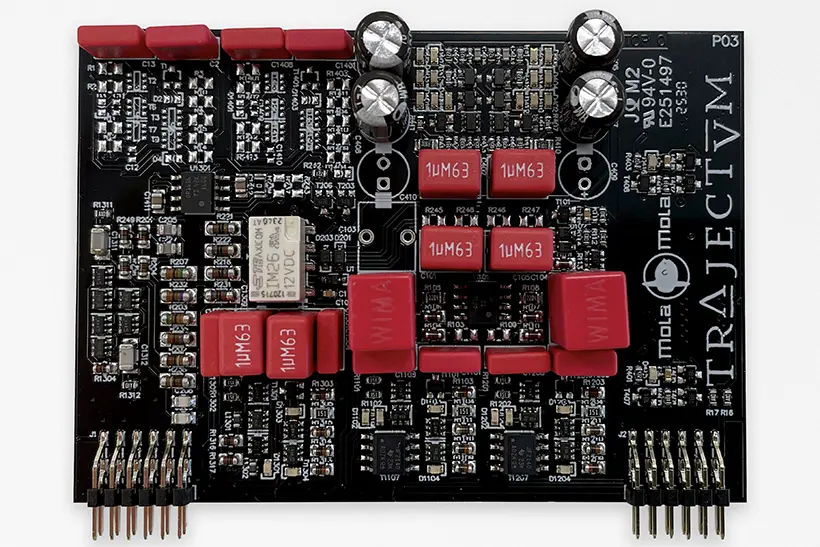
Feedback is essential because the types and profile of Class D amplification distortion are particularly unpleasant if not mitigated…and the only way to really get rid of them is by using feedback. The two problems with feedback are that it is sometimes (actually, quite often) used to mitigate for poor design, and that it is not just a matter of some feedback being good…and more is better still.
On the evidence of how the Ossetras perform, it is clear that Veldman knows something about this corner of audio design that few other designers do. He told me: “A lot is dependent on how feedback is implemented, where the gain is made, how the gain is made, what the bandwidth is, and how circuit behaviour varies over frequency and in the time domain. Starting with a circuit design that exhibits the best possible linearity from the power supply forward is important so that feedback isn’t necessary to paper over flaws that really should not exist.
However, even if feedback is implemented very badly it will probably still allow exemplary THD or IMD measurements to be achieved, but the sonic results will be less than satisfactory. In the Hypex Ncore amplifiers we used a lot of feedback, in the Nilais we used even more and in the Ossetras more still –over 80dB around the Class D power stage and output filter, right throughout the audio-band.
“If it were simply a numbers game, we could have used even more feedback and achieved still lower THD and IMD, but we have found them to have a slim correlation with how an amplifier actually sounds. There is more to it than simply trying to make the numbers right if you want to achieve a sound that is pleasing to the ear.”
Deflection
Veldman isn’t the first audio designer to make such an observation, but seasoned audiophiles will note that it is usually made by audio brands in an effort to deflect criticism of the poor measured performance of their products. That Veldman is making it, the design lead for products widely lauded for their test-bench excellence, might mean we should take him and Mola Mola even more seriously.
That Veldman and his colleagues did a lot of listening while the circuit was in development is plainly evident even in a first brief encounter with the Ossetras. There’s the strong level of separation previously mentioned, and it translates into the Ossetras having an uncommon ability to uncover the layering in recordings of complex music with a clarity and precision that exposes how many of the alternatives skim over the same tracks at a higher level and fail to show us detail buried deeper in the recordings. That’s not to suggest that the Ossetras push the detail forward. On more extended listening we realise that it is being presented as part of a coherent whole, subjectively in natural accord with the coarser higher level musical information.
Undoubtedly the -130dB noise floor is a major part of this, the level of detail retrieval is also enhanced by transients that in comparison to many amplifiers sound sometimes almost shockingly fast. Again, after listening for a while, we realise that it’s truer to life; the Ossetras’ response is more finely nuanced, so there’s an apparently greater difference between slower and faster transients than we might be used to, and that wider variability leads to a heightened sense of naturalism. Also notable is how Veldman’s design achieves better than average control of vibration and HF (high frequency) pollution for a lower than expected level of HF hash and intermodulation artefacts.
If I highlight the low end there’s a risk that some readers will jump to the conclusion that the Ossetras are ‘typical Class D’. I’ll take the risk anyway because how any amplifier handles the sub-50Hz end of the audioband is crucial to all listeners, whether their bag is dubstep or symphonic music. Through the PMC MB2s the Ossetras handled the square wave shenanigans deployed by Hans Zimmer in so many of his recorded works with a satisfyingly dry cinematic power, but I found that in what we might call in this context – more conventional music – you really wouldn’t know that this ability to shake the earth on its axis was there.
Recital
A household favourite is bass player Brian Bromberg’s 2002 album Wood; loved for its masterful combination of space-between-the-notes restraint and virtuosic chops. It’s a very good recording too. Listening through the Ossetras to the opening track, The Saga Of Harrison Crabfeathers, I was struck by how Bromberg’s bass and Randy Waldman’s piano were more playful and seemingly in-the-room present. The piano, recorded under the lid rather than from a distance, had appropriate percussive bite and weight, combined with purity and grain-free sweetness, while Bromberg’s bass had the kind of fingers-on-gut power and tonal density we’d expect if we were seated just feet away at a live recital.
If I have one nagging doubt it is that the Ossetras produced a rather flatter than hoped for sound picture. The lateral placement of events was heard to be highly confident, but depth on many recordings seemed to be relatively shallow front to back. That observation may be a consequence of an inadvertently unhelpful pairing in the review household, or probably even more likely my shameless reluctance to incur a hernia manhandling the 70kg PMCs around to achieve an in-room placement more suitable for the Ossetras’ particular qualities.
As an amplification package for what in the high end is considered a middling amount of money, the Ossetras are a veritable tour-de-force. They are winningly compact but have the technical ability to drive any speaker on the planet with impeccably neutral and naturalistic nuance. They are one of very few amplifiers of my acquaintance that give us ‘right’, rather than a transcription laced with characteristic colouration, and they deserve a strong recommendation.
Pros
Exceptional transparency: True ‘black box’ performance with no identifiable sonic fingerprint. Ossetra delivers music without the typical colourations associated with Class A, A/B, or D.
Impeccable power & control: Delivers 350W into 8 Ohms and doubles precisely to 700W into 4 Ohms, with enough current (31 Amps) to drive virtually any speaker load, including reactive and low-impedance designs.
Vanishingly low noise floor: Features a noise floor better than -130dB and total harmonic distortion (THD) of 0.003% across all frequencies and power levels, resulting in stunning detail retrieval and ‘ink-black’ backgrounds.
Superior transient speed: Transients are ‘shockingly fast’ and ‘finely nuanced,’ providing a heightened sense of naturalism compared to many traditional amplifiers.
Innovative Trajectum technology: Uses a proprietary hybrid design (JFET Class A input buffer with a high-feedback Class D output stage) with over 80dB of negative feedback to achieve linearity without the typical sonic degradation associated with high feedback.
Build & form factor: Housed in Mola Mola’s signature premium, wave-shaped, half-width chassis. It is compact and runs cool, even when driving demanding loads.
Flexible gain settings: Includes a toggle switch on the rear to select between 22dB or 28dB of gain, allowing for better matching with various preamplifiers.
Cons
Soundstage depth: A flatter sound picture than expected; while lateral placement was precise, the front-to-back depth felt relatively shallow in this system.
Ergonomic issues (LED brightness): The front-panel white LED is ‘penetratingly bright’ in dark rooms, and there is no facility to dim or turn it off.
Price: At £15,998 per pair (approx $22,000 USD), they represent a significant investment, though they offer strong value for money in their sector.
‘Truth-telling’ nature: Because they lack a ‘sonic fingerprint,’ the Ossetra will not mask poor recordings or add ‘warmth’ to a sterile-sounding system. If you prefer the euphonic distortion of tubes, these may feel too clinical.
Small connectivity toggle: Some rear-panel controls (like the RCA/XLR selector) use miniature toggle switches which can be fiddly to access.