

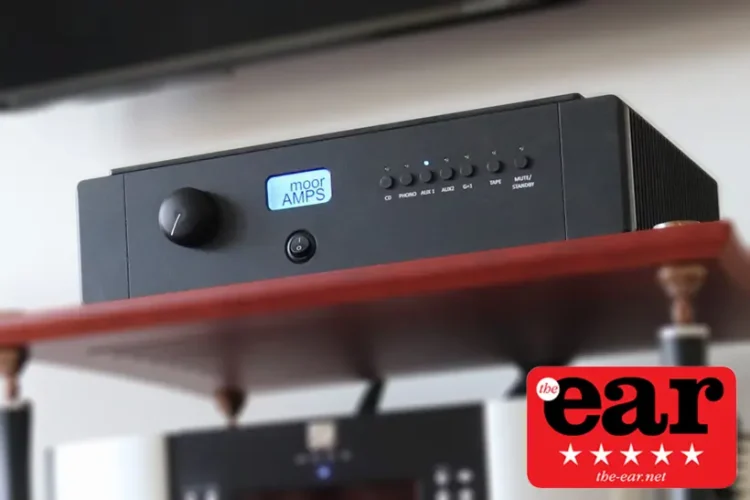
Moor Amps Angel 4i integrated amplifier
I have often enjoyed listening to Moor Amps amplifiers and speakers at audio shows, especially the Angel 6 and Ascalon-8 speakers. The Angel 6 is the amplifier of choice of a couple of fellow reviewers, including The Ear’s esteemed editor, Jason Kennedy. So naturally I was keen to try this newly launched integrated from the brand at home.
Moor Amps is a small, family business based in Portland, Dorset. The company name comes from the last part of the proprietors, Tim and Ruth Narramore’s surname. Moor Amps has a handful of dealers in the UK and a couple overseas. It is a small business, but one with an established name among audiophiles. It has been mentioned in these pages and others before, but for those who have missed it, the Angel moniker originated from the track of the same name by one of Tim’s favourite bands, Willie & The Bandits. This track provided something of a eureka moment for Tim during his research and development, and it’s a track he returns to when assessing new products.
The subject of this review, the Angel 4i integrated amplifier is based on the 75W Angel 4 power amp and the Angel preamp. However, this integrated benefits from the ‘Three Islands’ power supply used in the Angel 6 power amplifier. As the Angel Pre is a passive design, one assumes that the Angel 4i gives little away in performance to the two-box design, especially considering the power supply upgrade.

The entire Moor Amps electronics range is based on a low-feedback design with a DC-coupled output. As I discovered when turning the amp in and out of standby too quickly following a cable swap, there’s a DC servo that monitors the DC offset. When something is wrong, the front panel flashes between blue and red, similarly to my cheeks, until I was reassured that I hadn’t broken something after all. Like the power amplifiers, the Angel 4i operates in Class A/B mode, which arguably offers the ideal balance between power and musicality.
Build, design and features
With the exception of the retro tape loop and the remote, it is fair to describe the Angel 4i as a minimalist design. There are five line inputs, plus the in- and outputs for the tape loop. All connections are via gold-plated RCA sockets. Confusingly, one of the inputs is labelled ‘Phono’, yet no RIAA phono stage is fitted; it simply suggests that this input could be used with your external phono stage, which I suppose makes sense. One of the inputs, labelled G=1, is intended for use with a home theatre processor and therefore bypasses the volume control. There is no headphone output, but at least you can use the tape-loop to pair the Angel 4i with the headphone amp of your choice.
As with the Angel 4 power amp, the Moor Amps Angel 4i does not feature XLR connections. You will need to head for the separate Angel Pre and Angel 6 if that is important to you. Generally, a single-ended cable connection tends to work best with amplifiers that are single-ended in design, and vice versa with balanced designs, such as my Simaudio Moon equipment. So, forgoing XLR inputs should make little difference to most users.

The volume control is a top-quality ALPS motorised ‘Blue Beauty’ potentiometer. It feels good to use and can be adjusted with the supplied remote. There are buttons for each input, which are indicated by a blue light above the selected one. These buttons and their layout remind me of older T+A components, which is no bad thing. The remote itself is a simple affair, but its solidity reflects that of the amplifier itself.
I found the position of the IEC power input rather inconvenient; it meant that spade connectors on the Oephi speaker cables had to be connected from above, which made the cables rather unsightly. Connecting banana cables was more convenient, but it still meant that the cables touched the mains input cable, which risks mains noise getting into the audio output via the speaker cables.
The casing of the Angel 4i is made from aluminium of varying thickness, designed to cancel vibrations that can degrade performance. Although it is a full-width unit, at 36cm deep, this is a relatively compact amplifier. At 16kg, I would describe it as reassuringly solid, rather than a heavyweight. As you can see from the photos, heatsinks are fitted to each side. The amp got reasonably hot from time to time, but not enough to cause concern.

A natural performer
Some amplifiers have a marked character. For example, my Moon 600i, despite its strong dynamics and powerful presentation, sounds slightly richer and more spacious than is strictly neutral. The Chord Ultima Integrated, which I recently tested, produces an immense, warm, almost walk-through soundstage, but perhaps emphasises the speed, precision, and scale of the recording. The Moor Angel 4i proved harder to pin down, its performance reflects that of the recording and indeed the speakers it feeds.
The frequency response is even from top to bottom. Perhaps it doesn’t quite deliver the weight and slam to match the likes of the Chord Ultima Integrated or indeed my Moon amplifier. However, it possesses a good level of control and low-frequency dynamics, which makes it hard to keep still when listening to music with a great bassline.
I tested the Moor Angel 4i with three pairs of floorstanding speakers: my regular Totem Forest Signatures, the Oephi Lounge 2.5, which we recently reviewed, and the Oephi Transcendence 2.5, which will be reviewed shortly. It had no issues giving the Oephi Lounge 2.5 the speed and dynamics they thrive upon. This amplifier sounded suitably romantic and tonally honest with the Totems, albeit slightly less spacious and holographic than the aforementioned Moon amplifiers or the Chord Ultima. What you get instead is tonal honesty and superb timing and rhythmic integrity, which it displays without sounding unnaturally fast and dry. There is also an intimacy and focus that involves listeners on an emotional level.

The Angel 4i sounds uncluttered and natural, even during complex musical passages. No matter how busy the music gets, the amp stays in control and does not get flustered. The soundstage is less obviously three-dimensional than with some of the competition, but depth and layering information are present, just less etched and defined than it can be.
I spent an enjoyable afternoon listening to Idris Muhummed’s Power Of Soul (CD rip via the Melco) through the Oephi Lounge 2.5s, and an equally fabulous one listening to it again through the Totem Forest Signature speakers. The Oephi speakers told me that this amplifier’s timing, definition, and bass control are first-class. The Totems gave me instrumental timbre and refinement to die for. In both cases, the Angel 4i got out of the way and played the music.
Taking a trip back to the late 1950s, the Angel 4i resolved the smoky atmosphere of Miles Davis’s Kind of Blue (24/192 HD-Tracks download) and got the tonality of the brass instruments spot-on. From the same period, Dave Brubeck’s piano in Time Out (DSD) sounded suitably vivacious yet natural in tone. This amplifier reproduced the acoustic of the room and atmosphere of the recording, which transported me back in time and almost put me in the studio with the performers; magical stuff.
For nostalgic reasons, I recently purchased a few pre-loved ‘80s CDs from a well-known e-commerce site, which I ripped to my Melco; Whitesnake’s 1987 is one of them. The Angel 4i proved here that it can rock with the best of them. My headbanging days are long behind me, but I got close.

The Angel 4i’s 75 Watts proved more than enough to make the Oephi Lounge 2.5 sing, and indeed scream and shout when required, making the most of their timing abilities. My Totem Forest Signatures are less sensitive than the Lounge 2.5, but when combined with the Angel 4i, they produce suitably heavenly music. When the Oephi Transcendence 2.5 speakers arrived towards the end of the review period, they revealed the Angel 4i’s refinement, tonal accuracy, texture, and depth of field that were missing with the other two transducers. However, the higher-end Oephi speakers have a reputation as demanding partners, and in this case, the music lost some of its life, vibrancy, and punch.
As Jason has found, the Angel 6 is more than capable of driving current-hungry speakers, including Oephi models, so Moor Amps has it covered. Paradoxically, Moor Amps’ distributor is achieving great results with the Angel 4i driving a pair of MBL omnidirectional speakers, which are very low in sensitivity. Therefore, if your speakers are on the less sensitive end of the scale but have a benign load, it is worth trying them with this amplifier.
Conclusion
The Moor Amps Angel 4i has proven to be an easy amplifier to host over the last few weeks. It is a lively performer, yet a well-behaved one. The Angel 4i tells it like it is, but without compromising the musical message. It won’t add pizzazz or fireworks that aren’t present in your recordings, but it times superbly and sounds more intimate and focused than most. This is not to say that this amplifier lacks dynamics, far from it. Put simply, it does not exaggerate them by unnaturally highlighting leading edges. No matter how busy the signal, the amplifier stays in control and maintains its composure.

The Moor Amps Angel 4i is an amplifier that I can envision being a final purchase for many, and one that should provide decades of listening pleasure. If you are looking for a dedicated analogue amplifier that gives you the musical truth, this could be just the ticket.