

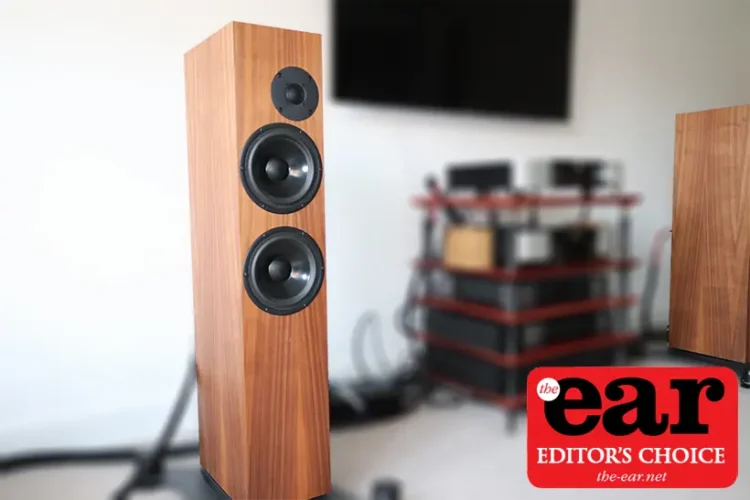
Oephi Ascendence 2.5 speakers
Oephi speakers have become a familiar sight in my listening room over the last few months, yet the Ear has not been alone in handing out plaudits to this Danish brand. Many of us in the industry feel that Joakim Juhl’s designs are genuine game changers. I, for one, have written many lines about his philosophy, emphasising his exacting focus on time-domain performance and phase-transition accuracy, which he feels are essential to system performance.
Having reviewed the Lounge 2.5 and Transcendence 2.5 floorstanding speakers, I wanted to see how the Ascendence 2.5 fitted into the lineup. As you can read in the reviews of those speakers, the cabinets and tweeters are shared across the models until you reach the Imminence and Reference ranges, where a ribbon unit replaces the modified metal-dome tweeter.
What distinguishes the Ascendence 2.5 from the equivalent Lounge and Transcendence models is the twin custom-designed bass/mid units built by SEAS. These drive units are designed for a combination of efficiency, speed, and accuracy. As a consequence, the Ascendence 2.5 speakers do not plumb the depths quite as low as the Purifi woofer-equipped Transcendence 2.5 — 35Hz vs 30Hz. However, the Ascendence is notably more efficient than its illustrious range mate, at 91dB vs 89dB. Therefore, the Ascendence speakers should work with a wider range of amplifiers than their more illustrious brethren.

Oephi also manufactures a range of highly regarded cables. Indeed, the brand started life as a cable manufacturer, and as you move up to the Ascendance level and beyond, the internal cabling is Oephi’s own that corresponds to their Immanence cable level. The construction and spacing philosophy follows a similar theme throughout the ranges, but the materials become more exotic as the prices rise.
At £6,495, the Oephi Ascendence 2.5 faces stiff competition, not least from my long-term Totem Forest Signature speakers, which now retail for a few hundred pounds more than these Oephis.
Design and build
Oephi’s floorstanders are tall, slim, reflex-ported designs. The tweeters are offset towards the edge of the cabinet, with the aim of reducing diffractions across the nearby bass/mid driver. In the majority of installations, you will want the tweeters on the inside; however, if your circumstances dictate that the speakers are positioned fairly close together, it may be worth experimenting with them the other way round.

The main cabinet body sits on plinths that are intentionally a slightly loose fit in order to reduce energy transmission into the floor. The bases of the plinths have threaded holes that accept spikes. I found these speakers worked well sitting on my Townshend Seismic Podium bases, so there they remained, sans spikes, throughout my time with them. I have found that Oephi speakers have particularly wide dispersion, which means they tend to sound best firing straight ahead rather than pointed toward me (toed-in), at least in my room.
The crossover is point-to-point wired and includes low-DCR copper-foil inductors and DC-biased capacitors. A single pair of pure copper input terminals, which accept banana plugs, spades, or bare wire, sits around the midpoint of the rear panel.
Musical ascension
I began with the Ascendence 2.5 hooked up to my Moon 600i amplifier, which was replaced after a few days by the Gold Note IS-1000 Deluxe MkII. These speakers pull off a neat trick: they are both revealing and easy to listen to. When something is wrong downstream, they do not shout it at you, but engagement and timing suffer.

Oephi’s slogan, Timing is Everything, reflects both their design philosophy and their demands for partnering electronics and cables. However, a system that accurately maintains phase coherence and time-domain performance should also accurately reproduce all aspects of the recording.
The Ascendence 2.5 is a particularly lively and expressive-sounding speaker, one that delivers the musical message like few others. However, it is also tonally accurate and capable of throwing an enormous, holographic soundstage. What’s more, these speakers make music fun.
This speaker sounds remarkably coherent across the frequency range, so I have to make a conscious effort to break down each part. The bass is taut, if perhaps lacking some of the slam and depth of the Transcendence 2.5 model above it, but satisfying nonetheless. The midband is notably more transparent than that of the Lounge model below, although it does not quite reach the heights of the Transcendence range. The top end is both detailed and well extended, sounding naturally airy with well-recorded music.
A friend of my son’s visited a few weeks ago whilst the Gold Note amplifier was delivering the tunes. He plays guitar and listens to a lot of live music. Much to my son’s dismay, I could not tear his friend away from the system. He was particularly astounded by the system’s ability to reproduce the impact and drive of hard rock music.
Tool’s Jambi, from their 10,000 Days album (24/96 download), demonstrated this particularly well. For those unfamiliar with Tool, they excel at producing riff-driven progressive metal and, conveniently for us audiophiles, most of their output is well recorded. If the system is up to the job, this track should present the band within a huge soundstage. The dynamic range is not groundbreaking here, but it is wide enough to make a strong impact as the track builds. The Ascendence 2.5’s rendition of the track kept us both pinned to the sofa for the full seven-and-a-half minutes — stirring stuff.
The Gold Note IS-1000 Deluxe MkII amplifier proved a great foil for the Ascendence 2.5. Whilst not the most airy and expansive-sounding amplifier, it delivered the music with the speed and timing accuracy upon which these speakers thrive. Returning to my Moon 600i brought more body and richness to the music. Initially, after the swap, I missed the Gold Note’s speed and timing accuracy, but thankfully those aspects improved as the amplifier warmed through and settled down. I have rarely hosted a pair of speakers that make it so abundantly clear when the rest of my system is truly on song.

With my Moon amplifier, Mick Karn’s bass playing on Japan’s Talking Drum sat further back in the soundstage via the Gold Note, but it started and stopped with greater definition. The Moon placed the bass line further forward in the soundstage and rendered it more fleshed out, with greater texture. The contrast between the two presentations was fascinating, but the Ascendence 2.5 made the most of both, making each version equally entertaining in its own way.
The Oephi distributor Airt also loaned me a power cable and speaker cables from Oephi’s Ascendence range. The power cable proved to be an instant no-brainer upgrade. The music was immediately tighter, yet more dynamic and transparent. The Ascendence speaker cable replaced a far more expensive run of cable, yet proved a superb match for the speakers. Whilst lacking a little of the weight and authority of my reference cables, the music had more energy without sacrificing refinement or soundstage accuracy, making it an excellent partner for the speakers.
Towards the end of my time with the Ascendence 2.5, I replaced the Dela S5 network switch with the company’s top-of-the-range S1 unit. This change produced profound improvements, particularly in terms of timing accuracy and soundstage definition and scale. The differences between these two components were audible through my long-term Totem speakers, but here they proved absolutely fundamental.
Yes’s sprawling Tales from Topographic Oceans has never gripped me in quite the same way as its three predecessors. The Super Deluxe Edition recently appeared on Qobuz, so I thought I would give it another try. Several versions of the album are included, but I started with the Bernie Grundman 2026 remaster in 24/192.
I confess this is probably the first time I have made it through this double album in one sitting, but I never once considered pressing pause during Oephi’s rendition, only time limitations prevented me from continuing through to the Steven Wilson remix. These Oephis helped turn something I had feared might become an ordeal into a truly enthralling experience.
The soundstage was presented in a genuinely cinematic fashion, which I have no doubt is what the band and engineers intended. The beginning of track three, The Ancient (Giants Under the Sun), which features some powerful drum work from Alan White, particularly benefited from this speaker’s combination of drive, impact, timing accuracy, and immediacy.

I have referenced a lot of rock and prog tracks so far, but the Ascendence 2.5 does an equally fine job with jazz. These speakers brought Miles Davis’s So What (24/192 download) into my room — and technically into the adjoining office to the right and the garden to the left. Aside from the wide soundstage, the studio acoustics were deep and palpable. Paul Chambers’ bass was truly locked into the groove, making it impossible not to tap my foot.
Idris Muhammad’s Loran’s Dance (CD rip) sounded suitably groovy. The trumpet can become somewhat piercing through some speakers, but here I got the energy and dynamics without any of the pain. Again, the Ascendence 2.5 made the most of the rhythm section, especially when the band really takes off around two-thirds of the way through the track.
The Allegri String Quartet’s Beethoven: Quartets, Opus 18 Volume One (24/192 download) demonstrated the Ascendance 2.5’s ability to reproduce both the natural tones and the dynamics of classical music. This is not a genre in which I claim expertise, but it nevertheless proved an involving and enjoyable listen.
Conclusions
It will be obvious to readers that I am a fan of Oephi and firmly believe the company has taken speaker design into new territory in several key areas. The Ascendence 2.5 fills the gap between the Lounge and Transcendence models brilliantly. In many respects, it is all the speaker I could wish for, and I know of few speakers at or near its price point that I would rather live with.

My system has evolved since I had the Transcendence 2.5 at home, and most of my time with that speaker included the Vitus RI-101 MkII streaming amp, along with superior cables from Oephi’s Imminence range. However, I am confident in stating that that speaker produces a slightly darker, weightier sound with greater levels of resolution. That said, with my current amplifier, I would be more than happy to live with the Ascendence 2.5 without feeling that I was missing anything fundamental to musical enjoyment.
This speaker turns listening to music into an event, involving the listener in the experience like few others. Not only does it satisfy musically, but it also performs all of the traditional hi-fi show-off tricks equally well. I failed to find either a musical genre or a recording that could trip it up.
If you are prepared to put in the necessary effort with system matching — and by this I mean partnering the speakers with electronics and ancillaries that do not inhibit musical flow or timing — the Ascendence 2.5 could prove to be all the speaker you will ever need, and an enthralling one at that.

Pros
Exceptionally coherent, expressive and engaging sound
Superb timing, dynamics and holographic soundstage
Revealing yet easy to listen to over long sessions
Wide genre compatibility from rock to jazz and classical
High efficiency makes amplifier matching easier
Excellent rhythmic drive and musical involvement
Cons
Bass lacks the ultimate depth and slam of the best
Demands careful system matching to perform at its best
Finish is functional rather than luxurious
Highly revealing of upstream equipment quality
Best performance may require experimentation with placement and ancillaries