

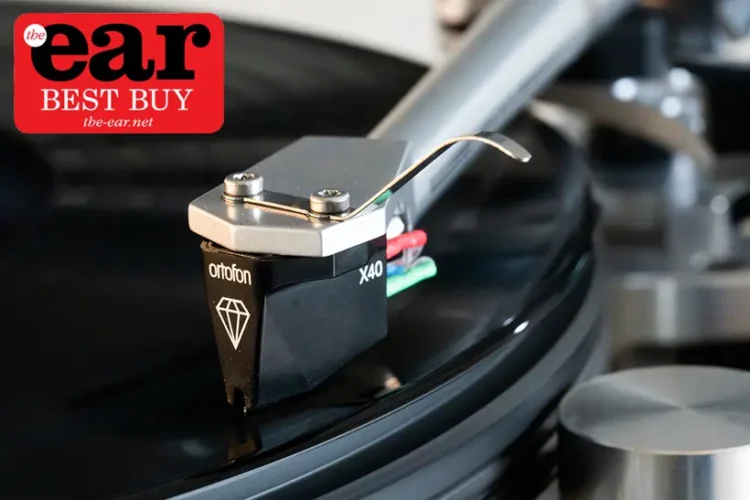
Ortofon MC X40 moving coil cartridge
It may surprise readers to know that the moving coil cartridge was invented by British inventor Paul Voigt in the 1930s, however it was Ortofon that launched the first commercially successful mass-produced moving coil with the Mono-A in 1948. At that time the firm didn’t just manufacture cartridges, but also the cutting heads used to cut vinyl lacquers. The launch of the SPU, the world’s first moving coil stereo cartridge in 1958 established Ortofon as a world leader in analogue stereo replay. Make no mistake, Ortofon have been there since the very beginning. The X40 is the latest addition to the fold and retails for £875, a competitive section of the market which is arguably the point at which optimum performance for the pound is achieved and one begins to experience a little high-end magic to season one’s vinyl replay.
Technical overview
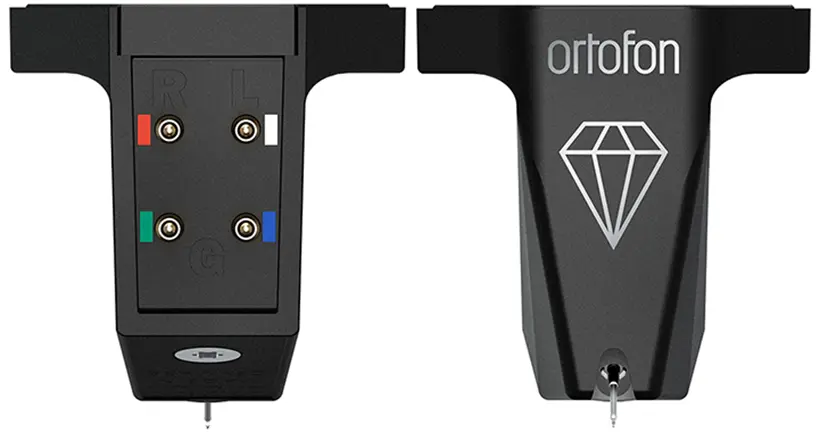
At first glance the X40 is a rather functional looking cartridge at this price point, but much of its impressive engineering is hidden beneath the austere black body. That body is actually an advanced honeycomb stainless steel frame which is injection moulded and designed to provide superior mechanical stability and rigidity. The steel is then sintered before a PVD (physical vapour deposition) coating is applied to enhance appearance and maintain integrity over the long term. Upon this firm foundation the rest of the engineering depends.
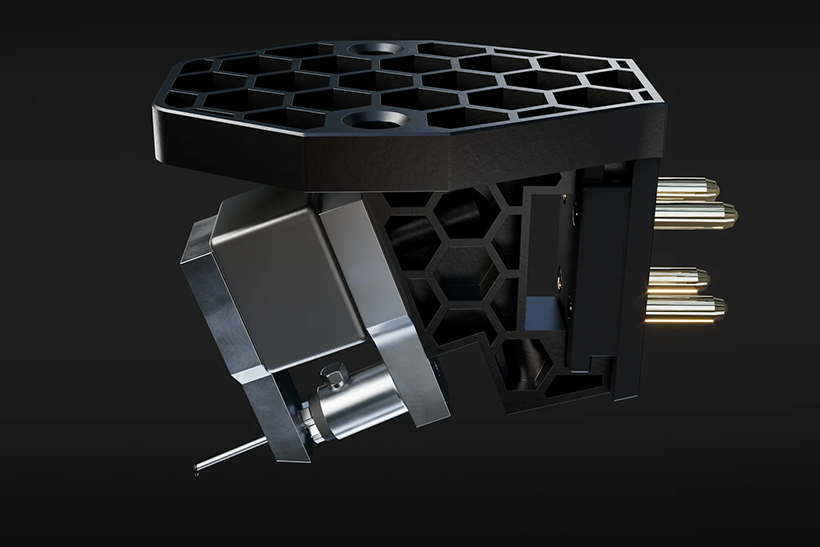
The motor unit comprises four coils wound around a cross shaped armature with high purity silver wire designed to ensure exceptional signal clarity and precision. The X40 utilises a newly developed magnet system with a single piece pole cylinder integrated into a rear magnetic yoke, all of which is designed to preserve the delicate signal tracked by the stylus.
The stylus itself is a nude Shibata type mounted on a boron cantilever and supported by Ortofon’s own proprietary stylus suspension. Output voltage is quoted at a typical 0.4mV at 1kHz with frequency response claimed to be 20Hz-20kHz +/- 1dB. The cartridge weighs 8.6g and has an internal impedance of 6 Ohms and is a medium compliance design at 15um/mN, so is ideally suited to most low to medium mass tonearms. Ortofon suggest a tracking weight of two grams with loading above 50 Ohms for optimal results.
Set up
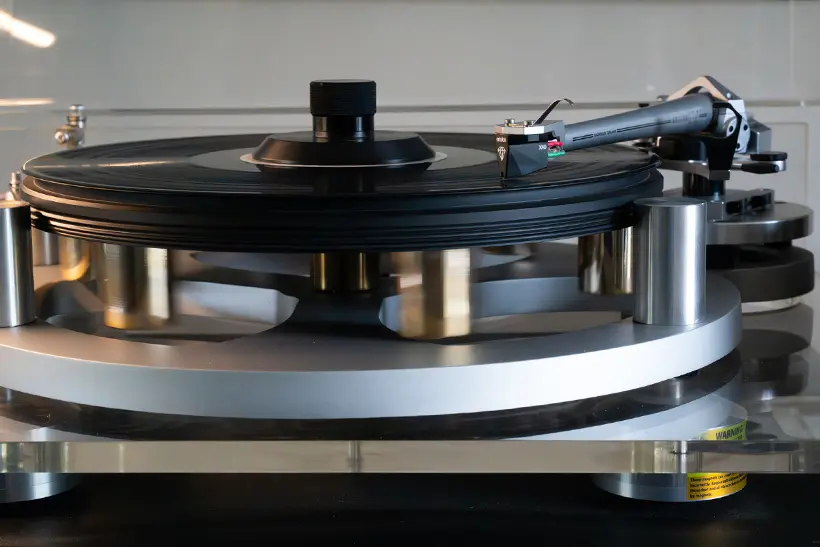
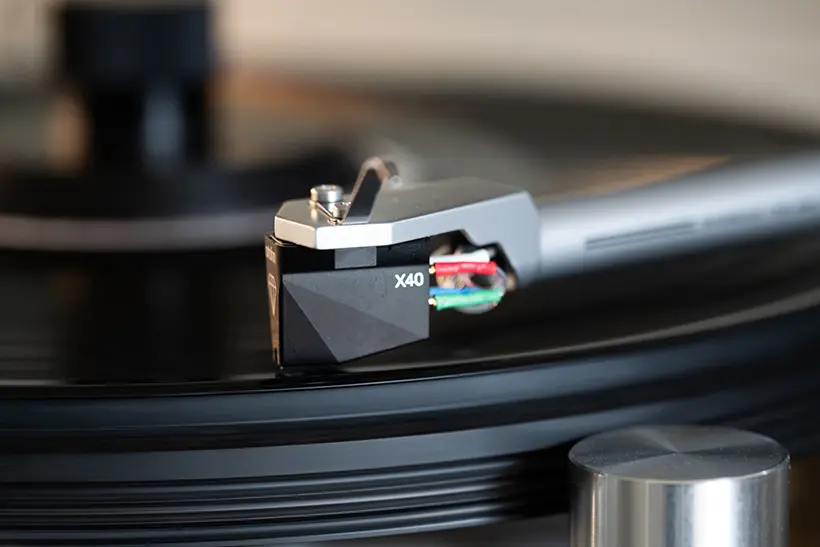
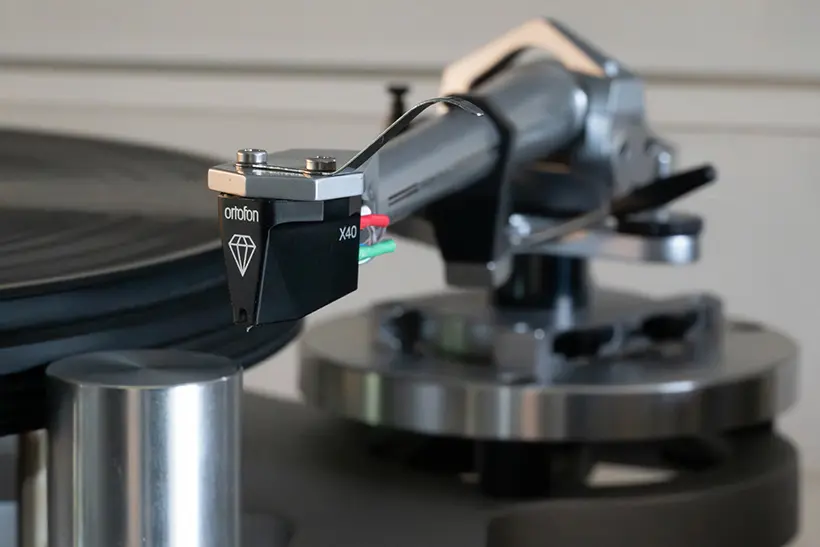
Alignment and setup proved effortless in my resident SME Series IV with good sight-lines and a symmetrical body shape. The only thing to note is that this cartridge would be a poor choice for arms which lack the ability to adjust VTA, it is a very tall cartridge (19.2mm) and I needed to raise the arm height of the SME quite a bit to accommodate it. This is one of many reasons why SME tonearms are adored by reviewers, because they offer sublime ease of adjustment and there’s not a single cartridge I have yet encountered that cannot be accommodated by one.
On the downside I was pretty unimpressed with the packaging for a cartridge retailing for nearly a grand. There’s simply no theatre when you open the cardboard box and the short accompanying booklet tells you very little. It feels like a missed opportunity and is no match for the presentation of say the Audio Technica AT-OC9 series which retail for less. However, it’s the cartridge that counts and if that cuts the mustard that’s what really matters.
Listening impressions
I elected to fit the Ortofon X40 to my resident Michell Gyrodec and SME Series IV tonearm, partly because I wanted to hear what it could do with that combination and partly because installing it in my distinctly more pricey SME Model 35 would be near lunacy.
I began with Deacon Blue’s glorious acoustic album Peace Will Come which was recorded live in Chem 19 Studios in Blantyre, Scotland, and has a very natural and unprocessed sound. In this respect it’s not unlike the Cowboy Junkies Trinity Sessions although the latter is sonically superior. Despite this, the Deacon Blue with its natural recording approach is an excellent choice for getting the measure of any hi-fi component.
Right from the off the X40 showed excellent bass warmth and depth with bass drums or the rich timbre of acoustic guitars portrayed with impressive solidity. This wasn’t at the expense of the rest of the frequency spectrum though, On Chocolate Girl Ricky Ross and Lorraine McIntosh’s vocals cut through the simple mix with good clarity. What was also impressive was the sense of the musicians being in a solid three dimensional space with good imaging precision.
The Heavy’s Short Change Hero showed similar rich tones compared to my usual AT-OC9 and demonstrated the excellent temporal speed and responsiveness of the X40. The attack, sustain, delay and release of musical notes was impressively resolved, especially on drums lending the track a sense of real snap and groove. Stevie Wonder’s extraordinary Master Blaster (Jammin) demonstrated just how quickly the Ortofon could react to the transient attack of drums and brass, with snare strikes positively ricocheting off the speaker drive units in a highly exhilarating manner. It’s very hard not to tap your feet to such a glorious record.
The new Steven Wilson remix of Frankie Goes to Hollywood’s audacious debut Welcome to the Pleasuredome hasn’t been far from my turntable for months. This is a record so magnificent, so avant-garde and so innovative compared to its peers that it’s the 1980s equivalent of the debut Beatles album being the White Album or Fleetwood Mac starting with Tusk and progressing from there.
This is an album which successfully manages to combine orchestral movements and choral interludes with hypnotic dance beats, astonishing fretless bass playing and as if that weren’t enough the Fruitless remix of the title track (check it out on Tidal) has Geoffrey Palmer narrating Friedrich Nietzsche’s ‘The Birth of Tragedy’. It’s overblown, pretentious and in places absolute twaddle but no less magnificent for that! Allied to which it really is a jaw dropping recording; which is guaranteed to give any system a hefty workout.
I found myself so captivated by it that I ended up playing the whole of sides one and two revelling in the precision, clarity and power of the Gyrodec/SME IV/X40 combination. One thing the Gyro has never lacked is dynamics and the X40 allowed it a full head of steam in this respect. Even when the mix got busy and with the immense Naim NAP350s hurling power at the ATCs, there was a sense of sublime control and order. Due to its extreme dynamics and splashes of cymbal this album can sometimes seem a little strident on some systems, but not here, not today.
The X40 provided a superbly balanced rendition of the record across the entire frequency spectrum. Sure, it can’t match the sheer detail retrieval of my Lyra Kleos SL at three times the price, but it digs darned deep for its price and certainly shows you just how extraordinary vinyl can sound given the right ancillaries. It’s a taste of the high end at an approachable price.
The X40 is no one trick pony either, classical works such as the masterful Chasing the Dragon recording of Scheherazade were portrayed with a sense of real gravitas. Strings were beautifully sweet toned while cellos and double bass demonstrated superb timbre and masterful precision. The delicate quieter passages with strings are so important to the emotional reproduction of this work and here producer Mike Valentine has excelled with his microphone placement and mix.
Every nuance of the performance was captured here, instruments have place, shape and size and the acoustic of the Henry Wood Hall was beautifully revealed via the Ortofon. The vinyl is admirably silent and half speed mastered and I know of no finer recording of Rimsky-Korsakov’s masterwork. Crucially while it was possible to hear all the details, at no point did the Ortofon over dissect the ensemble and the performance remained beautifully cohesive and enjoyable.
Conclusion
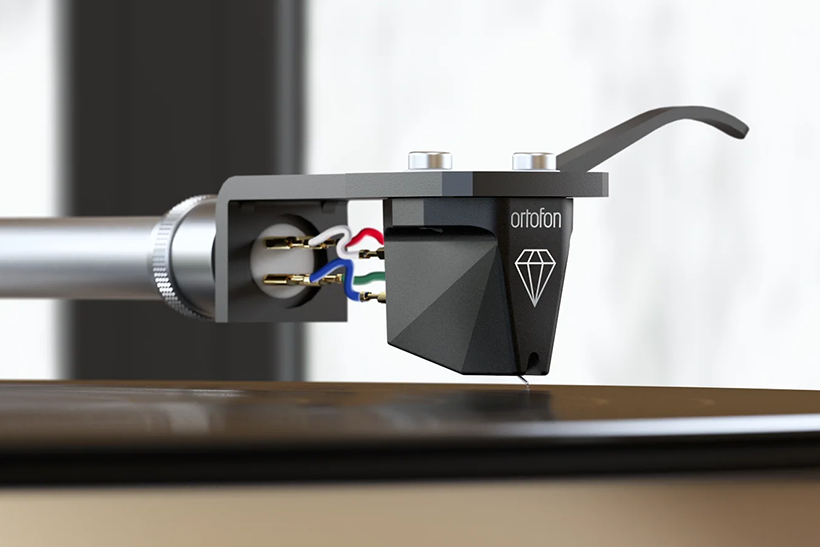
The Ortofon MC X40 might look unimpressive in terms of its understated visual style and packaging, but it’s got it where it counts – the sonics. It’s an emotive and highly enjoyable cartridge to play vinyl with no matter what genre you choose, and aside for some slight additional warmth in the bass region it is essentially neutral.
Crucially the X40 is a cartridge that is capable of digging deep into your vinyl collection and sprinkling the results with a little high end stardust, the way an accomplished chef can season and cook a wagyu steak to perfection. Its underlying engineering is deeply impressive thanks to Ortofon’s extensive expertise in designing a cartridge to track and transmit maximum information from the groove. Highly recommended.
Pros
Rich, engaging and highly musical sound
Excellent dynamics, timing and transient response
Strong imaging and three-dimensional soundstage
Neutral balance with pleasing bass warmth
Impressive engineering and value for money
Cons
Underwhelming packaging and presentation
Tall body may cause VTA compatibility issues with some tonearms
Functional, understated appearance