

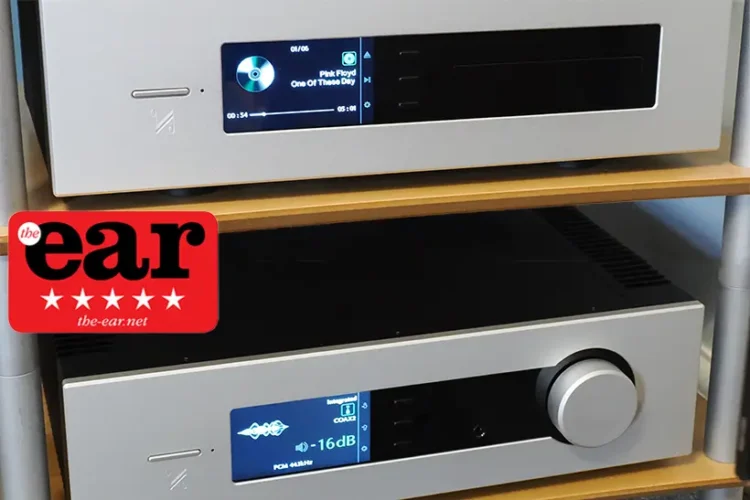
Quad Platina CDT & Integrated transport & amplifier
There are very few manufacturers of audio equipment who can claim to have been around for 90 years, but Quad most certainly can. Legend is a lazy epithet these days (a bit like iconic), but I think that we can safely and accurately apply it to Peter Walker who founded S.P. Fidelity Sound Systems in 1937. He later changed the name to The Acoustical Manufacturing Company, and moved it from the London area to Huntingdon in Cambridgeshire in 1941, where it still maintains its UK design and support centre. He concentrated the company’s efforts into the design and manufacture of amplifiers and public address systems, but once the second world war was over the company turned all its attention to the design and manufacture of high quality sound reproduction for domestic, laboratory and studio use.
In 1951 the company released a product designated Quality Unit Amplifier Domestic (QUAD). The acronym became the brand name and the rest, as they say, is history, as Quad’s reputation grew and cemented its place as a premier supply of audio equipment for the home, making both amplifiers and highly regarded electrostatic loudspeakers. At the same time the tag line ‘For the closest approach to the original sound’ started appearing in the brand’s advertising. Fast forward through the decades to 1997 when the company was acquired by IAG, a Chinese company that built a carefully curated portfolio of British brands.
In the interests of full disclosure I will happily confirm that my first ‘proper’ hifi system was built around the Quad 44 control amplifier and the 405 MkII ‘current dumping’ power amplifier, which I bought in the summer of 1981 and which gave me the best part of a decade of musical pleasure. During the ‘90s I upgraded the power amplifier, first to the 606 and then the 909, and continued to enjoy the Quad sound until well after the millennium bug had failed to rattle us.
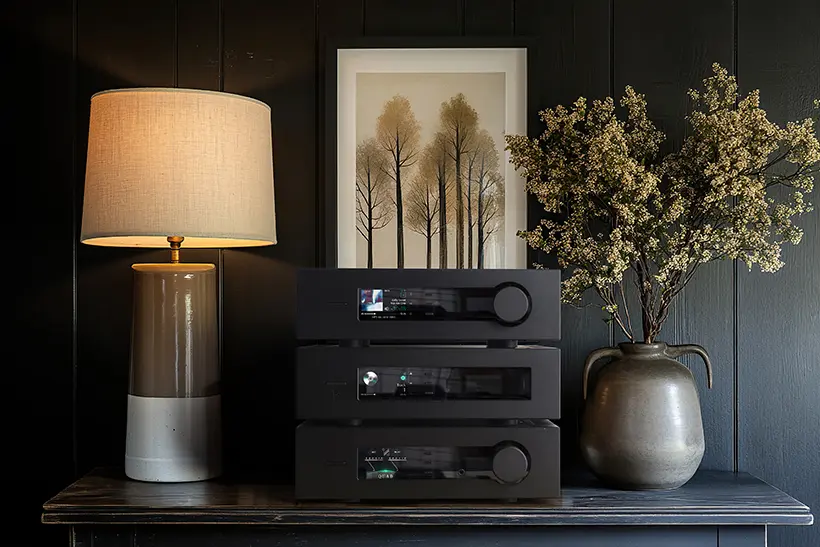
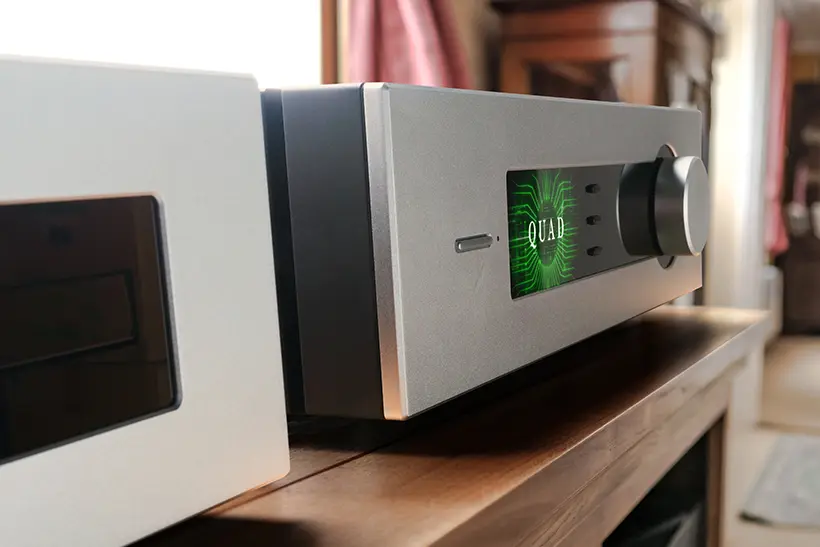
In more recent times I have had the pleasure of reviewing the new 33/303 pre/power amplifiers, which I really enjoyed. Not because we older folk are hostages to nostalgia but because they are really good in a contemporary landscape. The Platina makes no attempt to tug on the heart strings in that way. The design language is bang up to date, incorporating configurable colour screens alongside some perfectly weighted rotary controls for those who prefer a hands-on approach. The silver finish on the two review units is impeccable.
Platina
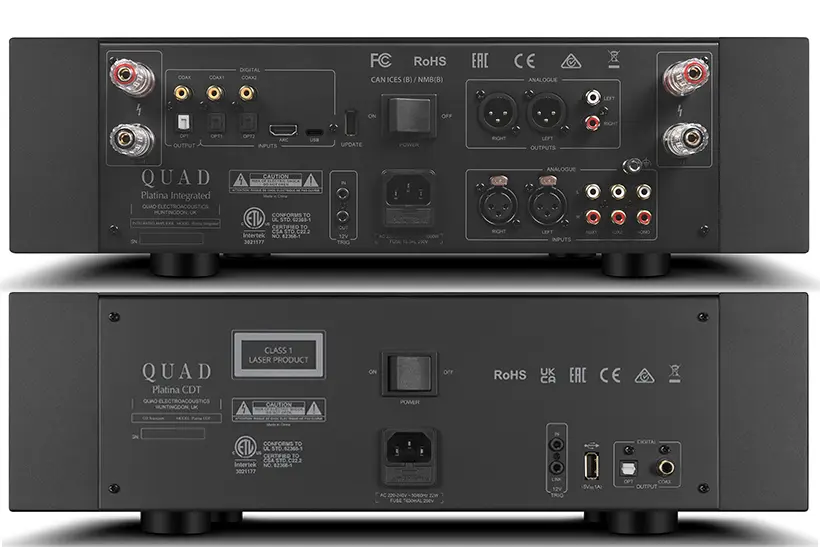
Taking the Platina Integrated amplifier first, here is a brief summary of its features. It is a class A/B amplifier Which can deliver 2x200W into 8 Ohms and 2x300W into a 4 Ohm load. It has an ES9038Pro 32bit DAC, an MM/MC adjustable gain phono stage, a highly linear analogue volume control and a current feedback headphone amplifier. There are 10 RCA input sockets, a pair of balanced XLRs (hooray) and all manner of digital options too. On the output side there is pair of RCAs, a balanced pair of XLRs (hooray again), plus optical and coaxial digital outputs. There are also 12V triggers for those looking for ease of system control.
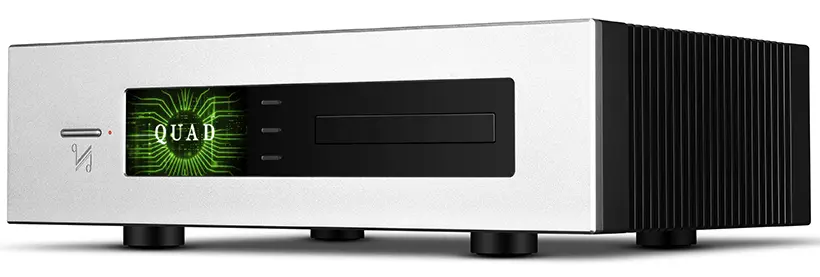
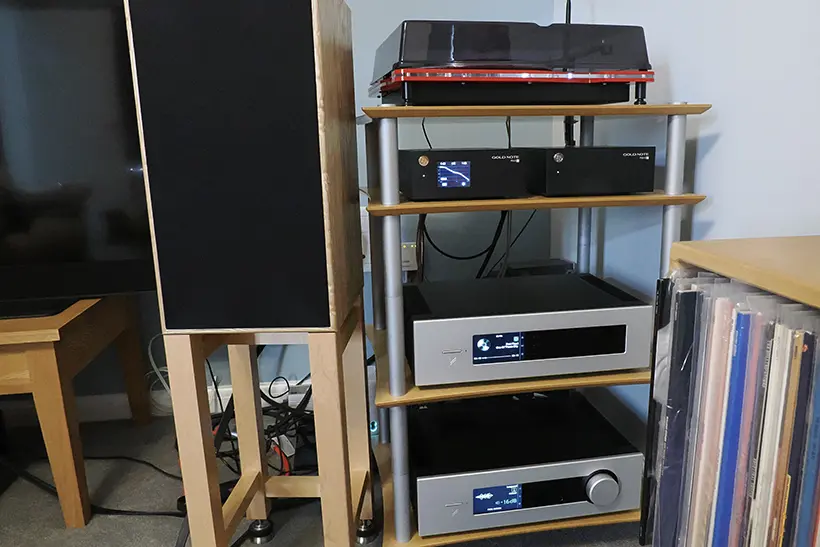
The unit can be operated in either integrated amplifier or preamplifier modes, and although I could not test it in that latter mode I am sure it would work very well if pressed into service this way. In terms of dimensions it conforms to what I tend to think of as standard full width hi-fi. Its vital statistics are as follow – 445×134.5×348 (WHD) and it weighs in at just over 17kg. Once installed on my venerable (17 years of faithful service so far) Quadraspire XL rack it looked quietly impressive..
Now let us turn to the matching Platina CD Transport, henceforth to be described as the CDT. This, as the name implies, is a device with but a single purpose. It takes the digital signal from a regular compact disc, as well as from CD-R and CD-RW and data CD and feeds it via either an optical or coaxial cable to a suitable DAC.
But wait. There is one more trick up the CDT’s rather elegant sleeve. It will also play music from a PC or streamer but only has a USB C input, with a veritable alphabet spaghetti variety of compatible file formats (6 in all). So no SACD playback, for those of us with single layer discs in that format. This because such discs require a proprietary transmission system to get the signal out to a suitably equipped DAC, SACD transports are extremely rare beasts. In the end It didn’t matter, but we’ll get to that later.
The design of the Platina CDT is a perfect match to the Platina amplifier, with a very good colour screen and buttons for stop/eject, pause and for access to the system menu.The CD mechanism is a drawer that comes out with a decent depth tray on which to place the disc. I greatly prefer that to posting my CD into a slot in the fascia. The CDT has similar dimensions to the amplifier and weighs in at a still chunky 10.9 kg.
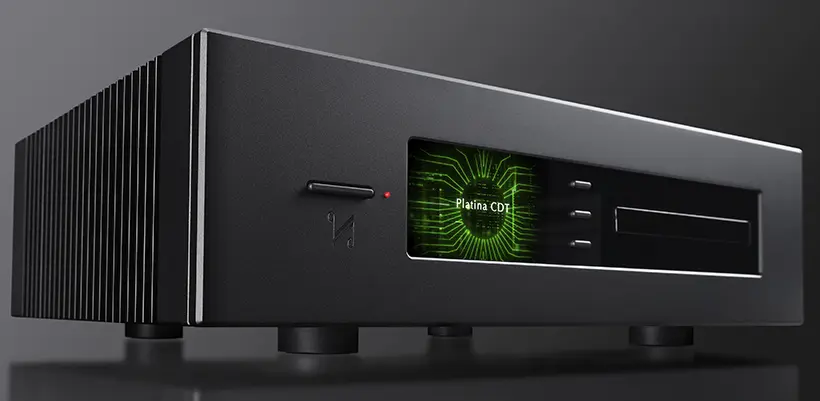
Installed on the shelf immediately above the Platina amplifier the CDT really looks the part. Once powered up both screens (which can be configured to the user’s preference) come alive and have real personality. Both units come with a long wand remote control which feels good in the hand but lacks backlighting for the buttons, which would have been handy in my relatively underlit lounge. The good news is that one remote can be used to control both units, reducing clutter and providing a spare should you ever lose one down the back of the sofa.
For the duration of the review period the bits that went to make a complete system were my own Vertere DGX turntable with the Mystic II MC cartridge on the Grooverunner arm, the GoldNote PH5.2 phono stage powered by the new 5.2 PSU and my trusty Harbeth C7ES-3 XD2 standmount loudspeakers. Cabling was either Vertere or Tellurium Q. I did not deploy my streamer, so all my listening was done with a physical medium supplying the sound – how old school is that? Quad have released a matching streamer by the way but that was not on hand for this review.
Listening to the Platina Integrated
Having warmed the Platina units up for a day without even sitting down to listen, I started my review session with my usual selection of vinyl discs, with a few extra plucked from the various storage spaces around the house. I ended up with some jazz, some late ‘60s rock, some ‘70s rock, some blues, some choral music, some Americana and some hard to pigeonhole stuff too (take a bow Shpongle).
Chosen almost at random, first up on the Platina was the Paul Chambers Quartet’s Bass On Top, which I haven’t listened to for a while. Recorded on a single day in July 1957 at Rudy Van Gelder’s studio in Hackensack, New Jersey by four musicians who had a day off from their regular gig with Miles Davis. Paul Chambers plays bass, with Kenny Burrell on guitar, Hank Jones on piano and Art Taylor on drums. As you might expect the eponymous band leader’s bass playing is more prominent on here than when he is doing sideman duties for Miles or others, and he is able to spotlight his wonderful bowing and plucking technique on this collection of six songs. Enough musicology. How did it sound?
In a word – spellbinding. The Platina made the speakers disappear and the four musicians took up their positions in an immense three dimensional soundstage. With the volume set to a realistic level the music ebbed and flowed effortlessly, with generous space being given to all the players. I was able to isolate different parts without losing the sense of reality of the performance. Art Taylor’s subtle brush work behind the leader’s bowed bass, Kenny Burrell’s delicious tone and Hank Jones delicate phrasing on the piano all coalesced into a memorable hour of listening.
From there, I played a recording from about 10 years later with the Platina amplifier, Love’s masterpiece Forever Changes, in this instance on the Mobile Fidelity double 45rpm release. This sounded majestic through the Platina, in The second track A House Is Not A Motel there is an instrumental wig-out that literally had me out of my chair. If any insouciant youth asks what was so special about the 1960s, play them this track – loud! I don’t often think this but in this case I think bigger speakers might have been even better. The instrumental crescendo sounds chaotic but through the Platina I was almost inside the studio with the band. Not bad for a recording now one year shy of its eighth decade.
Are you still with me?
Let’s move forward to the introduction of the Platina CDT to the proceedings. Now don’t get me wrong, I have never been a member of the CD is Dead club, nor would it cross my mind to donate my discs to the local charity shops. However, I only rarely opt to play a CD in my excellent Yamaha CD-S3000, which has been with me for 12 years now. Not because I don’t like them but because I am a vinyl junkie. Every so often I do have a day of SACD only music, because I can, but I have rather neglected my very large collection of regular CDs. The Platina CDT gave a great excuse to dig out the portable disc folder that I used to take to the Bristol Show before everything was done from a MacBook (Luddite? Moi?)
On 19 April to be precise, the death was announced of a gentlemen called Dave Mason, who was one of the founding members of Traffic. One of the first discs I saw as I opened the portable CD carrier was Mr Mason’s first solo album Alone Together from 1970. This copy happens to be a treasured gold CD from Mobile Fidelity. Switch inputs on the amplifier, open the CD tray and pop the little disc on, face up. Press Close. A cute graphic on the Platina CDT shows a spinning disc then the usual time and track info. I return to my seat and press play. The first song is Only You Know And I Know, which was subsequently covered by several other noted artists. But this is the original and good heavens it sounds good. Very good. Turn up the volume and we are now in amazing territory for four minutes and seven seconds of musical greatness.
As the day wears on and I troop back and forth every 30 or 40 minutes to change the disc I realise that in the right system the humble, downtrodden and slightly passé compact disc is a very long way from being dead. In fact, I then had almost a week of playing mostly CDs and not finding them wanting at all. I really hadn’t heard a pure CD transport like the Platina in I don’t know how long but it was certainly a compelling listen.
Just as another example, Jennifer Warnes Famous Blue Raincoat on a 24K Gold CD by Cisco. The atmosphere on these recordings of Leonard Cohen songs by one of his former musical collaborators had me glued to my seat from the first four bars of First We Take Manhattan. In fact I got quite wobbly – the emotional impact was immense.
The big finale
Thank you for staying with me this long. These Platinas are spectacular music making machines. If you went shopping tomorrow with £5,000 burning a hole in your pocket, you would come home with the heart of a fantastic music making system and about £2 in change. If you can forego the Platina CD transport the amplifier will set you back around £3,500. And here is the paradox – that is a lot of money but it is also a bargain. Why, because depending on your age etc, it may well be the last amplifier you need to buy. The core of the Platina – the A/B amplifier – does its job superbly. Extremely musical, insightful, with great timing – all the virtues we seek for our music reproduction.
I only used the DAC with the Platina CDT but between the two they managed to sound more analogue than almost any other digital replay system I have heard. The phono stage should be good enough for all but the most picky vinyl enthusiast.The user interface is pleasant – I set the display on the amplifer to be a pair of VU meters, which always keeps me amused – and the remote control is straightforward to use.
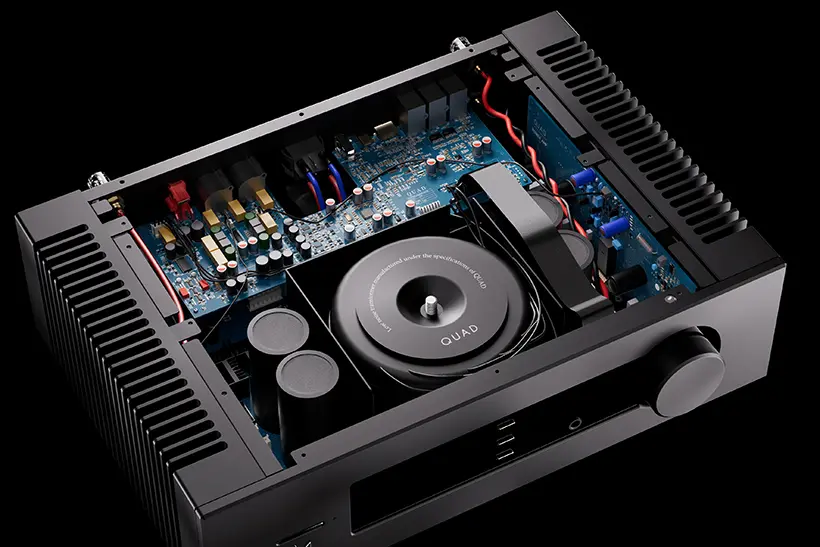
I can’t confirm how good the build quality is inside the Platinas, but close inspection of the outside fills me with confidence. The silver finish on these review samples is impeccable. I have great faith in the integrity of Peter Comeau and the Quad design team, and IAG seems to take its collection of legacy British brands very seriously. What’s more, both units come with a three year warranty here in the UK and the Quad repair and engineering centre is still in Huntingdon as it has been for decades now.
Funnily enough, I took on this review mainly to hear the Platina integrated amplifier., and I have been absolutely delighted with it. The Platina CDT was bundled in at the last minute, but it has been the real surprise for me. It has rekindled my enthusiasm for the Red Book standard music carrier, the compact disc. Did you know that Sony and Philips signed off on the Red Book in June 1980 and here we are in the same month 46 years later and I am getting all misty eyed about the sound from this little silver spinning disc. Talk about planting your flag at the top of the hill. Quad’s standard flies proudly up there, proclaiming to the world ‘CD is not dead’. Hell no, not while products like the Platina CDT keep showing up.
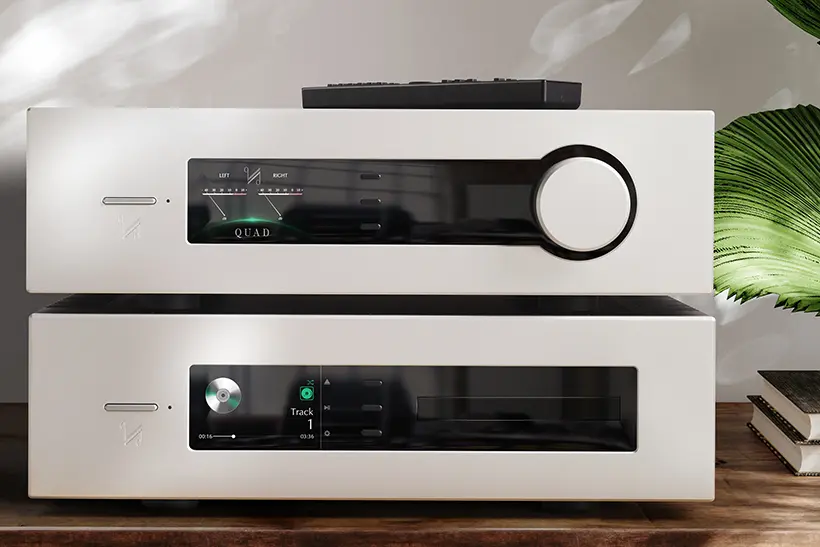
The Platina CDT and Integrated amplifier are not just good products – they are great products. ‘The closest approach to the original sound’? I don’t know, because I wasn’t there when any of these recordings were made, but I tell you this – as long as companies like Quad keep bring products like these to market the hifi industry has a rosy future. Peter Walker’s legacy is in safe hands.
Pros
Exceptionally musical, detailed and engaging sound
Superb CD transport revives Red Book CD playback
Powerful, refined amplifier with excellent connectivity
Premium build quality and intuitive user interface
High-quality built-in DAC and capable MM/MC phono stage
Cons
Expensive as a complete amplifier/CD transport package
No SACD playback support
Remote control lacks button backlighting
Large, heavy components require ample space