

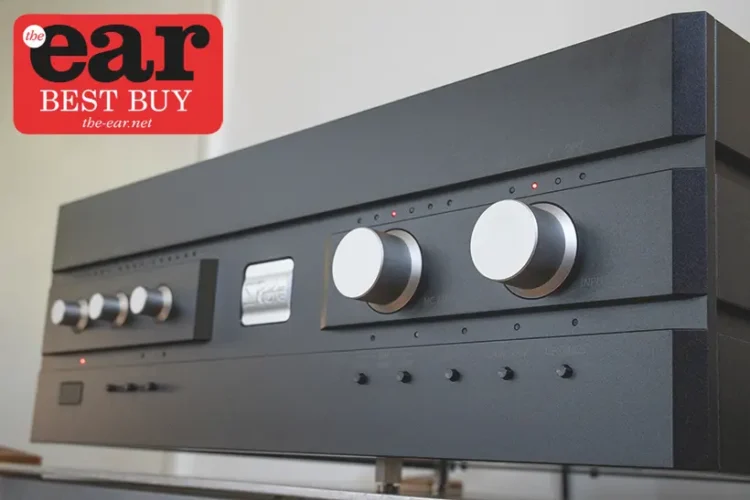
Soulnote E-2 ver.2 phono equaliser
When most companies call a phono stage an equaliser this is a reference to the RIAA EQ curve required to invert the response used to master a vinyl record, it’s a basic necessity for any phono preamp/stage, call it what you like. Soulnote’s phono equalisers go significantly beyond this and in the case of the E-2 ver.2 provide the means to equalise for records cut with the proprietary slopes chosen by record companies prior to the ascent of the RIAA (Recording Industry Association of America) EQ introduced in 1952. If you are a fan of records with different EQ a phono preamp that offers a wide range of curves is a real boon.
That is just one of many features offered on Soulnote’s E-2 ver.2 second tier phono equaliser but it’s something that you will be very hard pressed to find on a competing product at anywhere near the price. In fact I doubt there are many phono preamps that can offer as many features as this substantial Japanese design at any price.
Soulnote is a bit of an enigma in our world, it builds high end electronics in Japan with the sort of costs that involves and the limited scale of production found in this business, for prices that are distinctly lower than most in the high end. You can easily pay the asking price of the E-2 ver.2 for a phono stage with only impedance and gain settings in a much less sophisticated chassis. The answer must partly lie in the fact that the people behind Soulnote come from a mass production background, notably with Marantz where Chief Sound Director Hideki Kato earned his stripes.
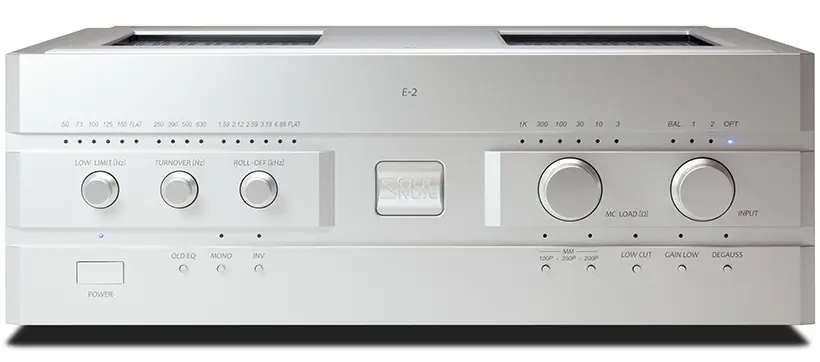
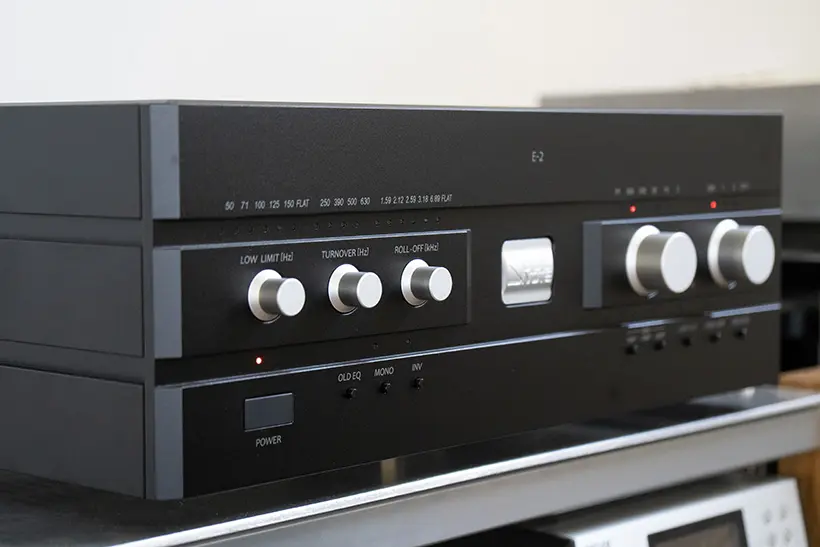
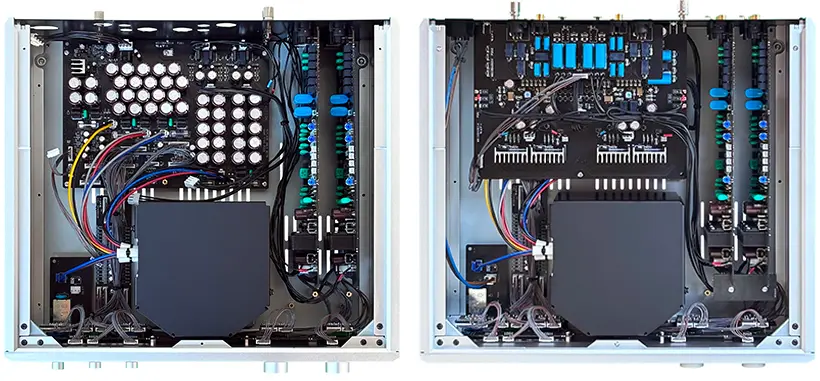
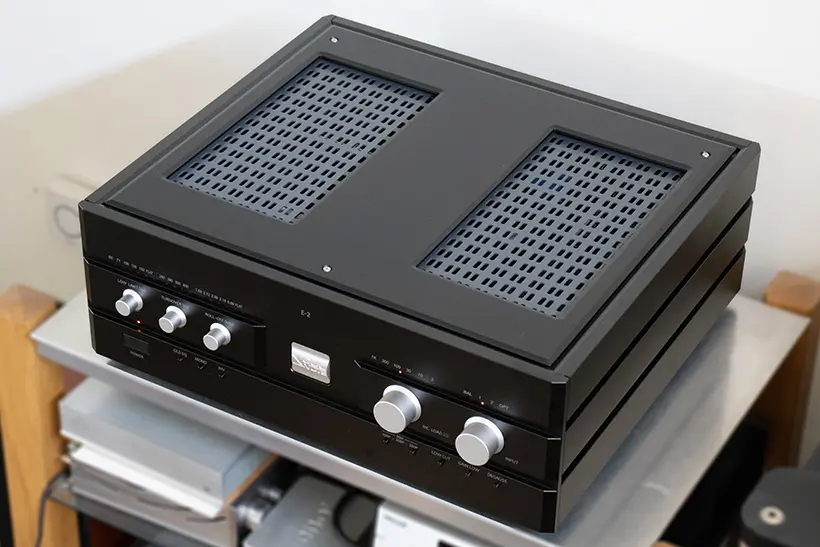
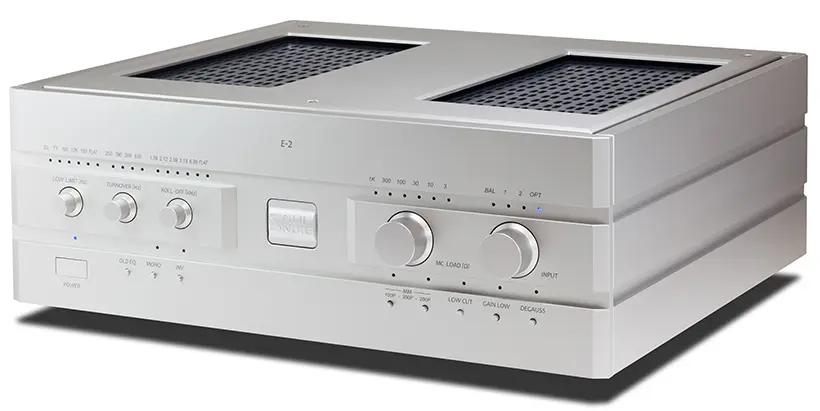
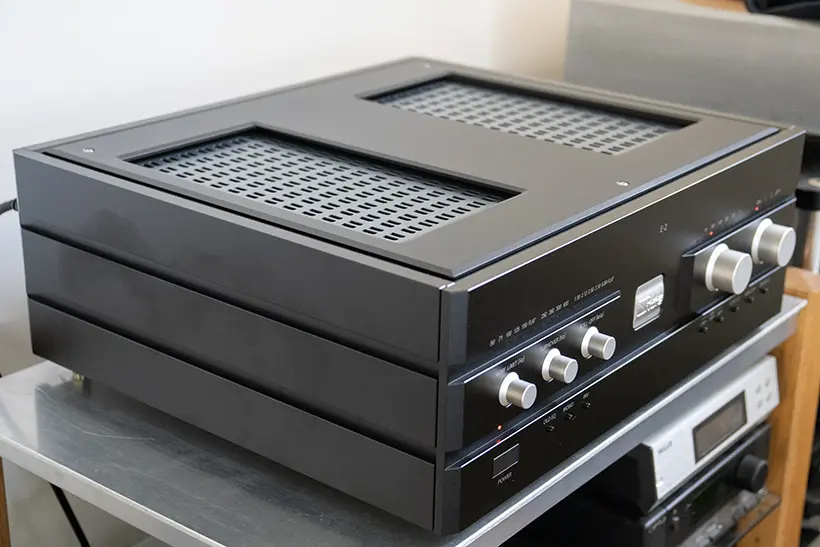
The Soulnote E-2 ver.2 is a substantial piece of kit that weighs in at 20 kilos and stands 16cm (over 6”) high, this is not just ballast either, there are an awful lot of components within the precisely machined casework. This includes a negative feedback free equaliser circuit built in a twin-mono configuration for best channel separation, four inputs, six moving coil impedance settings and the aforementioned equaliser curves. This consists of six roll-off settings (high frequency attenuation), four turn-over options (low frequency amplification) and six low-limit settings (ultra-low frequency amplification restriction) which are independent of one another.
Which means that you can dial in 144 different EQ curves to suit vintage recordings from a wide range of labels as well as something called SP records, which were cut flat with no EQ. Apparently some labels were using their own curves up until the 1970s – format wars are nothing new. Soulnote provides a list of labels and eras with the appropriate settings to apply in order to hear the correct balance on playback, these include Decca (both British and American), Columbia, Blue Note and many, many more. As some of these releases are from the pre vinyl era this applies as much if not more to shellac discs so is a minority interest but one which has a strong following. It would be thrilling to hear some of the original blues 78s artists via the E-2 ver.2 for instance.
The Soulnote E-2 ver.2 offers another rather more up to date feature in the form of a type R circuit for optical cartridges with power supply outlets in the form XLR sockets. The only player in this field is DS Audio whose cartridges require a totally different type of preamplifier which was originally sold with the cartridges, the company made the circuitry freely available a few years ago and now there are a number of electronics brands making compatible preamplifiers. This is one of four inputs on the Soulnote all of which can be connected simultaneously albeit only one can be used at a time. This is another uncommon feature that will be a boon to owners of multiple turntables or examples with more than one arm and cartridge. It’s worth mentioning that one input is for balanced cartridges and offers XLR as well as RCA sockets.
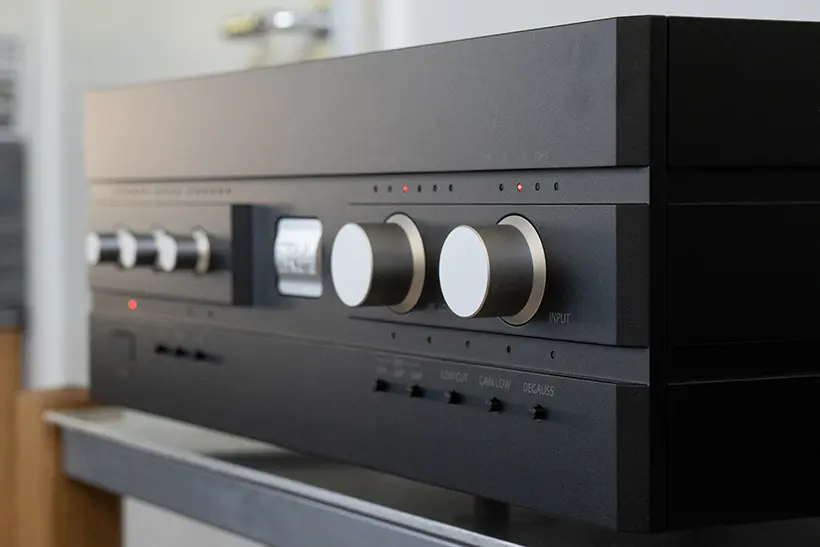
Other options provided on the E-2 ver.2 are a mono switch for the most desirable examples from the early Beatles catalogue and beyond, phase invert, a rumble filter designated low cut and low gain for those rare occasions when cartridge output is too great for the input. MC gain is fairly high at 77dB which means that this is a possibility with high output examples. MM is a typical 55dB and optical 32dB.
It’s worth noting that like other Soulnote pieces the E-2 ver.2 has three metal feet one of which acts as a mechanical grounding point for the power transformer. A set of three spikes are supplied which can be used instead of the pins should you like to live dangerously.
Sound quality
I used the Rega Aphelion 2 moving coil that lives on my Naia turntable for the majority of the listening, it has a preference for 100 ohm input impedance and enjoyed the high gain of the E-2 ver.2’s MC stage. The higher 300 ohm input loading was tried but while it added a bit of energy did not work as well as the recommended option. The result was very engaging indeed and unusually easy to live with.
The Rega pairing is very revealing indeed and that includes the bad stuff as well as the good, most of my vinyl sounds good to spectacular but some contains a degree of forwardness and/or compression that makes full revelation a little challenging. Typically this is instruments or voices that have been recorded on the hot side, with saxophones and other brass being the most common culprits. This is not solely the case with vinyl of course, digital reveals similar shortcomings when transparency becomes high. I very much enjoyed the way that the E-2 ver.2 manages to deliver the dynamic peaks without the usual accompanying hardness. This infers that it is soft sounding phono stage but that is not strictly true, a better word is generous, it doesn’t emphasise recording shortcomings and in the process makes all manner of material more approachable.
The E-2 ver.2 has a real knack for revealing tone, be that from instruments or voices and revels in the more textured timbres. I particularly enjoyed Leonard Cohen’s deep, gravelly voice on the version of The Jungle Line that he made with Herbie Hancock. The bass is well extended but clear, well defined and full of character, allowing both the voice and piano full range of expression. The absence of apparent effects on the piano makes it sound more real in this instance but who knows what laughing Lenny actually sounded like at that time and place.
I played a couple of vintage mono LPs to see what the E-2 ver.2’s mono switch would do for them, Muddy Waters’ Folk Singer was superb, producing decent depth of image through sheer reverb and plenty of energy and tension as he sang about wanting to go home with a schoolgirl on the premise that he “once was a schoolboy too”, times have clearly changed! Still, it was easy to hear why Brian Jones, Keith Richards, Peter Green and many more were so inspired by such artists. This sounded great as did Sonny Rollins horn on A Night at the Village Vanguard which had fabulous tone, mellow but upbeat over an easy groove, it was easy to hear why he had such a long and fruitful career. In both cases the mono button made a small improvement but not as great as I have encountered in the distant past. I tried to find some vinyl without RIAA EQ but what little I have is buried in the collection so deep that this proved fruitless.
I also tried a moving magnet in the form the Rega Nd9, initially I couldn’t find an MM switch but realised that by selecting one of the capacitance settings this defeated the impedance setting and thus changed the input gain. The result was highly musical with lots of body and detail but it lacked the speed and spaciousness of the MC, this is no surprise of course but those who enjoy the many qualities of moving magnet cartridges will find a lot to like in the E-2 ver.2. I got a great result with Sarah Siskind’s Times Square, her voice isn’t the sweetest yet it’s highly expressive and the way that the Soulnote/Nd9 took the hardness off without undermining the emotional impact was particularly engaging – the presentation resolute without dissecting the recording.
Back with the MC and the violin maestro Mari Samuelsen things were pretty spectacular, her album Mari is a remarkable thing and in the hands of the E-2 ver.2 the playing soars to considerable heights, the presentation is relaxed yet not soft, forgiving but also revealing. All of which makes it very easy to enjoy, there’s a Phillip Glass piece on this that reminds me of Arvo Pärt albeit without the profound misery. This builds up a big, timbrally rich aural picture that you can almost walk into with the Soulnote and inspired me to dig out some of the Estonian master’s works for some full immersion journeys through the bleak era of Soviet oppression. Top light entertainment it is not.
I finished up with the rather more upbeat Making Music by Zakir Hussein, John McLaughlin, Jan Garbarek et al, this once more revealed the E-2 ver.2’s ability to reproduce the magic of the music without emphasising the forwardness of instruments like Garbarek’s horn. It was certainly very easy to appreciate the remarkable speed and dexterity of Hussein’s tabla and the beauty of McLaughlin’s acoustic guitar.
Conclusion
The Soulnote E-2 ver.2 offers a lot of high quality audio engineering for the money. If you are interested in vintage recordings I don’t think there’s anything near its price that can offer the variety of EQ curves that it provides. It is also hard to think of competitors that offer the same build quality. There is also the optical input to consider, DS Audio cartridges are growing in popularity and many were in use at the recent High End, in fact I have requested a sample to try with the Soulnote and will add my observations when it turns up.
The E-2 ver.2 doesn’t offer quite the dynamic expression that more purist alternatives can muster but makes up for this with a generous presentation that makes more music accessible than much of the competition. I didn’t find a record that was anything less than enthralling in its capable hands, which for a design that’s so well equipped is a remarkable achievement.
Pros
Exceptionally natural, engaging and forgiving sound
Comprehensive feature set with vintage EQ curves
Superb build quality and extensive connectivity
Supports multiple cartridges, including DS Audio optical
Excellent tonal richness and musicality
Cons
Large, heavy and expensive
Not quite as dynamically revealing as purist rivals
Specialist features will go unused by many listeners