

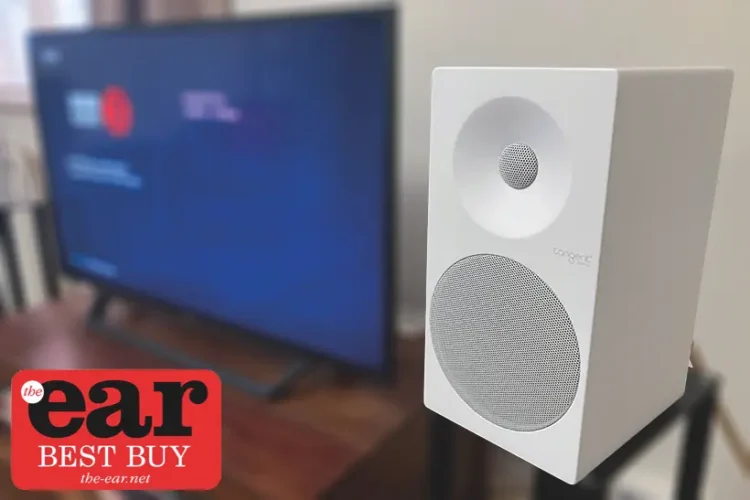
Tangent Spectrum II X5 speakers
Danish audio brand Tangent describes its history as ‘a story of sound and design’ for over two decades, it is part of the AV Industry Group which encompasses Lumene projection screens, Eltax and Elipson speakers, Norstone audio furniture. The company prides itself on remaining in touch with both technological developments and design trends. The team of experienced acousticians has worked extensively on built-in digital sound processors which grace the more upmarket products.
Scandinavian minimalism describes the aesthetics which involve external designers on selected products as well as those created in-house. The company forged a partnership in 2010 with Jacob Jensen Design and the launch of the co-developed Tangent Fjord was followed, in 2015, by the Bluetooth speaker Tangent Fjord Mini.
The Tangent philosophy is centred on prioritising quality over and above the ability to produce audio products quickly and at very low prices, as this can compromise key components. Thus, each model is approved by its quality technicians and specially trained acousticians before being released to market. Alongside passive loudspeakers, there are powered and wireless versions plus Tangent electronics including amplification and CD players.
Design
The new Tangent Spectrum II X5 is an upgrade on the first Spectrum series, offered in either satin black or white. I am not a huge fan of white hi-fi; white goods belong in the kitchen to my mind – but in this case, the units are so compact that the effect is not overbearing, plus they match my white-finish Hegel H190 rather nicely: presenting a modern, sleek appearance.

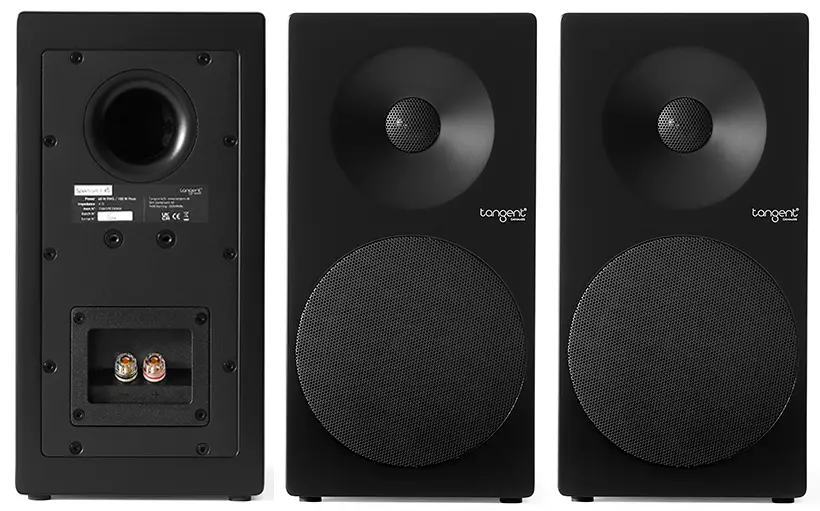
The renewed Spectrum line up comprises two bookshelf designs, of which the X5 is the larger, a floor-standing X6 plus Spectrum subwoofer and XLCR wall-mount model along with a centre speaker which looks ideal for home theatre applications. The two-way reflex design Spectrum X5, now in mark II form, combines an enlarged (130mm) cellulous fibre-coned mid/bass unit with a 25mm done tweeter, crossing over at 2.5kHz. The advertised output range (+/-3dB) is 60Hz to 20kHz using a recommended amplifier with 60-100W output. Sensitivity is a decent 88dB albeit with a nominal 6 ohm impedance, it should thus be suitable for a wide range of modern amplifiers.
The cabinet has been enlarged slightly over the initial version, but the rear port seems well designed and allowed placement fairly close to the rear wall without bass issues. While grilles are eschewed, wall mounts and even ceiling mount kits are available as optional accessories. Overall, build quality appears excellent and the retail price can only be described as competitive in what is a crowded market.
The organist entertains
The units were supplied run-in and I connected my Hegel H190 and placed the speakers atop some Custom Design FS104 stands, half-filled, and noticed that the Spectrum II X5 has rubber feet at each corner of its base. Their arrival coincided with news that Nigel Ogden, who for 40 years was The Organist Entertains (on BBC Radio 2), had died and this prompted me to reengage with some of his repertoire. I was amazed to find so many commercial recordings of his performances available, and so much that is not typical ecclesiastical repertoire.

While organ material is perhaps an unfair choice for a diminutive loudspeaker the little Spectrum II X5s did remarkably well. The bass that is generated is clean and Tangent has clearly avoided the trap which befalls so many designers of cheaper transducers of wanting to excite the listener with faux low-frequency information which can so easily excite room resonances and lead to a rather lumpy bottom end response. No, the Spectrums maintain a lovely and lively bounce to the beat, such that one’s feet tap along to the rhythm.
Using the Atoll pre/power combo of ST300/AM300EVO sonically the match could not have been better, even if the pricing was a little off the scale. BBC Radio 3 had a lunchtime recital featuring Shostakovich’s Piano Concerto Number Two with lots of lovely ambience from the venue coming across via the Spectrum II X5s. It made me turn to the 1958 mono recording with the composer at the keyboard. This emphasised Tangent’s desire to ensure that the Spectrum II X5s sound refined given acoustic music, delivering it with more than a degree of finesse. There is plenty of detail in the reproduction of an instrument which many lesser speakers will struggle with. The speakers produced a natural sounding piano, as brisk and lively as I’ve ever heard it, and I noted how the tweeter adds a lovely sparkle to the top-end while the midrange is clean and free from unwanted artefacts which could mar the output.
Midrange clarity was confirmed during many hours of speech-based material including TV soundtracks and radio drama, much of which is very familiar to me and some where I was at the recording itself. Voices sounded natural in a balance that was overall clear, clean and sweet.
The modern way
Vocals, also, were handled well by the Spectrum II X5s, which are thankfully not designed to project them forward and putting the performer in the listener’s lap which can be the ‘modern way’. With T’Pau’s 1987 hit Heart and Soul the X5s handled the multi-layered production better than I had expected. Carol Decker’s powerful vocals were well balanced, in the right place and the right proportion. The stereo soundstage extends beyond the loudspeaker cabinets and I moved the Spectrum II X5s further apart without creating any ‘hole in the middle’ to create an enormous soundscape. The track’s distinctive blend of spoken-word verses and its driving, high-energy chorus can be presented as an unpleasant, muddled blur. Not here. We are treated to excellent reproduction of the atmospheric opening before it builds into the fast-paced, synth-heavy rock anthem which lost very little via the Tangents. Impressive stuff.
Conclusion
I know how much French audiophiles adore Elipson loudspeakers from the same parent company but I think my vote is in favour of Tangent if the Spectrum II X5s are typical of the marque. They have a delicious sparkle in a rather refined top-end, a sensational presence region and midrange plus bass that’s anything but boom-boom.
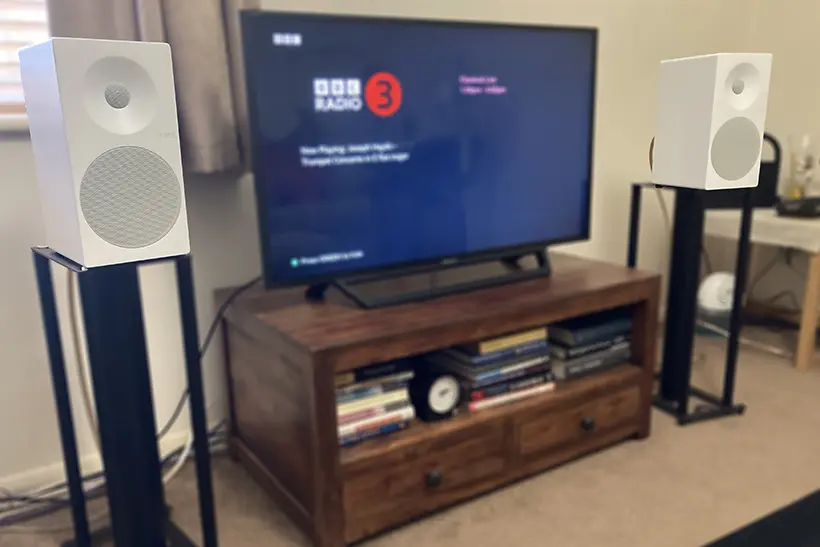
The Spectrum II X5 represents excellent value-for-money, helped by Far East manufacture, and matches well with a huge range of amplifiers. Not only is it suitable as a main hi-fi loudspeaker in smaller rooms, but is perfect when placed either side of a TV or screen. The smaller X4 variant may be more suitable for desktop placement while the X5 is very much at home on living room furniture, not forgetting the wall-mount option which would probably come into its own in many spaces.
All in all, Tangent has a superb product in its newly improved Spectrum II X5 and can be proud of the overall refinement and finesse of the design which wins my firm seal of approval as an undoubted Best Buy.
Pros
Refined sound quality: Features a ‘clean, sweet, and natural’ sound profile. The midrange is noted for its clarity, making it excellent for both vocals and speech-based media like radio dramas.
Controlled bass: Unlike many budget speakers that use ‘faux’ low-end to impress, the X5 offers a clean, rhythmic bass that avoids room resonance or ‘muddiness.’
High-end ‘sparkle’: The 25mm tweeter provides lovely top-end detail and atmospheric shimmer without becoming harsh.
Impressive soundstage: Capable of creating an ‘enormous soundscape’ that extends well beyond the physical cabinets, maintaining a solid centre image even when placed far apart.
Aesthetic & build: Features a sleek, Scandinavian minimalist design with a high-quality satin finish (black or white). The build quality is described as excellent for the price point.
Versatile placement: The rear-port design is well-engineered, allowing the speakers to be placed relatively close to rear walls. They are also compatible with optional wall and ceiling mounts.
Value for money: A ‘Best Buy’ and highly competitive within its price bracket.

Cons
Size limitations: As a diminutive bookshelf speaker, it may struggle to reproduce the full scale and deep authority of massive instruments like a pipe organ compared to larger floorstanders.
Impedance: With a nominal 6-ohm impedance, they are slightly more demanding than standard 8-ohm speakers, though they remain compatible with most modern amplifiers.
Non removable grilles: The design eschews traditional speaker grilles in favour of individual driver grilles that are designed to be left in place.
Subjective colour palette: While sleek, the satin white finish may not appeal to those who prefer traditional wood grains or darker ‘hi-fi’ aesthetics (though a black option is available).