

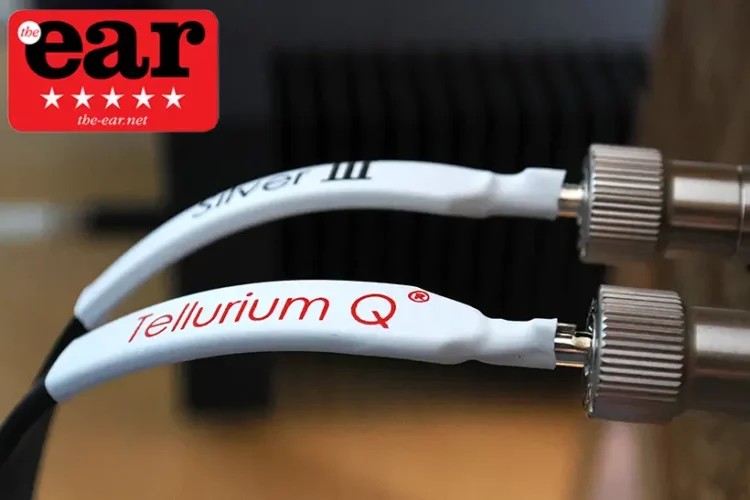
Tellurium Q Silver III speaker cable
Here is a question for our UK readers – what do you think of when you hear the word Somerset? Perhaps you think of scrumpy cider? Perhaps, if your interest extends to sport you think of Sir Vivian Richards, the cricketing legend? Me, I think of Tellurium Q and their wonderful portfolio of audio cables. My wife says this is because I am an anorak, which may be true, but I prefer to think of myself as connoisseur of fine audio products.
After many years of hearing what comes out of Langport, I have no doubt that Geoff Merrigan and more recently his son Ben have created a family of products whose performance at every level demands the attention of music lovers looking to wring the last morsel of performance from their audio systems. There is much to admire, from the Blue series, which focuses on helping to smooth out any slight brightness in a system, the Black series, designed to be transparent and life-like in its presentation, the Silver series, which brings added openness and a slightly more dynamic sound, through to the Statement series, which brings a money-no-object, astonishingly musical performance to high end systems.
In my own system, I have been using the Ultra Silver II speaker cables for a while now. Compared with everything that went before them, I have found them to be the very last word in transparency and musicality. Therefore when Geoff called me and asked if I would be interested in comparing the new Silver III with the outgoing Silver II I was sufficiently intrigued to take on the task.

A pair of each duly arrived, and were carefully unboxed and examined. Visually, they are in the same slim form factor as my own pair of Black II speaker cables, which to this day I consider to be the best value for money cables that I have actually bought for my own use. This means that the Silver II and III are very easy to work with and are relatively discrete compared with the much larger Ultra Silver IIs that I use these days. As always with Tellurium Q loudspeaker cables the banana plugs fitted to both sets of Silvers look and feel like high quality components and with clear red or black script and directionality arrows on the white sheath that protects the area where plug and cable are connected.
I have been an audio anorak for more than four decades now, which means that I have been kneeling, bending and stretching to get audio cables in and out of the components on my system rack for a long time, and I can tell you that it is still the least favourite part of my audio life. The fact that I can easily see what goes where with Tellurium Q products is actually a real plus point. I gave both sets of the Silver speaker cables a good couple of weeks in my system to let them settle in without any critical listening being done.
At the beginning, I was using my own Primaluna EVO300 Hybrid Integrated amplifier with my usual Harbeth Compact 7 ES-3 XD loudspeakers. The source components were my Vertere DG X turntable with the Mystic II moving coil cartridge playing into my Gold Note PH10/PSU phono stage and a venerable (purchased nearly 12 years ago) Yamaha CD-S3000 SACD/CD/DAC . Interconnects were Vertere Red between the phono stage and the amplifier and Tellurium Q Silver III between the Yamaha and the amplifier. Later in the review I had a Primaluna EVO 300 Hybrid power amplifier with matching EVO300 valve preamplifier here for review, but more of that later.
Silver II vs Silver III
In the years that I have been involved in this reviewing malarkey, I have not often had the opportunity to compare an outgoing model with its successor, which is a pity because it is a very interesting exercise. However, I have met the senior and sometimes only product designers for a company and I have yet to meet one of them who is not confident that the latest iteration of any given product will offer a significant improvement on its predecessor. Geoff Merrigan is so confident that this is not the first time he has sent me a copy of both in order for me to share my opinion as to whether the new outperforms the old. In order to do that with the Silvers I switched them over every three or four days for several weeks of listening.After a few iterations I could tell by the sound which was which, because the difference was not subtle.

Starting with Silver II I cued up one of my ‘old faithful’ albums, Dave Alvin’s Eleven Eleven, which features his rich baritone voice supported by a battered Stratocaster and and a small band of expert sidemen – atmospheric Americana of the highest order. As the opening notes of the first track Harlan County Line flowed through the Harbeths I was fully engaged with the music and the storytelling in Alvin’s lyrics. Moving on to Johnny Ace Is Dead the effect was almost cinematic as the characters in the lyrics came to life in my head. At the same time tiny details floated into my consciousness. A breath taken here or there, a subtle tap on a cymbal and other tiny details were apparent – not distracting, just making the whole performance feel like being at a small venue with the band on low stage just a few feet away.
I then tried a slightly different, rockier American working man’s musician and got Bob Seger’s Greatest Hits compilation onto the Vertere’s platter. From the first track Roll Me Away I was locked into another master songwriter’s vision of his world. For most of the songs he is backed by the Silver Bullet Band, who were mostly friends of Seger’s from the Detroit area. Between them they created a body of work which has stood the test of time very well indeed. Any band with a saxophonist called Alto Reed must be worthy of attention – sadly he passed away in 2020 but his work in the Silver Bullet Band over a span of 42 years will live on.
When I subsequently swapped out the Silver IIs for the Silver IIIs I went back to those two first albums and played them again. This time I wasn’t a few feet from the stage. I was instead right in front of Dave Alvin – could almost feel his breath as he led us through the disparate cast of characters in his stories. The controlled power of the Silver Bullet band encouraged me to nudge the volume up on the Primaluna and once again these studio recordings sounded like live performances. The Silver IIIs had all the characteristics that I had enjoyed on the Silver IIs – the realism, the immediacy, the detail and then added a little extra bass weight to the proceedings.

The clarity with which performers were locked into place within the soundstage was almost startling and the soundstage itself was spread well beyond the boundaries of the loudspeakers in all three dimensions. Timing seemed a tad sharper too. None of this distracted from the music of course. It was as if the Silver IIs had been to the gym and under the watchful eye of a personal trainer had added some muscle and some intensity.
Two further swaps between the two sets of cables and I had heard enough to know that once again Tellurium Q had delivered on their stated intention, to take the good things about the Silver IIs and make them even better. I then received the two guest Primaluna pieces which required a dismantling of my whole equipment rack to accommodate them. I was tempted to sideline the Silver III and get its big brother back into the room but decided to keep the slimmer Silver in place.
The new amplification was given a couple of days to warm up without any serious listening. But I cannot stop myself being drawn into the room whenever music is playing and the SACD version of the Stones Let It Bleed was irresistible. Midnight Rambler was epic and deserved the extra volume at which it was delivered that day. As luck would have it we had a visitor come to stay, a friend from my teenage years and we both were huge Beach Boys fans (while our friends argued back and forth between the Beatles and the Rolling Stones).
I brought out two albums from that era and we played them one evening during his visit; Surfer Girl and Smiley Smile. These six decade old (OK 5.9 in the latter case) records sounded more vivid, more alive and far more intricate than they did back in the day. 1967’s Smiley Smile has so many tiny, subtle details woven through its very odd soundscapes as well as Brian Wilson’s two most epic recordings Good Vibrations and Heroes And Villains. “Wow” was all my friend could say as the last notes of Whistle In faded away at the end of Side Two. Wow indeed.
Conclusion
Should I upgrade from Mark II to Silver III is the sort of question I always fear, because spending other people’s money is all too easy. I’ll dodge it by saying this – ask your local Tellurium Q retailer to do what I have done. Play some music you know well through a system using Silver II, then play the same music through Silver III. If you hear enough improvement in the unmasking of detail, the sense of realism, the extra bass weight and the sheer musicality of the performance as I did then you will have your answer.

These skinny cables delivered a sound that is not far off what their much bigger (and more costly) siblings the Ultra Silver IIs give me. That is not damning with faint praise, it is giving them a big compliment because I absolutely love the sound of the bigger cables. For years I resisted silver cables because retailers would suck their teeth and tell me they were too bright for my system – whatever that was at the time. I now know that thanks to Mr. Merrigan and his skills as as a cable designer, Silver is most definitely for me, and the Silver IIIs are a relatively cost-effective entry point to the Silver product family. I know it is still only April, but I think I have just found one of my Products Of The Year: Bravo Geoff, mission accomplished.
Pros
Clear step up from Silver II: greater detail, sharper timing, and improved realism
Expanded, immersive soundstage with precise instrument placement
Added bass weight and dynamic impact without losing finesse
Highly musical and engaging presentation across genres
Slim, flexible design with quality terminations makes setup easy
Delivers performance close to pricier Ultra Silver models
Cons
Improvements over Silver II, while obvious, may not justify upgrade for all users
Still a significant investment for a “mid-tier” cable
Benefits depend heavily on system resolution and matching
Lacks the ultimate scale and authority of higher-end Tellurium Q models