

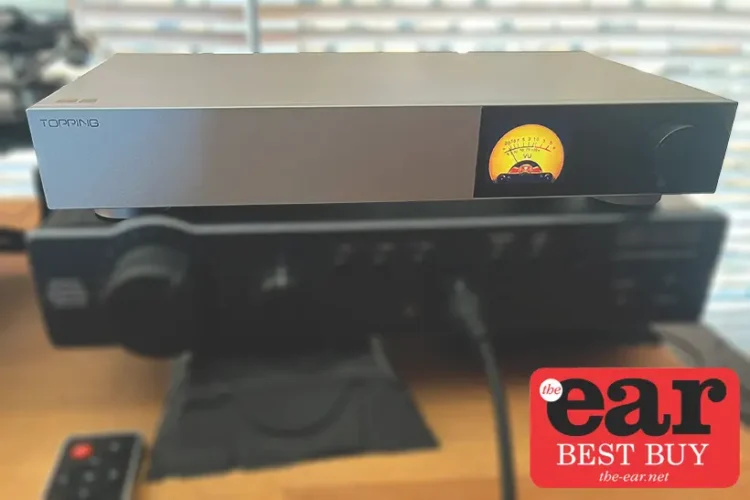
Topping D900 DAC
Does it really need to be said that the time is long past when made-in-China audio kit was almost always a copy of western designs? Today, not only do a very large number of the west’s audio companies rely on China for high-quality, low-cost manufacturing, but China’s universities are churning out bright young audio engineers on a mission to demonstrate original thinking to the world.
We see evidence for this in the rapid growth of Chinese audio brands including Topping, whose D900 DAC, recently available in the UK and the subject of this review, embodies remarkable technology at a truly disruptive retail price of £1,800.
Darling of that element of the audio community that puts test measurements above all other considerations, Topping’s products in the past have not always received universal approval. Even its earlier DACs and headphone amplifiers posted gravity-defying SINAD (signal-to-noise and distortion) scores, but some buyers (and reviewers including this one) could not get past the rather sterile and matter-of-fact sonic aesthetic.

The D900 shows Topping has listened to the market. The D900 will not disappoint objectivists – it measures exceptional well – but it combines the technical high-wire act with a sonic delivery that is such a contrast with previous generations of Topping DACs that I would not be surprised if, by simultaneously pushing both objectivist and subjectivist buttons, it becomes the company’s best-selling DAC by some margin.
In the hand, the D900 impresses. Topping’s presentation is of a quality that puts a lot of other brands to shame; the fit and finish of the transit box, the cushioning inserts, and the neatly packaged remote control, leads and Bluetooth antenna all bespeak attention to detail. When lifted free of its cocoon, the DAC is found to be flawlessly executed in CNC’d aluminium, with quality sockets on the rear secured with counter-sunk stainless fixings, a rectangular display window and nicely weighted rotary control on the front. The remote control is robust machined aluminium and button presses have a satisfying click. The D900 looks and feels like a product that Topping wants us to be proud of; high-end in a compact physical form that can be squeezed onto the kit table and hold its own visually with very much more costly components.
Pseudo 1-bit
Topping says the D900 is a 1-bit DAC. It is not the first audio manufacturer to make such a claim; I could name at least five other brands making similar noises. However, if we define 1-bit as being a single, perfectly symmetrical +1 / –1 polarity switch with no oversampling, no digital filtering, no internal multi-bit modulators, no DSP reconstruction and in which every clock edge directly forms the analogue waveform with nothing in between, then all of them – Topping included – fall outside the definition.

Pseudo 1-bit DACs convert the incoming music stream into 3-6-bit data and employ multiple parallel multi-bit switching arrays (the D900 has 32) and sigma-delta modulation along with extensive DSP, including digital decimation and multi-stage oversampling, often accompanied by FIR/IIR digital filtering. The resultant waveform is not native DSD, but a reconstructed approximation.
We might well ask why Topping and the others don’t just adopt the simple elegance of true 1-bit designs. The answer is cost. Underneath the apparent simplicity of true 1-bit decoding lies a minefield of technical challenge, much of it related to the extreme (and very expensive) clock accuracy required. It is ironic, but a matter of fact, that pseudo-1-bit costs a lot less, but is necessarily much more complex. The complexity leads to multiple attendant risks that include altered time domain, phase rotation, group delay, softened transients, pre-/post-ringing and code-dependent noise and switching artifacts. These are outcomes that only serious quality engineering can mitigate, and so we should salute Topping’s achievement. The D900 represents a masterclass in high-value, low-cost audio engineering and manufacture.
Topping 2.0
Of the D900’s generous array of inputs I chose to use the USB C socket, feeding it via a Kubala-Sosna Realization cable a mixture of PCM, DSD and DXD files from a linked pair of Euphony Summus servers running Stylus music player. I ran the DAC from its line outputs into the household monoblocks, having briefly used, just to confirm operation, the alternative outputs which offer 256 step relay-based volume control. I also briefly tried the Bluetooth 5.1 connectivity (LDAC, aptX Adaptive, and aptX HD) again, just to confirm that it worked as billed. I left the built-in 10-band equalisation set flat in order to get an understanding of the DAC’s native voicing, although I can imagine quite a few owners, especially head-fiers, might make use of it.

The overwhelming majority of listening was done with either Qobuz or the Summus servers’ internal SSD as the source, playing a mixture of PCM files from 16/44.1 upwards, and some DSD files. As noted in my introductory remarks, the D900 gives a reading that is very far from what we might have expected in the past from Topping. I recently spent time with the company’s Centaurus R2R DAC, also relatively new to the catalogue. At just under £1,000, the Centaurus shares the same sonic aesthetic and thus gave a teasing glimpse of what the D900 would shortly deliver. Both DACs sound tonally rich and dynamically muscular – perhaps we should call the new sound Topping 2.0. If we pay closer attention however, we find that beyond this similarity, they actually sound quite different.
Both are almost preternaturally quiet in measurement terms, but the D900 makes even better use of that silent backdrop to show us more of what is hidden in recordings than the Centaurus does. It has that elusive quality that I’ve heard some of the other (and much more expensive) alternatives deliver and that’s a heightened sense of naturalism and flow. Where the Centaurus sounds overtly (and enjoyably) technical, the D900 initially comes across as darker and less obviously in-your-face detailed. That’s until we realise that, in comparison to alternatives at its price-level and quite a way above, the D900 is subtly re-framing what we should understand by the term ‘detail’.

Bagpipes
In the second bar of the opening track on Sssht by Belgian folk band Wör, buried amid the robust main theme as it develops on accordion and bagpipes, a single note is quietly struck on a metallic object. Many DACs, if they don’t skate over it altogether, render this as a flat-sounding non-event; a performer’s mistake even. The D900 shows it not only to be timed to perfection to fit with the surrounding energetic sonic acrobatics, but also as a multi-dimensional event, with appropriate transient attack, inner tonal quality, and brief decay.
We hear too that the accordion and bagpipes – yes, apologies, I’ll wash my mouth out later – have more tonal and textural subtlety than we might have heard before, and that there’s a greater sense of naturalised impulsion to the playing. The band members are having a riot playing together and somehow the D900 lets us hear it.
The foregoing observation may cause frothing at the mouth in objectivist circles, but it is not correct that all DACs sound the same and it is true that some DACs – the D900 included – sound more like real live acoustic music because they better transcribe the temporal detail buried within recordings. Rather akin to the way that we might hear a poem recited by two readers, the first using a matter-of-fact, plodding delivery, the second using pace and inflection to engage with listeners. Same poem, different levels of enjoyment.

As a daily-driver package – considering the wide range of physical connectivity options, the Bluetooth, the preamp and equalisation functionality, and the comprehensive and actually quite easy to navigate user interface with its choice of ‘analogue’ VU meter, FFT or simple status displays – the D900 also ticks so many boxes.
In hi-fi terms, we’d expect the D900 to deliver a full and even bandwidth, and it does, of course. Nothing to see here. Topping’s voicing gives us a low-end that in the review system sounded notably powerful, but not to the point of crossing the line into colouration. Spatially, I found the D900 to be superior to the less costly Centaurus, adding a pleasing, if not startling degree of depth to a confident lateral placement of musical events.
As a partner to the review system’s Niimbus 5 Pro headphone amplifier, the D900 proved particularly satisfying. With parametric equalisation still left flat, its rich voicing and ability to portray inner details made late night listening sessions via a Susvara headphone a treat to be looked forward to.

Conclusion
Overall, the D900 is just so darned all-round competent that it is tempting to ignore the lowly price ticket and place it naturally within a hierarchy of alternatives four, five times its cost.
Some readers may take thin joy from learning that Chinese audio brands are just as competitive between each other as they are with western companies. It’s easy to imagine Denafrips, for example, for some years arguably the most ubiquitous of Chinese DAC brands, looking on the D900 with anxiety. And well they might. Musically satisfying, functionally powerful and even against its made-in-China rivals highly affordable, the D900 is a worthy flagship for Topping: a lot, an awful lot of DAC for the money.