

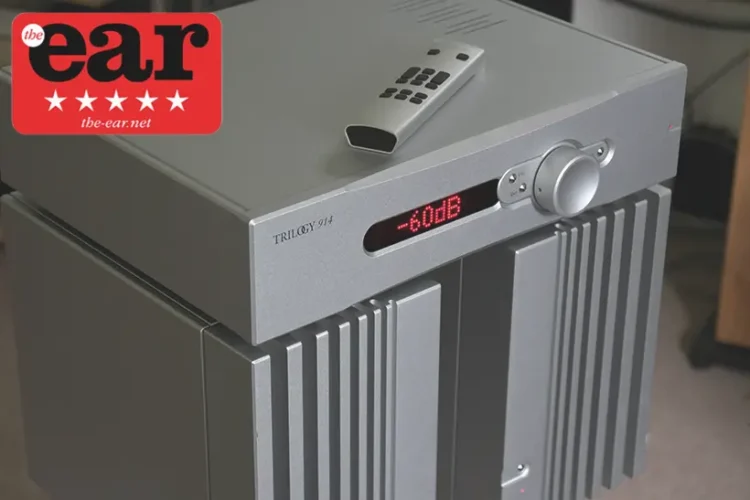
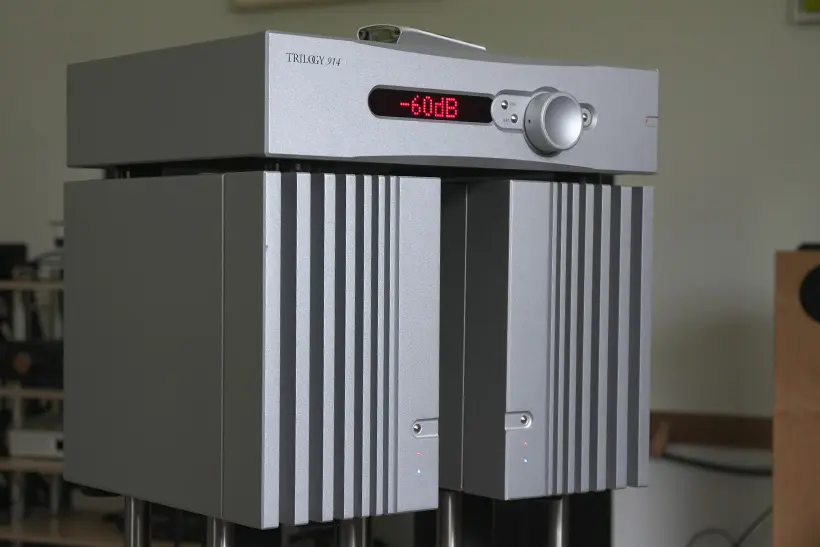
Trilogy 914 preamplifier & 994 power amplifiers
Trilogy head honcho Nic Poulson is a workaholic, every time we meet he is envious of those with a healthier work/life balance, but you don’t get to run an audio electronics company for over 35 years by taking it easy – Nic has chosen a path that requires dedication. It has paid off with a range of often tube based components with build quality that puts them in the premier league. It’s hard to think of other British manufacturers in this sector who achieve the same fit and finish that Trilogy does with products including the 914 and 994, which are the penultimate amplifiers in the catalogue.
The top models, 915R pre and 995R monoblocks, look pretty much identical (the 995R is bigger) but contain what Trilogy calls “apex level topology”, in other words the best that they can do. The 914 pre and 994 monoblocks have a few less features but still represent tube and transistor electronics of the top flight.
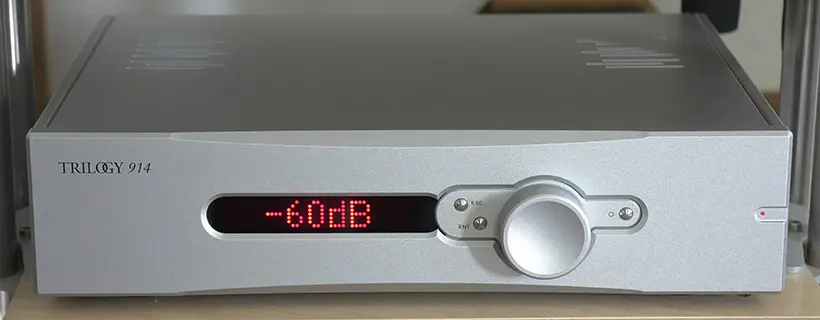
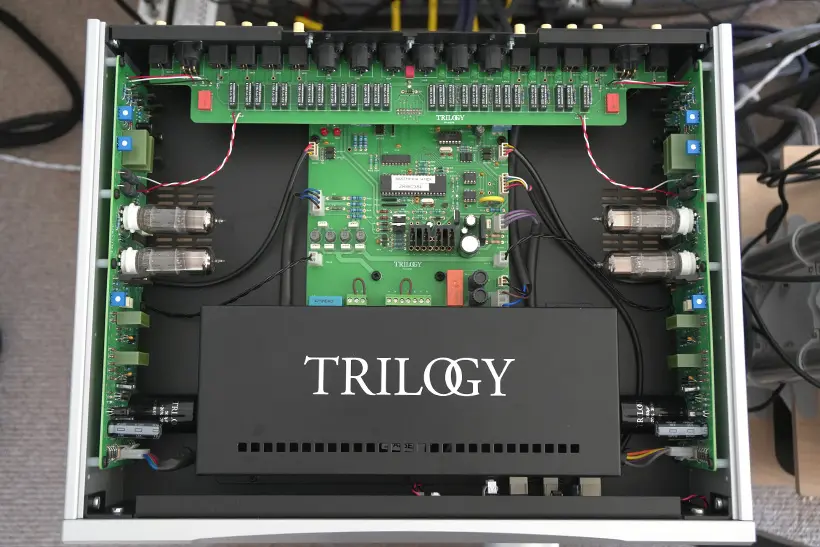
The 914 is a fully balanced, tube powered preamplifier containing four of the company’s preferred high transconductance 6H6П triode tubes with a solid state power supply. The latter consists of four shunt regulated supplies which are popular among those in the know about tube electronics because they are quiet and stiff, able to respond to demand without demur. The 914 incorporates three transformers in order to isolate power supply to the control electronics, valve heaters and high tension elements of the circuit.
Like all Trilogy preamps and integrateds the control side of the 914 is based around firmware that allows a broad range of user settings. Accessible via the front panel this system allows adjustments to display brightness, input naming and gain trims for each input in order to match output level regardless of how much signal voltage is coming in. This doesn’t overcome differences in recording level within a given source, some recordings are louder than others, but does help if your phono stage for instance has a lower output than your DAC.
You can also select film mode (AV bypass as it’s usually known) for a specific input and set sleep countdown as well as timed switch on. The most controversial option for those of us who turn the power off at the wall every night is a six digit PIN code that needs to be input whenever power has been cut for a few hours. I asked Trilogy about this and they explained that it can in fact be defeated, another RTM fail on by behalf!
Once the PIN has been entered you can switch the 914 on which elicits the message ‘warming up’ on the display, then you have to be patient for a minute while it makes sure that everything is in order. This is a sensible approach where tubes are concerned as nothing shortens tube life like rapidly receiving full voltage.
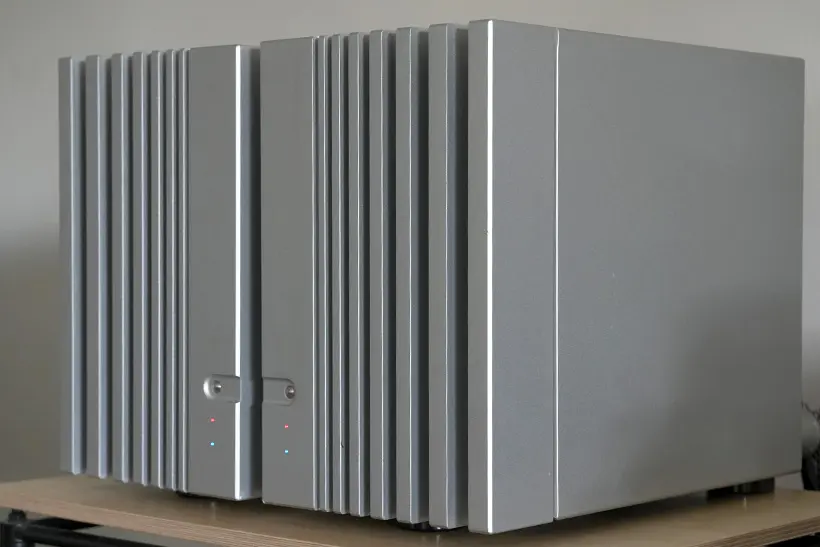
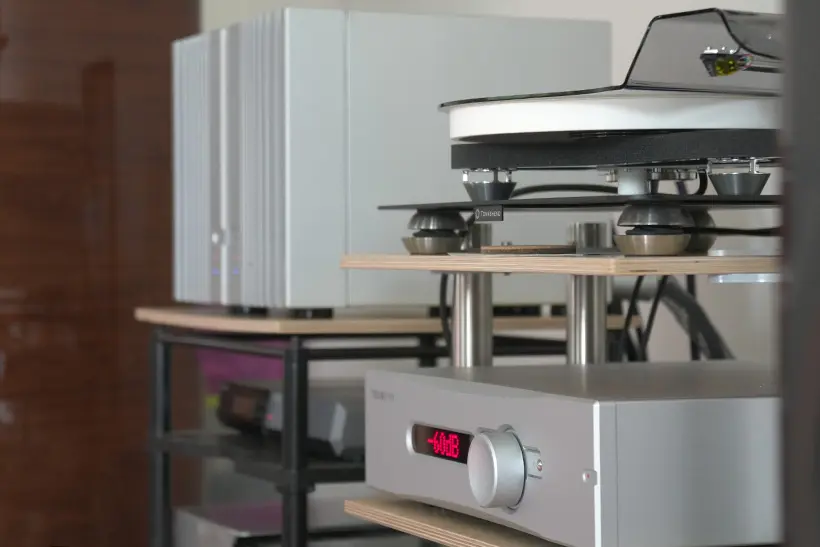
The 914 offers six inputs half of which are single ended and the other three balanced with output via both connectors, there are also ‘send’ RCAs for both channels, this turns out to be what used to be called a record output, something that’s useful if you want to integrated a processor with the system. The pre-outputs are at either end of the full width chassis so well spread apart which might be an issue with some interconnect cables. I had to change the way that the Atlas Aran interconnects were grounded in order to accommodate the gap. There are also in/outputs on ethernet sockets for Trilogy’s TASlink bus system that allows multiple components to be controlled together. Input selection, volume control and menu access is available via the rather nice remote supplied with the 914 which also has phase and mute buttons.
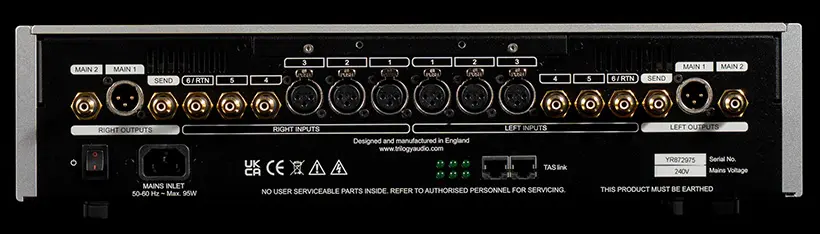
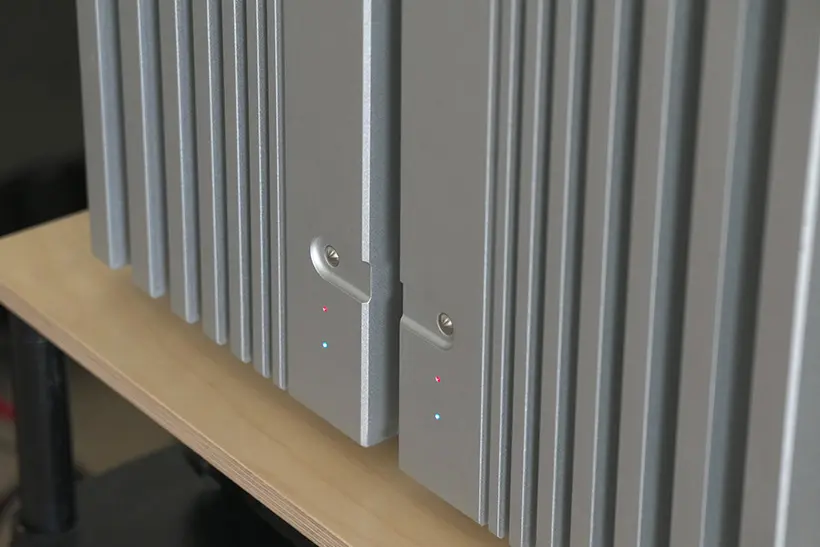
The 994 power amplifier is a bit of a beast, it might not look enormous but each mono block weighs 25 kilos thanks to a substantial heatsink and what must be a pretty meaty power transformer. It’s heavy enough for me to place on a speaker stand while not in use so that I don’t have to lift it off the ground (note to self: get down the gym). The 994 is unusual in that it can be used in either Class AB or Class A modes, the former providing rated power of 140 watts while the more appealing Class option is rated at 20 watts but offers ‘actual usable power’ of 30W according to the spec. This is from a tube input, solid state output hybrid design with a big heatsink, and when used in Class A that lump of metal does get hot. Once again this amp has a choke input power supply albeit a ‘massive’ one, and the same 6H6П triodes as the 914.
Input is limited to a single ended RCA socket perched high up on the back of the case with chunky speaker cable terminals lower down, the latter being unusually easy to tighten which is a boon for those with spade connections on their speaker cables. The only other sockets are for the TASlink and AC power, there is an on/off switch as well as another on the front – like the 914 the 994 likes to take its time switching on, the LEDs blinking for a while before the amps come fully to life. Look closely and you can also see the mode button to the left of the RJ45s, this changes operation from Class A to AB.
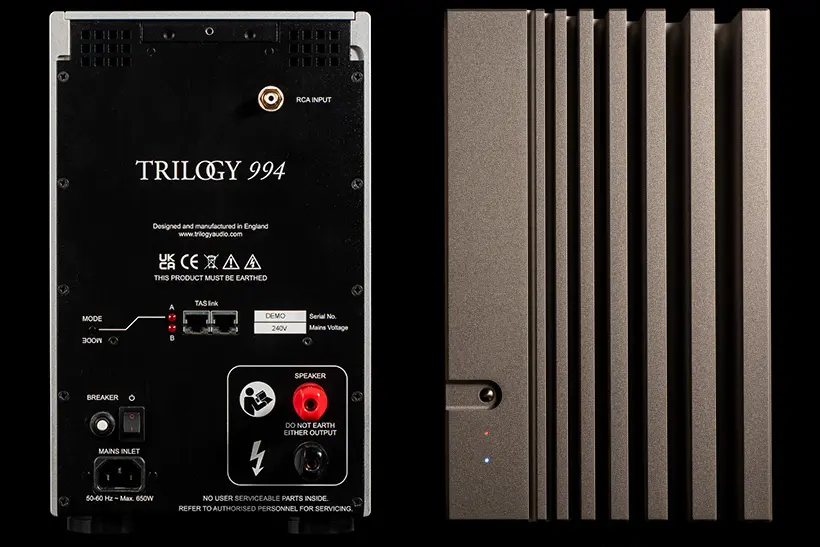
Both 914 and 994 are supported by hard feet made of a solid surface resin called Krion, this means the amps are easy to slide into place and may well contribute to the overall sound. There is increasing evidence to suggest that rubber feet do not provide a sonic benefit but are merely the easiest option in most cases.
Sound quality
When the Trilogy 914 and 994 first arrived I had the ATC EL50 speakers running and not wanting to shift them I decided to start with just the 914 preamplifier. There is something of a fashion for combing tube preamps with transistor amps like those in these active speakers and it was easy to hear why it continues. The Trilogy replaced ATC’s CA2 preamp with a not particularly tubey but distinctly Class A sound that brought out the richness of instrumental tone without undermining the sparkle of high notes, which can happen with the softer sounding tube gear. I particularly enjoyed the depth of double bass that it revealed thanks to an innate ability to reveal the full character of each note, especially with regard to texture.
This combo delivered a fabulous widescreen sound with a number of tunes, the preamp’s juicy low frequencies fleshing out the tight ATC sound, the tonal articulacy of the 914 bringing out the harmonics of every instrument and voice on whatever was being played. The bass really rolls out of the system, full, ripe and controlled while the highs had a shine that gave the performance a realism that is hard to attain with solid state. Tubes are not as precise as transistors in measured terms but their harmonic characteristics do a great job of emulating the fine details that are lost in the recording and reproduction process.
With Joan Osborne’s St Theresa this subtle enhancement works a treat, the feeling she puts into the performance is laid bare to catch at your heart despite the compressed nature of the recording. The less obviously emotional Black Napkins instrumental by Frank Zappa is spectacular in a different way, the playing is highly expressive and the way that he plays with effects is revealed alongside the work being put in by the band behind him, separation is very strong but what gets you is just how good those musicians were.
Moving the ATCs out and bringing Dali Epikore 9s in for the 994 power amps to drive resulted in a more relaxed and rich sound but one with plenty of detail, power and dynamics that remained just as musically compelling. The full Class A combination takes the hardness out of more forward recordings and allows the emotional depth in everything to be felt, this has long been a tube quality but not one that many can preserve when combined with solid state power. Trilogy seem to have mastered this in the 914/994 pairing and it makes for a far more involving musical experience that doesn’t sell you short on bass depth or imaging precision.
The leading edges are a little smoother than transistor amps but this didn’t make the timing seem sluggish, in fact when it came to musical engagement the 914/994 pairing was exceptional, really drawing you into the tune regardless of its nature. I played Joni Mitchell’s Court and Spark, which is a great album but not her best, it sounded sumptuous yet as clear as a bell, the purity of voice being absolutely sublime. It was also clearer than usual just how great the musicians are on this album, Mitchell rarely worked with anyone not at the top of their game but the likes of Larry Carlton, Joe Sample, Jose Feliciano and more including Cheech and Chong on backing vocals (Twisted) sounded superb.
With the much more contemporary tune Baba Drame (Bill Frisell) it’s clear that recording technology has moved on dramatically in the intervening 40 years. The body and scale, dynamics and realism were stunning with this piece, it was as if the band were in the room with me, Frisell’s guitar having a solidity in the high notes that is rare and the way that he weaves his playing in with that of the rest of the musicians is magical.
Someone recommended Alpha Blondy’s Jerusalem which is a superb bit of reggae with a muscular rhythm that the Trilogy/Dali pairing revelled in, making it possible to turn it up without any hardness becoming evident in beats with real shape and substance to them. These amps exude calm but are exceptionally good at bringing music to life. I particularly like their Class A polish and detailed presentation, all too often the polish eliminates fine detail to leave you with a polite but unengaging sound, that is obviously not the case here.
Conclusion
Nic Poulson has done a fine job with his penultimate pre/power pairing, the Trilogy 914 and 994s combine sophistication, finesse and a solid grasp of what’s required to make music a thrilling experience. The way that these amps open up recordings and let you find the inner detail that makes the music tick is particularly enjoyable, and goes just a little bit beyond mere transparency.
Good Class A amplification, especially that which includes tubes, brings a certain magic to the sound of any system that solid state struggles to match. Transistors will give you quieter backgrounds but don’t seem to be able to deliver the musical fluency on offer here, anyone looking to fall in love with their music once again should have a good long listen to the 914 and 994s, you are guaranteed to come away smiling.
Pros
Rich, engaging Class A/tube hybrid sound
Exceptional musicality and emotional involvement
Deep, textured bass with excellent control
Spacious, detailed soundstage and imaging
Superb build quality and finish
Extensive setup and customisation options
Smooth yet highly revealing presentation
Cons
Very expensive high-end separates
Long warm-up and startup process
Large, heavy monoblocks require muscle
Class A operation generates significant heat
RCA-only input on 994 power amplifiers
Wide spacing of 914 outputs may not suit all cables