


Solen CV20-N integrated amplifier
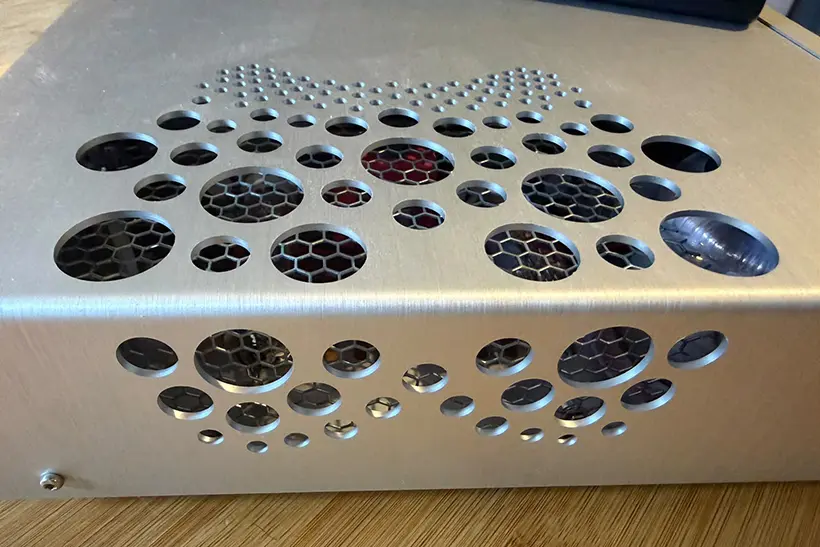
Solen is a typically French company, you can see as much in the quirkiness of the CV20-N valve amplifier’s casework and a quick peak at their website reveals even more distinctive designs such as the Tigre B50 from an age before they had accepted that rectilinear forms were the key to success. Founded in 1988 Solen took a break from audio to focus on radio systems between 1997 and 2011 since when they have built up a small range of largely valve components and loudspeakers at their HQ in Grenoble. The CV20N is the least expensive of their amplifiers.
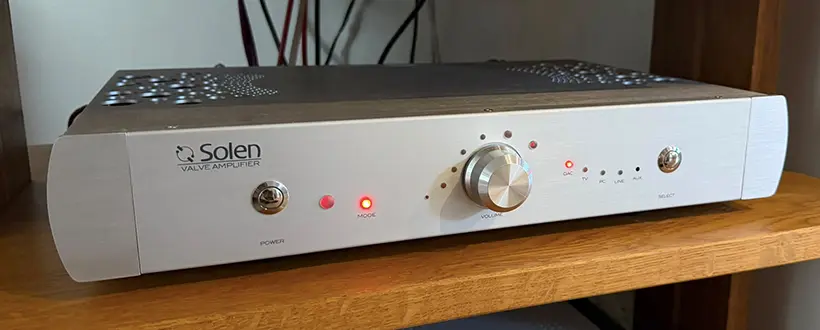
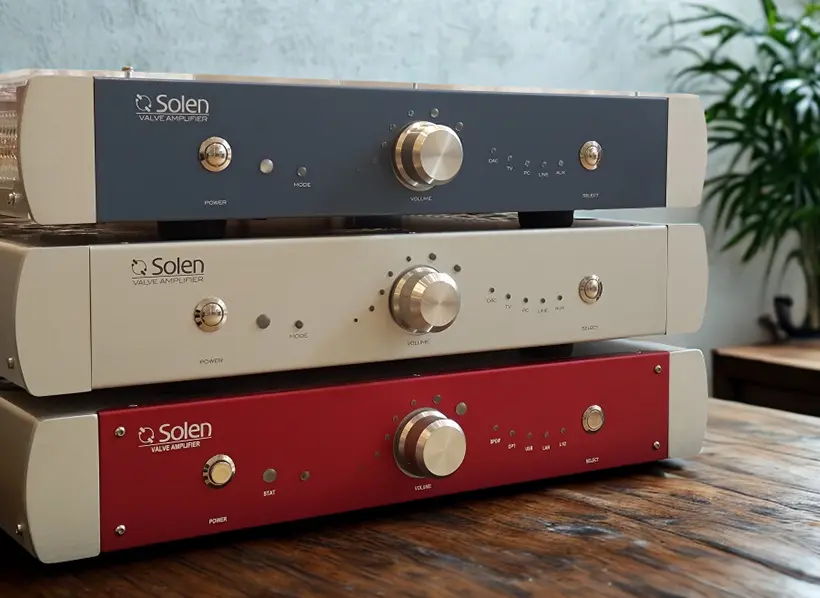
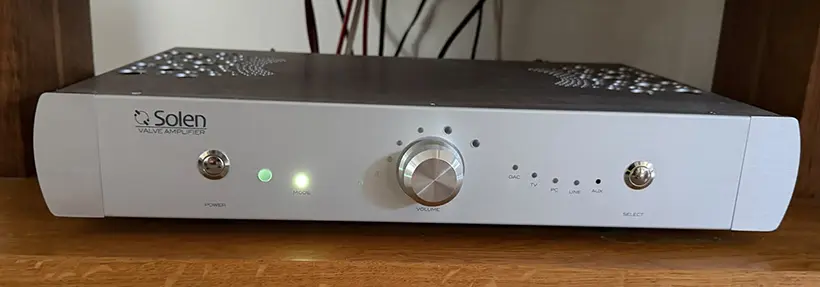
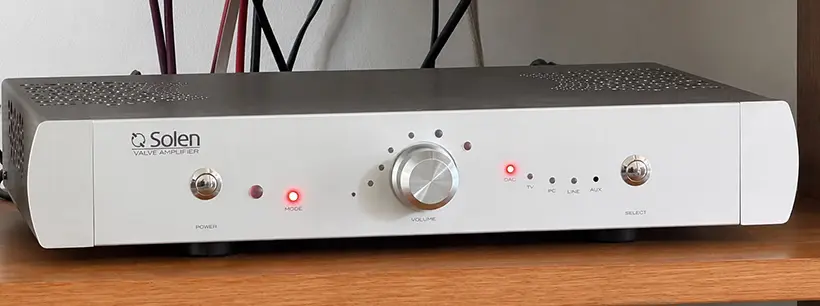
The fascia is adorned with a curving wave of LEDs. Some illuminate to show how loudly you’re playing music, while others indicate which source is selected. None of them are entirely necessary, but all of them add a lovely quirkiness that I have to say I’m completely here for. I love them but they may divide aesthetic opinion. This quirkiness extends to the overall design philosophy. Solen describes the CV20-N as a ‘digital valve amplifier’. A what, sorry? Yep, it’s an integrated valve amplifier with a built-in DAC.
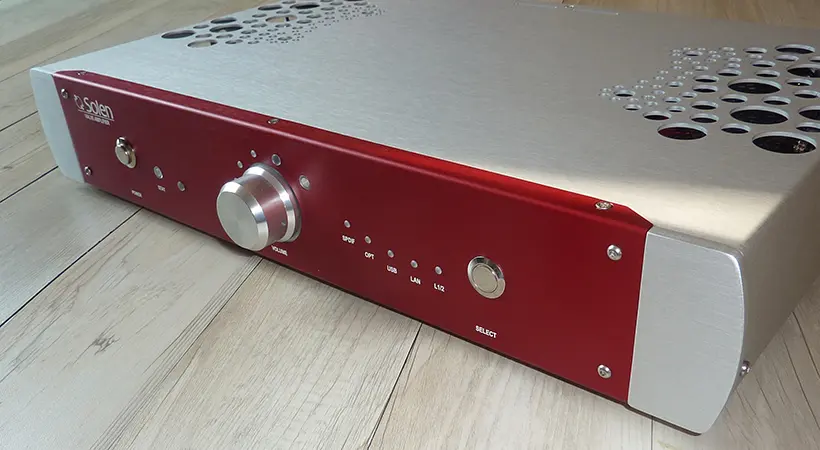
Solen clearly recognises that many of us now favour the convenience of streaming, and building a high-quality DAC into the amplifier makes this a remarkably pragmatic solution. The EL84 valve output stage produces 18 watts into 4 or 8 ohms, with a stated maximum distortion figure of 2%. Eighteen watts is more than enough to drive my 92dB/W Triangle Delta Signatures to ASBO-inducing levels, but I suspect Dynaudio owners may need to save their pennies for the CV20-N’s bigger 40-watt sister, the aptly named CV40-EL85.
As I write this, the CV20-N’s DAC itself remains something of a mystery. The website tells me very little about it, although I did note that Solen sells a standalone DAC featuring a Wolfson-based design. Dare we assume? An email to the UK distributor, Replay Audio, was required to confirm matters. Their response went into considerable detail, so I’ll reproduce it here verbatim:
Numerical Section: This DAC is equipped with a very low-jitter clock generation circuit (Wolfson WM8805). USB data flow is supported by a multi-core XMOS processor operating asynchronously, meaning the DAC clock is independent of the host device. The digital-to-analogue conversion stage consists of two independent converters (Analog Devices AD1955), one for each channel.
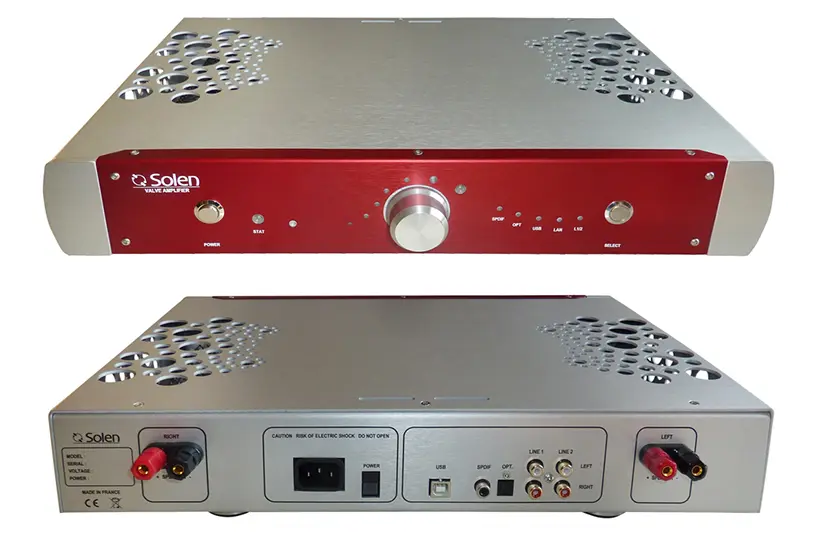
Analogue Section: No operational amplifiers are used in the signal path. Signal transfer between the DAC chips and analogue circuitry is performed via high-quality audio transformers using passive current-to-voltage conversion. The transformers have been specified to perform the required filtering functions. At the transformer outputs, the signal is restored to line level via a Class A transistor amplification stage. The DAC used in the CV20-N is the same design as that employed in the Mudac 300.
This is the first time we have come across a DAC that uses transformers to provide filtering functions, this is usually done with chips and suggests that Solen electronics are as interesting under the casework as they are from the outside. Let’s fire her up and see what she’s got.
Sound quality
Contrarian that I am, I decided to ignore the ‘digital-focused’ messaging and put an LP on. I went fully analogue and fully valve, using a valve phono stage into the Solen. Eek-A-Mouse’s classic Wa-Do-Dem is an album every reggae fan knows, and anyone unfamiliar with the genre should hear at least once. I chose it for one simple reason: Bass.
In my experience, bass can be the weak point of affordable valve amplifiers, yet bass underpins everything. Without good bass you’re unlikely to get a convincing overall performance regardless of musical genre. It needs to be fast, agile and deep, without ever becoming unintentionally flabby.
And as Eek-A-Mouse reminds us: “The wise man build his house on foundation, the fool him build his house on the sand.” The Solen passes the test. The French have built this sound on solid foundations. There isn’t an ounce of flab here. Bass is beautifully taut and transitions quickly without ever becoming edgy.
Compared with my usual 100 watts of Class A, perhaps the CV20-N doesn’t offer the final word in grip and control, but it does a thoroughly convincing job. More importantly, there’s a lovely smoothness to the overall presentation that draws me into the music. Camille Yarbrough’s voice emerges with uncanny realism at the beginning of Take Yo’ Praise.
This is an amplifier I’m genuinely struggling to fault. For those who like the look, the rewards are all present in the sound quality. I should add that all listening up to this point was through the single-ended analogue inputs. It was now time to test the DAC.
I’m using a Cambridge Audio streamer equipped with an excellent ESS Sabre DAC. By feeding both analogue and coaxial outputs into the CV20-N, I can switch between the two using the remote and compare them almost instantaneously. That’s a luxury reviewers rarely enjoy.
The levels aren’t perfectly matched, however, so switching to the Solen’s DAC requires a quick volume adjustment. The differences? Honestly, they’re subtle. The Sabre implementation sounds cleaner and perhaps a little faster. The Solen’s DAC, meanwhile, brings a richness and density that can be deeply appealing.
As Made for Radio by Jaga Jazzist oozes from the speakers, I switch back to the Cambridge’s analogue output for comparison. The Sabre is sharper on leading edges and arguably reveals more low-level detail. Yet the picture painted by the CV20-N’s DAC possesses a warmth and coherence that makes long listening sessions a genuine pleasure. Do I have a favourite? Yes. Does it matter? No. One isn’t objectively better than the other. They’re simply different presentations, and you’ll either prefer one or appreciate both.
There’s a great deal more listening behind this review than I’ve detailed here. Several sessions over the May bank holiday weekend ended with me falling asleep on the sofa and waking with a start sometime after 2 am, Charlie Mingus still plunking away while pianos tinkled softly in the darkness.
I listened to Pink Floyd’s Animals twice. Once through the Sabre DAC and once through the Wolfson-based design inside the CV20-N. Both were equally enjoyable. At no point was I tempted to switch halfway through. The Sabre dug deeper into detail, while the Wolfson presented the music as a more cohesive whole.
An evening spent with Stevie Ray Vaughan streamed through the Solen’s onboard DAC proved to be the highlight of my time with the amplifier. Everything just clicked. I genuinely found myself wondering whether I should buy it. Stevie’s guitar sounded better than I’ve ever heard it. His gravelly voice felt startlingly present in the room. Every instrument was clearly defined, yet never mechanical.
The CV20-N’s presentation is luscious, velvety, luxurious. I had deeply enjoyable couple of hours with Texas Flood and then Couldn’t Stand the Weather. I would happily have continued into the small hours but for the inconvenience of my day job the following morning. The rumbling opening of Tin Pan Alley was a genuine fireworks moment. Whenever I encounter the Solen brand in future, that’s the memory that will immediately come back to me.
Conclusion
While the styling may divide opinion, I rather like it. More importantly, there’s tremendous value here for the enthusiast. The inclusion of such a capable DAC at this price point is remarkable. Had the amplifier arrived without one, I wouldn’t have quibbled at the asking price. The sound quality alone comfortably competes with my reference amplifier, which costs roughly twice as much.
The CV20-N is a serious piece of hi-fi equipment offered at an unusually accessible price, combining pragmatic design with genuinely engaging musical performance. Is it a firm thumbs-up from me? Mais oui.
Pros
Warm, engaging and highly musical sound
Excellent built-in DAC with a rich, cohesive presentation
Tight, controlled bass for a valve amplifier
Strong value for money
Distinctive styling and quality engineering
Cons
Low 18W output limits speaker matching
Styling will divide opinion
Onboard DAC lacks ultimate detail compared with the best external designs
Sparse technical information from the manufacturer
No balanced inputs or advanced connectivity options