


Heed Obelisk integrated amplifier
Way back in the mists of 2024 I had the responsibility and pleasure of writing about the Heed LaGrange, an integrated amplifier that performed at an epic level and which I professed would definitely be on my short list when I needed a new amplifier. That day has not yet come, but when the UK Heed distributor Toby Allen called and asked if I would like to hear the Obelisk, a less expensive integrated amplifier from the same design team, I jumped at the chance, keen to see if the same magic dust could be sprinkled on a device that retails for less than half the price of its older sibling.
A few days later, Mr. Allen arrived at Kelly Towers with the very first Obelisk that had arrived in the UK. Now some of our greyer headed readers will be tutting and telling me that the Obelisk is at least 30 years old and you are right – to a point. The Heed Obelisk was indeed considered a fine amplifier back then, so the challenge for the good people of Heed in Hungary was to stay true to the original whilst introducing all the the goodness of the technology they have devised since, which they call Transcap. Rather than try to paraphrase what that means I suggest you visit Heed’s website where you will be able to read what it is and why it matters so much in Heed designs.
We removed the unit from its double shipping boxes and the first impression was of solid construction. It weighs in at a little over 10kg, but feels heavier, if that makes sense. This first version does not sport some additional modules which are in the final stages of development and should be available by the end of this year, I am not sure in which order they will appear but we can look forward to an external power supply and a fully featured DAC, which will transform the Obelisk into a truly versatile heart for any music lover’s audio system.
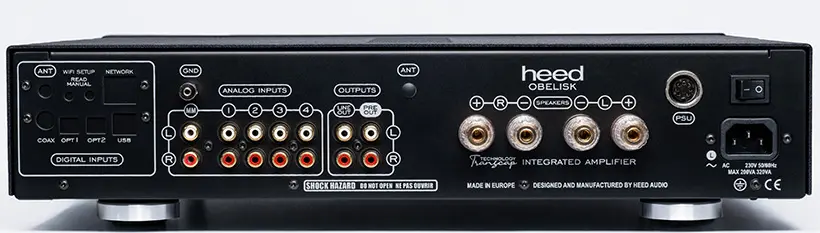
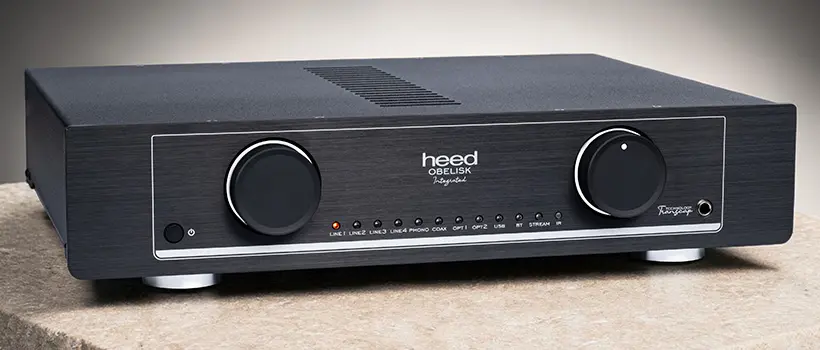
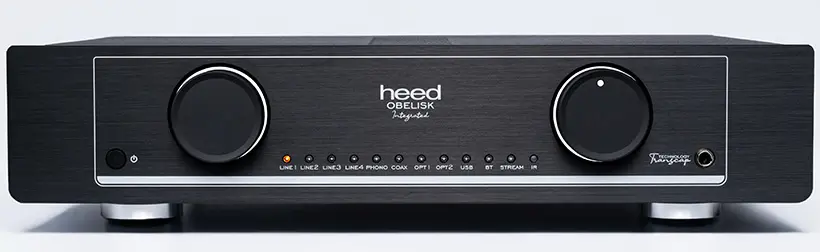
What was on offer here was the baseline Obelisk which offers Class AB amplification with power output of 50W per channel into 8 ohms, and 65W into a 4 ohm load. It is fitted with an MM phono stage. There is a rotary selector dial for input selection on the left and a matching one to the right for volume setting. Between those two runs a line of orange LEDs which indicate which input is selected. There is a full sized headphone jack to the right of the volume control. In the analogue domain, beside the aforementioned MM phono stage, there are four pairs of line level RCA inputs plus two more pairs marked Line Out and Pre Out. Then we have two pairs of multiway speaker terminals with an input socket for the forthcoming separate PSU. Last but not least there is a rocker switch to turn on the unit and an IEC input socket for the mains power.
I plugged in the Vertere Red Line cables from my Gold Note PH10/PSU phono stage, which amplifies the signal from my Vertere DG X turntable with Groove Runner arm and Mystic II moving coil cartridge. I connected my venerable Yamaha CD-S3000 CD/SACD player and DAC using TelluriumQ Silver interconnects. My Harbeth Compact7 XD2 speakers, were connected to the binding posts with TelluriumQ Silver cable. We were nearly ready to rumble. The supplied mains cable was inserted directly in to a wall socket and the rocker switched was pressed to bring the Obelisk to life. A short break was then taken while I wrestled with a paper clip to get the battery tray open in the small remote control. Once that was done, I lined up some SACDs to get the Obelisk properly warmed up prior to any serious listening.
During that period I did sit and admire this lovely machine from my usual listening chair. It has an understated , gloriously symmetrical frontage, with no gaudiness and no unnecessary distractions.
Listening to the Obelisk
Other than going in to change discs as necessary I really did not stop to listen to the Heed for the first two days it was here but I had set aside day three to sit down and give it my full attention. I went back to the SACD pile I had used for the warm up and set Dire Straits’ Alchemy into the disc tray. This Japanese SHM version has always impressed with its sound quality and through the Obelisk it really came to life when I advanced the volume to just over halfway. This was originally released back in 1984 but you would never have guessed it from listening. What was captured in the summer of 1983 was a band of excellent musicians evidently having the time of their lives in front of a very appreciative crowd at the Hammersmith Odeon.
The Obelisk put me virtually in front of the stage as Mark Knopfler ripped out brilliant solo after brilliant solo on his Fender Stratocaster. Sultans Of Swing, the band’s first hit single and their signature song, was a particular highlight. Terry Williams on drums was immense, propelling the music along and yet always in perfect time with dynamics of the song, but all of the players did their part superbly. I enjoyed it so much I played it three times before letting the rest of the album have its turn in the spotlight.
The Rolling Stones Let It Bleed from 1969, released on the Abko label as an SACD in 2002, was an absolute blast. From Mick Jagger and Merry Clayton’s vocals on the opening Gimme Shelter to the fade out on the epic You Can’t Always Get What You Want, this was an absolute blast. There is an instruction on the album sleeve that says ‘This album should be played loud’ and the Obelisk was more than happy to oblige.
And so it went on Eric Clapton’s 461 Ocean Boulevard was another highlight, again on a Japanese SHM SACD. The Obelisk brings music to life without trying to impose its own character on things. It just allows the music to speak for itself. It is genre agnostic, giving the same degree of musical insight on hard rock and delicate classical pieces. Despite it being associated with Christmas, I gave GF Handel’s Messiah an outing in mid-summer. My SACD version by the Dunedin Consort and Players under the direction of John Butt is a delightful recording on the Linn label. The five soloists come through so well, and the playing as a whole is a wonderful mix of exuberance and solemnity, all conveyed with great realism by the Obelisk. My last SACD to come through the Obelisk was Love’s masterpiece from 1967 Forever Changes. A friend at school bought a copy when it came out and we listened spell-bound to this extraordinary auditory soundscape. This version was on the Mobile Fidelity label and has a sumptuous sound that burst from the speakers as fresh as it did to us nearly six decades ago.
When I later switched to vinyl through the DG X the Heed continued to impress. I ran through all my usual fare of rock, jazz and blues, but was also tempted to try some solo classical guitar from Julian Bream. This requires a delicacy and refinement not required so much in those other genres and the Obelisk delivered both with aplomb. I played the vinyl version of Forever Changes, a Mobile Fidelity remastered version, and it thrilled me all over again, with the added touch of warmth which vinyl replay usually seems to convey. Folk, hard rock, mariachi trumpets and goodness knows what else poured from the Harbeth’s with huge realism. John Echols’ guitar cut through the dense mix with power, precision and passion. Arthur Lee and Bryan Maclean, who between them wrote the songs and provided the vocals with very different styles, give us an album that in my opinion rings true through the decades better than almost any of its contemporaries – and 1967 saw some exceptional album releases.
Final thoughts
You may have read the technical information about the Heed Obelisk to which I alluded above and thought ‘Only 50 Watts? Is that going to be enough?’ I grant you that my speakers are an easy to drive design, offering 6 ohms across virtually the whole frequency range, but by the time I had turned up the volume to about 75% on the dial it was too loud for me to listen comfortably and was probably getting to be antisocial outside the double-glazed windows of our lounge. Only the most recalcitrant loudspeaker might present a challenge, not just to the Obelisk but to any amplifier with a slightly modest maximum output. Most modern mainstream loudspeakers will work just fine, an audition at a Heed dealership should allay any doubts about that.
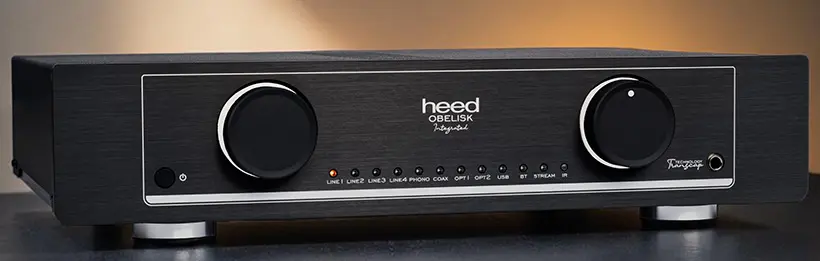
This is the entry level Obelisk. There is also a Super Obelisk, with 75W available should you want it. It shares the casework of the standard machine but has upgraded components inside and will also take the external PSU and the optional DAC when they become available. For me, the standard machine with the DAC would be more than enough. If I had an extra shelf on my rack I would probably go for the PSU too but as I have tried to express here, the entry level amplifier is a magnificent machine in its own right. I also loved the symmetrical design of the front panel. The Obelisk has understated elegance and looks lovely on the shelf.
As is often the case with desirable but slight less well known brands, you may have to search around to find a dealer to show you what the Obelisk can do. Make a day out of it if you have to because it will be worth the time and trouble. There are plenty of fine amplifiers available at this price point, but I have yet to hear one that outperforms the Heed Obelisk and its Transcap technology. I am very impressed.
Pros
Exceptionally musical, engaging and natural sound
Excellent with every genre and source tested
Solid build with elegant, understated design
Surprisingly powerful despite modest 50W rating
MM phono stage included with future upgrade options
Cons
No built-in DAC at launch
Optional PSU and DAC add to overall cost
Limited dealer network may make auditions difficult
Standard model may lack power for demanding speakers