


Monitor Audio Anthra W12 subwoofer
When I heard that Monitor Audio were sending an Anthra W12 subwoofer for review I was intrigued, but slightly hesitant, as I’ve had mixed experiences with subwoofers playing music before and was not sure if I would like it, but that was a few years ago and things have moved on. ‘I won’t review it as a home cinema product’ I said to the editor, as I don’t haven’t the set up, and don’t do that kind of review any more’. ‘That’s fine,’ he said, ‘we don’t want that anyway, an audio-only review is what we need’.
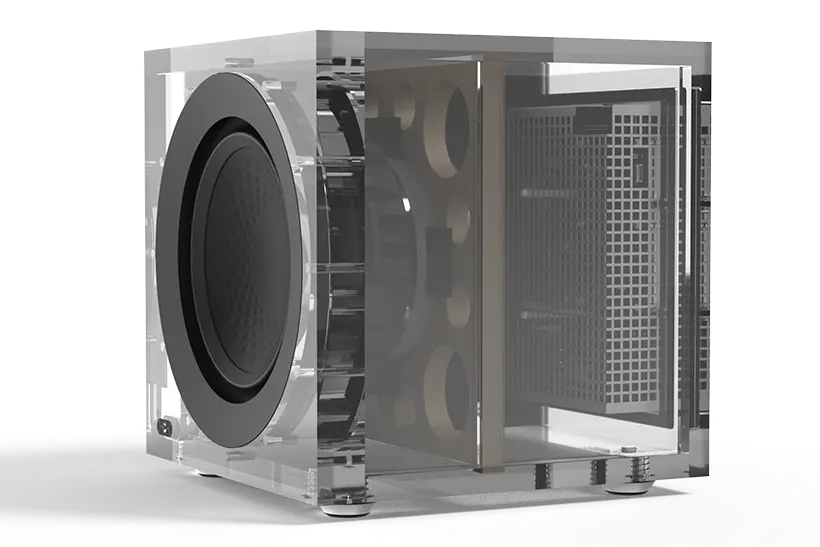
So, what is the Anthra W12? It’s the middle model within the Anthra subwoofer series, featuring a 12” (30 cm) coned woofer, employing what Monitor Audio call their Rigid Surface Technology II (RST II). This basically means a high-excursion (+/-25mm) driver with a dimpled ceramic coated C-CAM aluminium cone. Internal amplification is via a 1,700 Watt (instantaneous) Class-D amplifier. The cabinet is sealed and internally braced, so it has no ports or passive radiators to make unpleasant noises.
Expanded functionality
Being a class-D amplifier, the heat sink is tiny and barely gets warm. On the rear there is a small full-colour display and a push-button on switch, which doubles as a selector for the menu. This is a bit limited, but Monitor Audio’s Maestrounite app, expands functionality, and with a larger and more comprehensive display which made setting up more convenient and a lot easier – all from the listening seat.
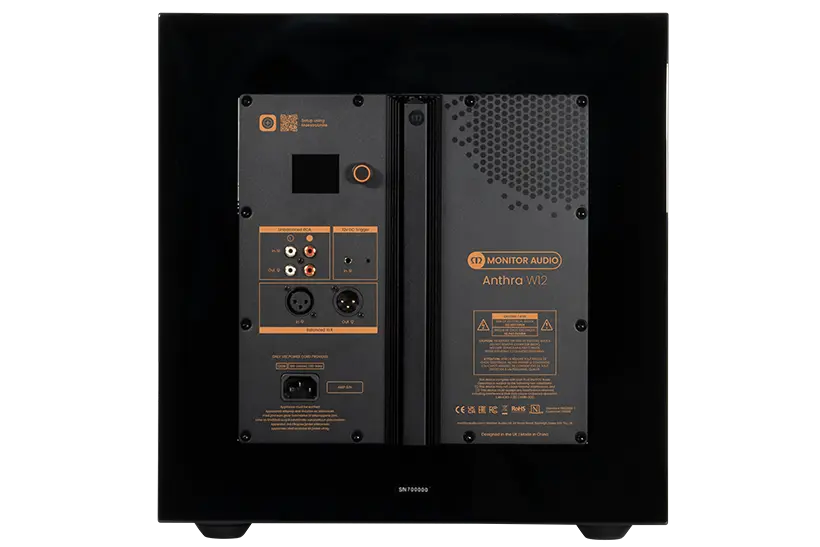
Connections for inputs and outputs are via both RCA phono and balanced XLR sockets, which are all at line level. High-level inputs, as provided by some other brands, are conspicuous by their absence. That’s a pity, because there are many who prefer to connect their subwoofer directly to the power amplifier’s output, as they feel it delivers a sound more consistent with that delivered to their main speakers.
I was able to connect the W12 to the RCA line-level outputs on my preamp and use its XLR outputs to connect up to my power amp. The W12 does have unbuffered left and right line-level unbalanced feed-throughs, but I preferred not to connect my power amp via these sockets, which would have meant adding longer lengths of lower quality cable to and from the sub to the pre and power amps.
Smooth three
The W12 can be used on its own or linked with up to three other Anthra subwoofers, which would offer the advantage of being able to distribute them around the room for a potentially smoother overall bass performance than might be achievable from just one.
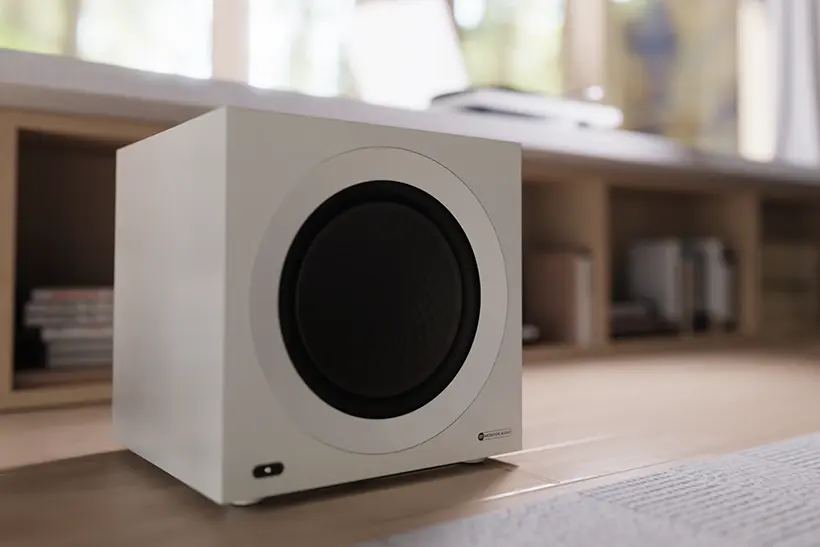
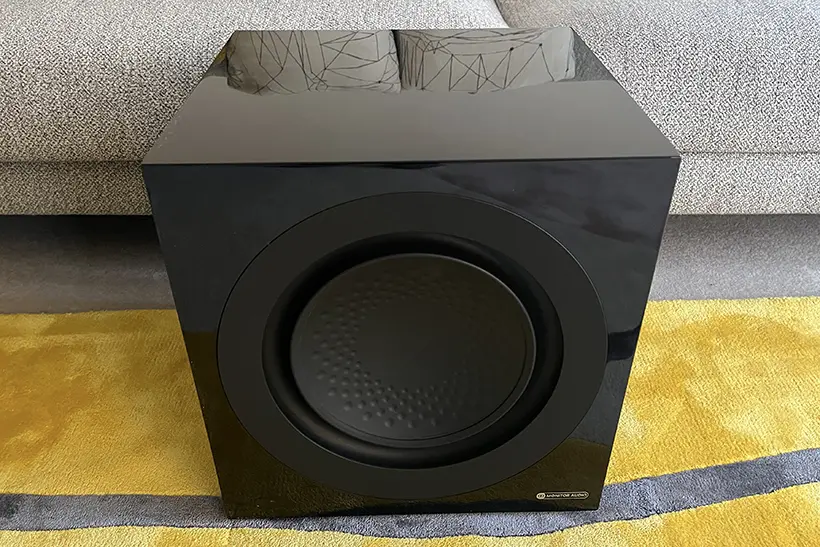
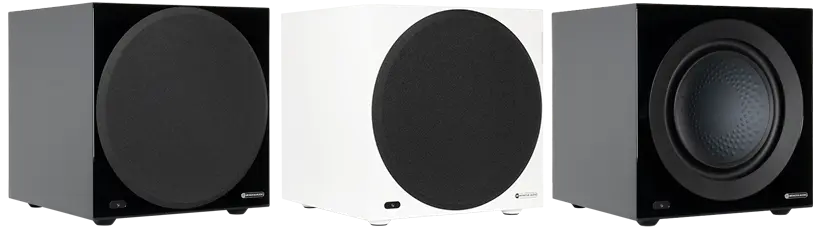
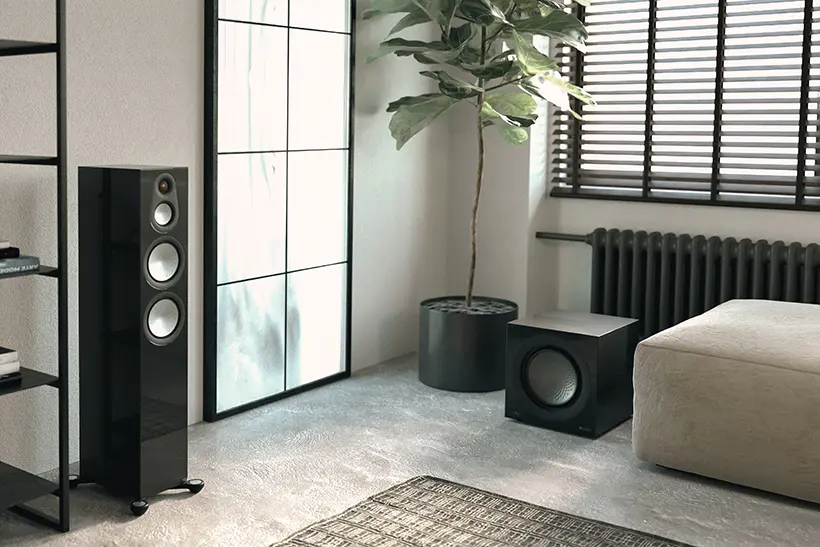
My review sample was in a very nicely finished high gloss black and supplied with rubber-bottomed feet, or spikes (I used the feet). The circular grille is held on magnetically, and I’d recommend keeping this attached to avoid damaging the woofer’s metal cone, as these are typically easily dented. Under test, I noticed that the woofer, back panel, sockets and controls were all perfectly sealed. This was great news, because poor subwoofer sealing can cause nasty distortion-like noises under heavy drive. The Anthra W12 is therefore not so inflicted and of course, with no port, there is no noise due to air turbulence, or port resonances either. To be clear, the bass from this subwoofer was very clean and controlled.
Position critical
Monitor Audio’s recommended method to find the best subwoofer position is to place the sub at the listening position and find the best location by crawling around the room and listening for the cleanest bass (the two positions, once optimised, can be reversed). However, due to having less than great knees, I decided to put a microphone for Clio Pocket measurement software at the listening position and move the woofer around until I found the flattest in-room frequency response, by balancing the effects of room modes as much as possible.
Initially, I set up the subwoofer with my resident floor-standing Kudos Cardea Anniversary Super 20 speakers, near to the left-hand loudspeaker. Previous experience with subwoofers indicated how tricky it was to set them up. So, prior to any listening, I ran a few measurements of the sub and main speakers with Clio Pocket. With the mic up close to the Anthra’s woofer cone, the near-field response of the W12 indicated a very flat frequency response down only 3dB at 20Hz and -12dB at 16 Hz.
The low-pass filter has a wide range of adjustment so that it can be set to suit the main speaker’s natural roll-off and room acoustics, and is also continuously adjustable for phase, which are both ideally required to get a good blend without undue reinforcement or cancellations. It has EQ settings for music (flat) movies, and impact, which have different levels and frequencies of boost and cut. The specification also boasts an 8-band parametric equaliser, high- and low-shelf filters, and variable low pass filter frequencies and slopes.
I prefer to work with the room if possible because boosting levels in an attempt to raise deep troughs in response simply puts more energy into standing waves which continue to cancel regardless. Notching out peaks, however, can be beneficial.
Fireside fun
With the sub positioned next to the main speaker, and the microphone at the listening position, the sub and main speakers shared the same large irregularities due to room modes, namely peaks at 30Hz and 80Hz, and a deep valley at 55Hz. So, I moved the W12 away from the speaker which smoothed its response, but not by a lot. A few more positions were tried, and the best turned out to be half-way down the right-hand side of the room, immediately in front of the fireplace. Maybe not domestically ideal, but the best acoustically.
A few more tweaks to the low-pass frequency and phase at this location improved things further. But only partially filled in the deep 55Hz ‘hole’. Once optimised, listening commenced. There was certainly an improvement to the bass, but not by a lot, simply because the low-frequency extension of the main speakers was pretty good already, thus overlapping and boosting the subwoofer’s output. Also, it was not possible to fill in the dip by shifting the low-pass filter to a higher frequency, or increasing the slope, without peaking the main speaker’s output at 80Hz even more.
I eventually settled on a low-pass filter roll-off of 62Hz (-3dB) and 82Hz (-6dB), gain of 0 and variable phase of +180 degrees phase (positive setting). Listening confirmed that this was about the optimum for this pairing, but I felt I could do better.
Another approach
I needed another approach, so I borrowed a pair of Proac Tablette Ten Signature loudspeakers. Not only are these small, so they don’t play as deep as the Cardea, the Proacs are sealed, so have a well defined 12dB/octave high pass roll off, which should make it easier to make a good blend – although the room still has a strong effect of course. This turned out to be the case, as after a few adjustments to the volume level, low-pass filter frequency, and phase I obtained a very nice curve with the Proacs and W12, as measured at the chair.
Listening confirmed these settings were pretty good and trying to improve them by ear didn’t bring any tangible benefit – apart from small tweaks to the level setting depending on the recording. (Subsequent near-field measurements, after my listening sessions, surprisingly but gratifyingly, confirmed a near-perfect crossover between the W12 and main speakers).
The Anthra W12 added just the right amount of bass extension, without it becoming heavy or ponderous. With the level set optimally, there was no sense of hearing where the subwoofer was placed. However, if the filter frequency is too high it would be possible to hear the woofer as a separate source, (due to psycho-acoustics), and so I would not recommend going above 100-150Hz, to avoid this effect. Timing was precise too, with things starting and stopping just so. It was as though I had a much larger pair of loudspeakers in front of me, with bass seemingly emanating from them alone, and with the bonus that I was able to adjust the sub-bass level subtly to account for variability between different recordings. It was a very pleasing and satisfying result.
Part of the process
Of course, the subwoofer cannot reproduce bass that is not there – and it should not, so with some music, there is not a massive improvement, but with tracks containing deep bass notes the difference is clear. For instance, Morcheeba’s Part of the Process, reproduced deep, slappy bass at the (0dB setting) in a most satisfactory manner with no extraneous noises, by adding a welcome foundation and driving pulse which this track deserves. Likewise Mark Knopfler’s Baloney Again from his album Sailing to Philadelphia, the W12 sub clarified a strong guitar bass line, which allowed me to follow the notes easily, whereas this was not so evident with the less even or extended bass without it; and yet, the bass with the sub was not heavy or unrealistic when set optimally. Likewise, Macho from the same album, with its strong clean bass lines, had no boom or waffle.
Even with little deep bass present in the recording, the extra extension added a subtle but welcome sense of warmth and realism – best to avoid the temptation to crank it up though, as it can spoil the effect. This is not unique to the AnthraW12, of course, but a general subwoofer observation.
Summary
In conclusion, the Anthra W12 exceeded my expectations, especially when used with the Proac Tablette Ten Signatures, because I was able to use the sub’s flexible adjustments to get a good blend between the main speakers and the subwoofer when best positioned. The optimised combination worked very well, filling in the bass missing from the Proacs, also providing smoother and deeper bass than the Kudos speakers on their own.
In addition, the bass was well formed and timed, making greater sense of what was being played. The subwoofer gave extra power and weight where it was needed, and was sorely missed when turned off. However, I reckon the W12 would be just as beneficial when used with any good-quality small loudspeaker (especially sealed-box types), particularly if it can be located away from the main speakers to improve bass smoothness.
Measurements greatly facilitated optimisation and, while it might be possible to get results as good by ear, it would probably take a while longer. So, anyone considering adding the Anthra W12 (or any other subwoofer for that matter) would need to set aside a few hours to optimise the sub’s position and adjust the settings.
All in all the Anthra W12 did precisely what it’s designed to do, adding clean, extended low frequencies that blend seamlessly with the main stereo channels without drawing attention to itself. It effectively means that you can hear more of what’s on each recording and not just bass notes but the character of instruments and studios, it also adds to the dynamic impact of the music and that means extra musical thrill power. Every home should have one, just not my neighbours!
Pros
Exceptional bass power and extension, reaching down to around 20Hz with strong output.
Clean, controlled bass with no port noise thanks to the sealed cabinet design.
Very powerful 1,700W Class-D amplification provides substantial headroom and dynamic impact.
Highly flexible setup options including adjustable phase, low-pass filter, parametric EQ and shelf filters.
Maestrounite app makes configuration and adjustment from the listening seat straightforward.
Build quality is excellent, with well-sealed cabinet and high-quality gloss finish.
Capable of blending seamlessly with suitable speakers, creating the impression of larger full-range systems.
Supports linking with multiple Anthra subwoofers for smoother room integration.
Fast, well-timed bass that enhances rhythm and musical drive without sounding heavy.
Adds weight, realism and scale to recordings without drawing attention to itself when correctly set up.
Cons
No high-level (speaker-level) inputs, which some audiophiles prefer for integration with stereo speakers.
Careful setup and positioning are essential and can be time-consuming.
Performance depends heavily on room acoustics and speaker matching.
Best placement may not always be aesthetically convenient.
Rear panel display and controls are limited without using the app.